The Books That Made the Myths: Kojiki and Nihon Shoki
The Kojiki (712) and Nihon Shoki (720) as texts with makers and purposes: lineage versus annals, the Nara court's state project and Izumo's place in it, the provincial fudoki ordered in 713, and reading central and local versions side by side.
- 6 min
- 7 steps
- 3 questions
- Lesson 15 of 24
In this lesson
- Two books, two reading experiences
- What the court was building
- The third shelf: fudoki
- A four-pass reading method
- Field exercise at Nara
- Check your understanding
Picking up where you left off.
Nearly every story in the first half of this course reaches us through an edited source. Izanagi’s escape, Amaterasu’s cave, Susanoo and Orochi, the descent of Ninigi, and the first emperors were not copied from a single timeless “Japanese mythology.” They were selected, arranged, and written for an eighth-century court.
That does not make the stories fake. It makes them texts with makers, audiences, and purposes. The skill for this lesson is learning to keep two thoughts together:
- a myth can be religiously and culturally important;
- its written form can also make a political argument.
Two books, two reading experiences
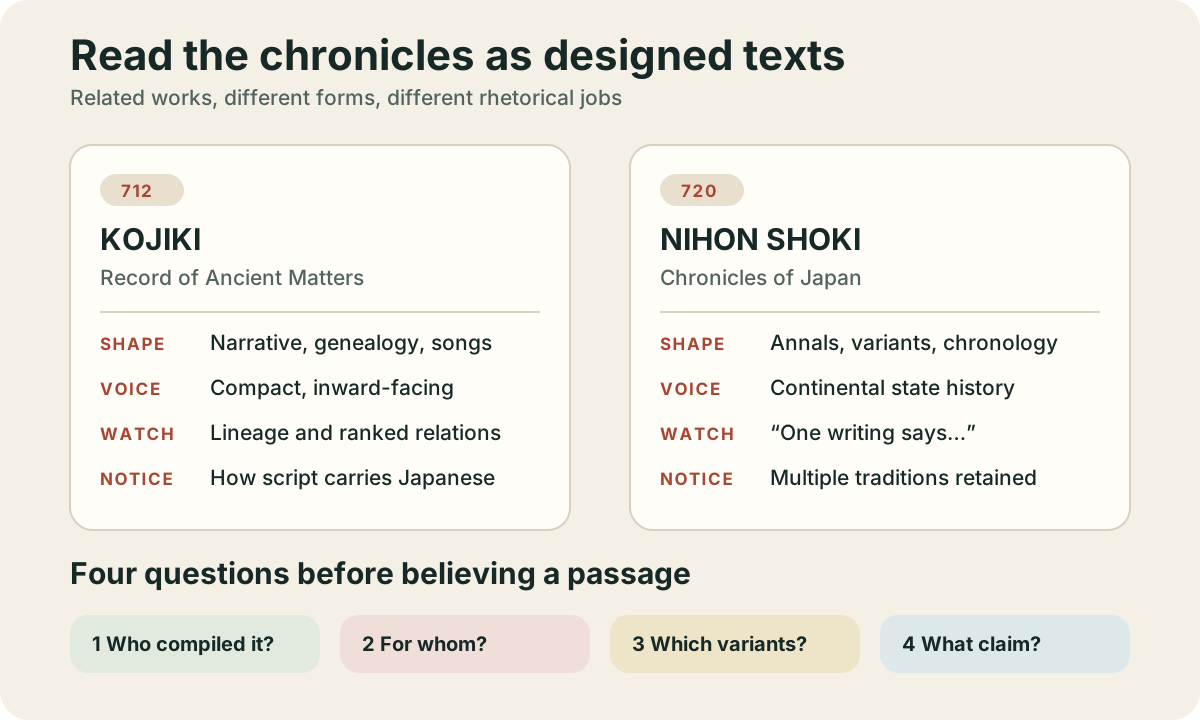
The Kojiki, presented in 712, is the oldest surviving Japanese narrative. Its three books move from divine origins through genealogies, reigns, tales, and songs. Gustav Heldt’s modern translation describes it as an account of the islands’ and dynasty’s mythical beginnings rather than as a modern history book 1. The preface names Ō no Yasumaro as the person who wrote down material associated with the reciter Hieda no Are for Empress Genmei.
The Nihon Shoki, completed in 720, uses the structure of continental annals. It is organized chronologically and was written in a learned classical-Chinese register suited to an official state history. Kokugakuin’s reference guide notes both that annalistic model and the text’s ritual and sacred afterlife 2.
The easiest memory aid is useful as long as you treat it as a prompt, not a law:
- Kojiki = kin: lineage, relationships, songs, and a compact narrative spine.
- Nihon Shoki = nation: annals, diplomatic posture, chronology, and named alternatives.
The Nihon Shoki often preserves variants with a formula equivalent to “one writing says.” Those alternatives matter. If one chronicle assigns an act to Tsukuyomi and another version assigns it to Susanoo, the disagreement is evidence: the tradition was plural before an editor put versions on the same page.

Quick check
Kojiki = kin; Nihon Shoki = nation.
What the court was building
The new capital at Heijō-kyō was part of a larger state project. The Nara National Research Institute describes a planned capital established in 710 with an imperial palace at its northern center 3. Law codes, offices, ranks, taxation, diplomacy, ritual, and written history all helped a central court describe—and exercise—authority.
The chronicles contribute to that project in narrative form. Their mythic opening does not stop before imperial genealogy begins. Instead, divine descent flows into human reigns. That continuity supports a claim: the ruling house belongs inside the sacred order presented at the start of the books. Kokugakuin’s history of Shinto literature therefore calls the Kojiki, Nihon Shoki, and provincial fudoki political myths compiled within the Yamato court’s world 4. “Political” here does not mean “mere propaganda.” It means that the stories distribute status, territory, ancestry, and legitimacy.
This is why Izumo receives so much attention. The central narrative must explain how Ōkuninushi’s land comes under the rule of Amaterasu’s descendants. A local deity can remain powerful and beloved while the plot places that power inside a Yamato-centered settlement.
Quick check
A local deity stays powerful while the plot places it inside a Yamato-centered order.
The third shelf: fudoki
In 713, provinces were ordered to compile fudoki: records of land, products, place-names, customs, and local stories. Kokugakuin’s reference entry ties the order to a dated Shoku Nihongi entry and explains that five gazetteers survive, with only the Izumo Fudoki complete; the other four are incomplete, abbreviated, or disordered 5. It is valuable precisely because it changes the camera angle. A central chronicle asks how the realm fits the dynasty. A provincial gazetteer asks how a landscape got its name, which deity occupies it, and what a locality produces.
When the sources disagree, do not rush to choose a winner. Write the versions in parallel:
| Question | Central chronicle | Provincial or local account |
|---|---|---|
| Who acts? | Which deity or ruler is foregrounded? | Which local deity or clan remains visible? |
| Where? | Is the place part of a realm-wide route? | Does the story explain a named hill, river, or village? |
| What changes? | Does authority pass toward Yamato? | Does the landscape retain a local relationship? |
The difference is often the lesson.
Quick check
Five survive, only Izumo’s nearly complete.
A four-pass reading method
Use M-A-P-S whenever a myth is presented as though it were a transparent report:
- M — Maker: Who compiled, copied, translated, or sponsored this version?
- A — Audience: Court insiders, foreign readers, pilgrims, shrine visitors, or modern tourists?
- P — Pattern: Genealogy, annal, place-name tale, ritual explanation, or heroic episode?
- S — Stakes: Which relationship, territory, office, or ritual does the story authorize?
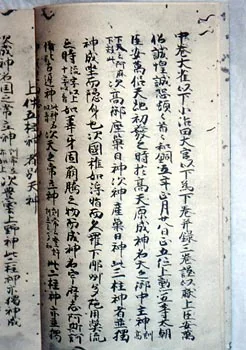
Then add a fifth line: survival. The work may be eighth-century while the manuscript, edition, and translation you are actually reading are much later. A facsimile page is evidence for how a text was transmitted, not a photograph of the original compilation scene.
Worked example: the heavenly cave
Apply the method to Amaterasu’s cave:
- Maker: compare the Kojiki telling with the Nihon Shoki main account and variants.
- Audience: notice how a court ritual audience would recognize mirrors, jewels, recitation, and performance.
- Pattern: the crisis is solved by coordinated ritual action, not one warrior’s strength.
- Stakes: the episode helps explain the prestige of ritual lineages and objects used by the court.
- Survival: a modern performance at Takachiho is a living interpretation with its own local history, not a recording carried unchanged from 712.
That reading does not drain the story of wonder. It reveals why every prop and performer matters.
Field exercise at Nara
At the Heijō Palace Site, make one page with three columns:
- Text: one claim the chronicles make about order or descent.
- Institution: one palace, gate, office, road, or reconstructed spatial feature that shows how the court organized people.
- Gap: one thing the archaeology cannot prove about the story.
The gap is not failure. It is disciplined boundary-setting.
Check your understanding
- Why is “the Kojiki is myth while the Nihon Shoki is history” too simple?
- What does a preserved variant let you see that a harmonized retelling hides?
- How can a story be politically useful without being culturally meaningless?
- Pick one earlier lesson and label its source as chronicle, local tradition, later literature, visual art, or current practice.
If you can answer those without flattening the sources into either literal fact or disposable fiction, you are ready for the legendary rulers in the next lesson.
Lesson complete
Nice work.
Sources for this lesson
- 1Gustav Heldt. The Kojiki: An Account of Ancient Matters. Columbia University Press. 2014. verifiedPublisher description of the modern translation and the Kojiki as an eighth-century narrative of the islands and ruling dynasty. Cited at: The Kojiki.
- 2Introduction: Texts and Sources. Kokugakuin University Digital Museum, Encyclopedia of Shinto. verifiedAcademic overview of the Kojiki and Nihon shoki as genealogical, ritual, and historical texts; describes the annalistic model of the Nihon shoki. Cited at: Introduction: Texts and Sources.
- 3Excavations at the Nara Imperial Palace. Nara National Research Institute for Cultural Properties. verifiedOfficial archaeological overview of Heijo Palace and the Nara capital established in 710. Cited at: Excavations at the Nara Imperial Palace.
- 4Shinto and Literature. Kokugakuin University Digital Museum, Encyclopedia of Shinto. verifiedAcademic discussion of the Kojiki, Nihon shoki, and fudoki as political myths compiled by the Yamato court. Cited at: Shinto and Literature.
- 5Fudoki. Kokugakuin University Digital Museum, Encyclopedia of Shinto. verifiedScholarly reference on the 713 compilation order, requested contents, surviving gazetteers, manuscript condition, and relationship between regional and central mythology. Cited at: origin and surviving manuscripts.