The Tricksters: Kitsune and Tanuki
Fox and tanuki tales: Inari's messengers versus wild tricksters, the fox wives Kuzunoha and Tamamo-no-Mae, the tanuki of Bunbuku Chagama and Shigaraki's ceramic statues, and auditing a transformation story.
- 6 min
- 7 steps
- 3 questions
- Lesson 8 of 24
In this lesson
- Kitsune
- Tanuki
- A transformation audit
- Worked claim: “a fox wedding”
- Places to visit
- Travel rule
Picking up where you left off.
Fox and tanuki stories are often paired because both animals transform, deceive, and cross human boundaries. The tidy contrast—dangerous fox, comic tanuki—is a useful first memory aid, but individual tales overturn it. Begin by separating animal, messenger, yōkai, and character. A real fox is not automatically a kitsune spirit; an Inari fox statue is not a wildlife portrait; a story’s shapeshifter is not evidence about animal behavior.
Kitsune
White foxes in Inari settings function as messengers, while wild foxes in tales may deceive, possess, repay kindness, marry humans, or produce mysterious light. Fushimi Inari’s official history is about the shrine and its enshrined kami, not a claim that every fox tale belongs to Inari 1. Keep shrine iconography and narrative shapeshifting in adjacent, labeled boxes.
Numbers such as one hundred years of age or nine tails vary across sources and East Asian traditions. Say “in some later schemas” rather than presenting a level chart as universal folk zoology. Likewise, kitsunetsuki belongs to social and medical history as well as tale. A past diagnosis could stigmatize living people; it should not be romanticized as proof of magic.
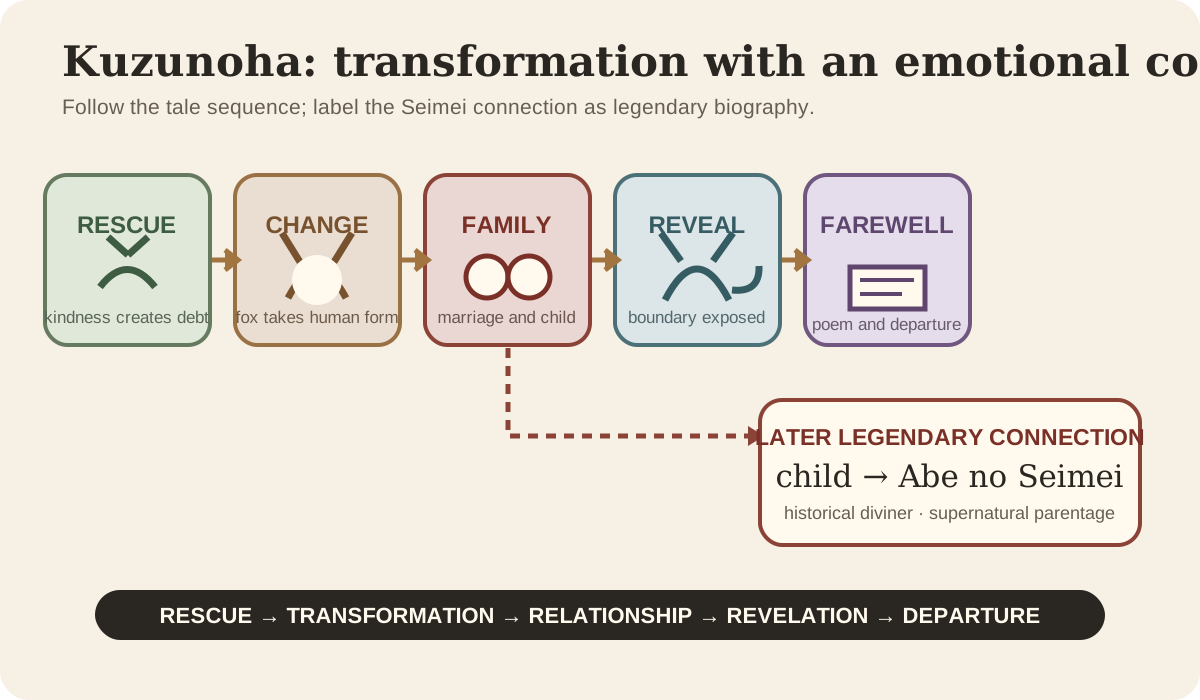
Two fox-wife and fox-courtesan cycles show different emotional registers. Kuzunoha repays rescue by becoming a wife and mother, but departs when her fox nature is exposed. Later tradition makes her child Abe no Seimei, a historical court diviner whose supernatural family is legendary biography.

Tamamo-no-Mae is exposed as a destructive nine-tailed fox and associated after death with the volcanic Sesshōseki, or Killing Stone. A real rock in a volcanic landscape can be a pilgrimage object; the courtesan becoming that rock is narrative. The tradition connecting the priest Gennō and the Japanese hammer name is a folk etymology, not settled linguistic proof. When part of the stone split naturally in 2022, modern news and social media added another layer to the story.
Memory pair: Kuzunoha leaves to protect a boundary; Tamamo is hunted after crossing one. Both use revelation, but one produces grief and the other threat.
Quick check
Kuzunoha, by contrast, leaves her family when her fox nature is revealed.
Quick check
His supernatural family is legendary biography.
Tanuki
The tanuki, or Japanese raccoon dog, is a real canid whose story-self drums, pays in deceptive money, and transforms into people or objects. Edo prints often use bodily exaggeration for visual comedy. Modern ceramic statues—hat, flask, belly, account book—belong especially to commercial good-luck culture. Do not project those statues backward as the one ancient tanuki form.
In Bunbuku Chagama, a tanuki and a tea kettle become entangled through transformation; versions differ on whether the animal repays kindness, is trapped, or becomes a performer. The National Diet Library describes the Morin-ji-associated version in which the seemingly inexhaustible kettle is eventually revealed as a tanuki 2. That is a documented tale version, not authentication of a magical museum object.
Shigaraki’s massed ceramic tanuki are a modern craft and commerce tradition. Lists of “eight virtues” attached to hat, eyes, flask, ledger, tail, and body vary in wording; treat them as interpretive sales lore unless a maker documents a specific lineage. A craft visit is most useful when you ask how a statue was formed, fired, glazed, and marketed—not only what each accessory supposedly means.
Quick check
Its story-self drums, pays with fake money, and transforms.
A transformation audit
For any fox or tanuki story, record four items:
- Trigger: rescue, hunger, desire, revenge, or play?
- Form: human, object, light, money, sound?
- Reveal: mirror, shadow, tail, mistake, confession?
- Debt: is kindness repaid, greed punished, or identity protected?
That method finds the story’s moral mechanics without assuming every transformation is a prank.
| Feature | Kitsune tendency | Tanuki tendency |
|---|---|---|
| frequent emotional register | danger, longing, ambiguous marriage | appetite, commerce, bodily comedy |
| religious link | strong Inari messenger association | usually looser and local |
| common reveal | tail, shadow, possession, foxfire | failed disguise, object transformation |
| warning | do not equate messenger and kami | do not equate modern statue and old tale |
Foster’s broader point applies: yōkai become recognizable through repeated names and images, but every repetition can change their function 3.
Worked claim: “a fox wedding”
A sunshower may be called a kitsune no yomeiri, a fox’s wedding, while other tellings use the phrase for mysterious processional lights. Do not force both into one origin story. Record:
- the region and speaker using the expression;
- whether it names weather, lights, a procession, or a tale;
- whether the explanation came from current local usage or a later dictionary;
- what the teller believes the phrase does—predict, warn, amuse, or beautify.
This turns a charming translation into linguistic evidence. “Fox wedding means sunshower in Japanese folklore” is too broad; “this source uses fox wedding for a sunshower” is strong enough to build on.
Fox and tanuki together teach the bestiary’s grammar: the same power — transformation — read as numinous threat in one animal and slapstick in the other. Which one a story reaches for tells you what the storyteller fears or forgives.
Places to visit
- Kuzunoha Inari (Shinoda no Mori) — Izumi, Osaka — the fox-wife’s shrine and forest.
- Seimei Jinja — Kyoto — her legendary son’s shrine; properly visited in Module 4, flagged here for the connection.
- Sesshōseki — Nasu, Tochigi — the killing stone in its volcanic moonscape; obey the gas-warning signs, which are not folklore.
- Morin-ji — Tatebayashi, Gunma — the tea-kettle temple.
- Shigaraki — Kōka, Shiga — tanuki statues at industrial scale, ancient kilns, and a ceramics park; a craft traveler’s natural stop.
Travel rule
At a shrine, temple, stone, or kiln, ask which layer the site itself claims: worship, tale association, memorial, craft, or entertainment. Photograph public objects where allowed; do not treat worshippers or private offerings as costumed evidence for your bestiary.
Lesson complete
Nice work.
Sources for this lesson
- 1History. Fushimi Inari Taisha. verifiedOfficial shrine chronology and account of the tradition that Inari was enshrined on the mountain in 711. Cited at: History.
- 2Toriyama Sekien's Illustrated Night Parade of the Demon Horde. National Diet Library, Japan. verifiedOfficial library guide to Sekien's four illustrated yōkai books and their relationship to earlier and later visual traditions. Cited at: Bake-danuki.
- 3Michael Dylan Foster. The Book of Yokai: Mysterious Creatures of Japanese Folklore. University of California Press. 2015. verifiedHistorical and interpretive guide to yōkai as named, pictured, transmitted, and continually remade phenomena. Cited at: Kitsune and tanuki.