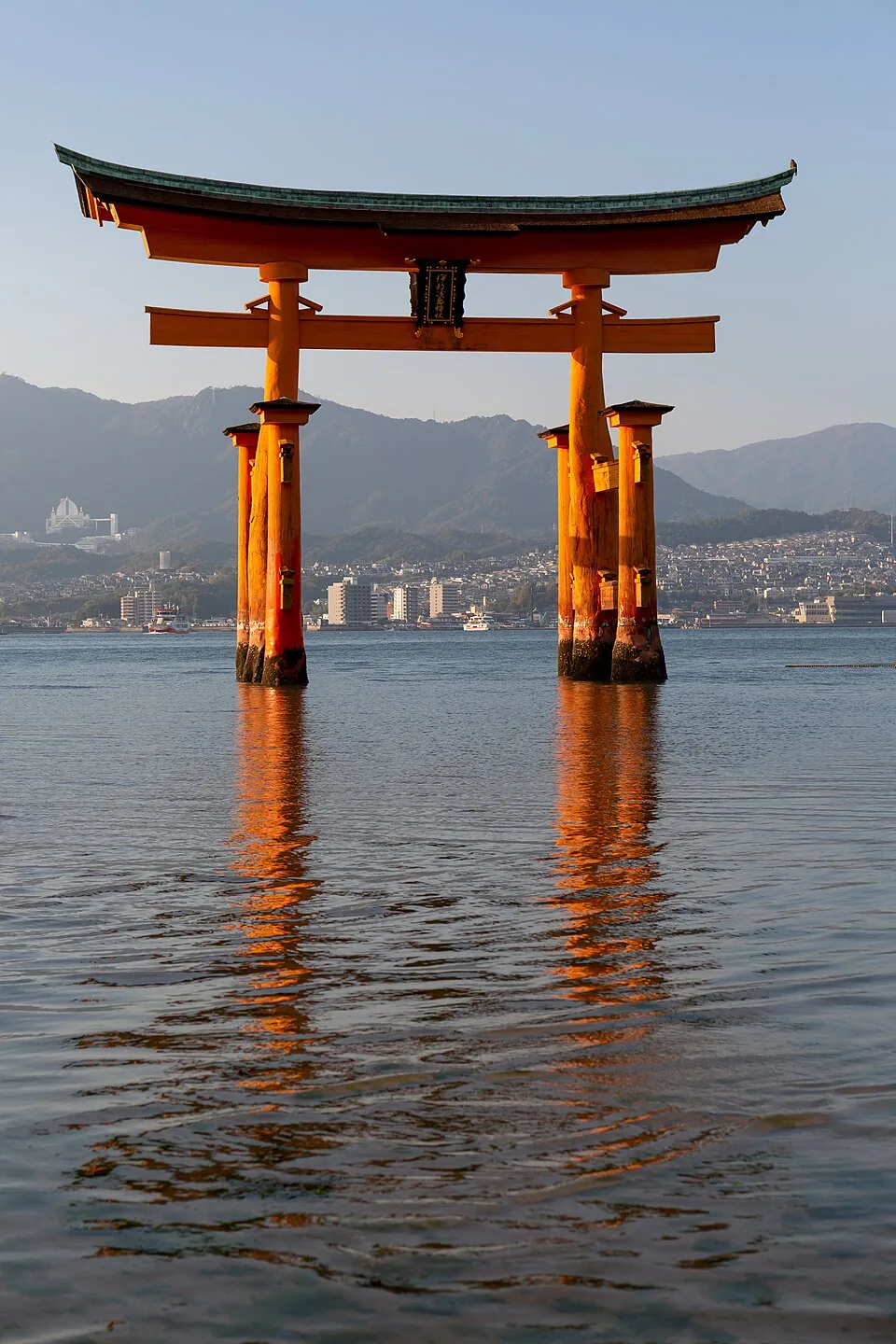
The Shrine: Architecture and Sacred Space
Reading a shrine as a sequence of access: torii, sandō, temizuya, haiden, and honden; shimenawa, guardian figures, and subsidiary shrines; the shinmei, taisha, and nagare honden forms; Ise's twenty-year renewal; and Izumo's giant pillars described carefully.
- 7 min
- 10 steps
- 3 questions
- Lesson 2 of 24
In this lesson
- 1. Gate: torii
- 2. Path: sandō
- 3. Water: temizuya
- 4. Prayer: haiden
- 5. Sanctuary: honden
- Three rooflines worth recognizing
- Ise’s craft answer to impermanence
- A five-pass observation method
- Mistakes to leave behind
Picking up where you left off.
A Shinto shrine is easiest to understand as a sequence of access, not a building you are meant to enter and inspect. Space changes by degrees: public road to marked precinct, approach to purification, worship area to screened sanctuary. The architecture teaches where a visitor may go and where attention should stop.
Memorize the sequence Gate → Path → Water → Prayer → Sanctuary. The Japanese terms are torii → sandō → temizuya → haiden → honden. A large precinct may add several gates, bridges, secondary shrines, offices, and fences; a small roadside shrine may compress or omit stages. Treat the mnemonic as a reading tool, not a claim that every jinja has one standard plan 1.
1. Gate: torii
The torii announces that you are crossing into shrine space. It is a gate without a door: two posts and upper crosspieces, varied into many regional and historical forms. Some are unpainted wood or stone; some are vermilion; some have straight members and others strongly upturned ends. Color alone does not identify a shrine’s sect, age, or importance.

On site, first ask what the torii frames. A distant roof, a mountain, the sea, a straight avenue, or simply a change in ground texture may be the real composition. At Itsukushima, the gate stands in the tidal zone and makes water part of the approach. Elsewhere the first torii may sit beside traffic and be easy to miss.
2. Path: sandō
The sandō is the approach. Gravel, paving, stairs, trees, lanterns, or repeated gates slow the transition. The path may bend; topography may hide the worship hall until late. At many shrines visitors leave the central line open as a courtesy, but circulation rules are not identical everywhere. Follow signs and the behavior of the precinct rather than turning a custom into rigid dogma.
This is also where you begin to see sacred markers:
- Shimenawa are twisted ropes, often with white zigzag paper shide, placed on gates, trees, rocks, or buildings to mark sacred status.
- Paired guardian figures may flank an approach. Lion-dogs (komainu) are common; fox messengers are strongly associated with Inari shrines, but the animal is not itself a universal substitute for komainu.
- Small sessha and massha are subsidiary shrines. A precinct can therefore be a network of relationships, not one god in one building.
3. Water: temizuya
The temizuya or chōzuya is the purification basin and roofed pavilion, when present. Its position makes bodily preparation part of the architecture: before prayer, hands and mouth are rinsed. The next lesson gives the exact sequence. Here, notice drainage, ladle storage, carved water spouts, and whether instructions modify the usual procedure.
4. Prayer: haiden
The haiden is the worship hall or the public-facing place of prayer. An offering box, bell rope, or open forecourt may make its role obvious. This is generally where an ordinary visitor’s forward movement ends. The point is not to “get inside”; it is to face the sacred core from the appropriate public position.
5. Sanctuary: honden
The honden is the main sanctuary, often behind the haiden and additional fences. It houses or protects the goshintai, the material focus through which a kami is enshrined. The object is not normally displayed as a museum piece. At Ise’s principal sanctuaries, successive fences and gates intensify restricted access; the larger Ise Jingu network contains 125 jinja centered on Naikū and Gekū 2.
Not every shrine has a conventional honden. Kokugakuin’s architectural overview notes older arrangements in which a mountain or other natural feature is the sacred focus; Ōmiwa Jinja is the famous example 3. That exception clarifies the rule: shrine architecture organizes a relationship with a kami, not access to an idol or interior attraction.
Quick check
The honden is the screened sanctuary behind it, holding the goshintai.
Three rooflines worth recognizing
The names below describe honden forms, not the layout of every building in a precinct.
Shinmei-zukuri
Associated above all with Ise, shinmei-zukuri uses a rectilinear raised-floor form and a gabled roof. At Ise, unfinished-looking cypress, thatch, forked chigi projecting beyond the ridge, and horizontal ridge billets called katsuogi create the unmistakable silhouette 4. It evokes ancient raised-floor construction, but avoid the overly neat story that every feature is a frozen “primitive granary.” The extant system is also the product of centuries of ritual renewal and precise craft.
Taisha-zukuri
Taisha-zukuri is identified with Izumo. The current Izumo Taisha honden dates to 1744, rises about 24 meters, and uses a square, nine-part plan organized around major pillars 5. Its scale is impressive even though visitors read it through fences and from oblique views.
The excavation story needs careful wording. In 2000, archaeologists uncovered remains of enormous pillars made by binding three logs together. Dating and comparison with a medieval plan support the existence of a very large thirteenth-century sanctuary 6. They do not by themselves prove every traditional claim about a 48-meter building in remote antiquity. At the museum, label three layers in your notes: excavated object, documentary comparison, and reconstruction.
Nagare-zukuri
Nagare-zukuri is the most widespread named form: its gabled roof extends farther on the entrance side, creating a flowing front eave that shelters the steps. Use that asymmetry as the visual cue. Do not identify it from vermilion paint or ornament alone 3.
Quick check
Identify it by the asymmetric roof, not by vermilion paint.
Ise’s craft answer to impermanence
Ise’s shikinen sengū renews the principal sanctuaries and their sacred furnishings on a twenty-year cycle, using paired adjacent sites. The 62nd cycle culminated in 2013, and work for the next renewal cycle is underway 7.
The lesson is subtler than “the entire shrine is replaced every twenty years.” Ise is a large network, and the program has defined ritual scope. What persists is a coordinated system: material preparation, forestry, tools, measured form, craft transmission, ceremonies, and the transfer between old and new sanctuary sites. For a woodworker, it is a model of preservation through repeated skilled practice rather than an attempt to keep every fiber unchanged forever.
Quick check
The 62nd cycle culminated in 2013; what persists is the system of craft, forestry, and ritual.
A five-pass observation method
On your next shrine visit, make five passes before reaching for a fact sheet:
- Threshold: photograph or sketch what the first torii frames. What changed when you crossed it?
- Route: draw the approach as a line. Where did it slow, turn, narrow, or climb?
- Markers: note one shimenawa, guardian, fence, or change in surface and what boundary it marks.
- Access: identify where visitors pray and the farthest point they may enter. Do not assume the largest visible roof is the honden.
- Carpentry: choose one roof. Record gable/eave orientation, supports, chigi or katsuogi if present, finish, and weathering—only what you can actually see.
Then add interpretation in a second column. Separating observation (“extended front eave”) from identification (“probably nagare-zukuri”) keeps a beautiful site from becoming a pile of confident guesses.
Mistakes to leave behind
- “A torii means the main building is next.” It marks a boundary; a long approach or more thresholds may follow.
- “All shrines are red.” Material and finish vary widely.
- “The honden is the hall with the offering box.” Public prayer commonly occurs at the haiden; the honden is the screened sanctuary behind it.
- “Every shrine has the same route.” The mnemonic is a scaffold. Landscape, scale, history, and local rules alter it.
- “Reconstruction equals archaeological fact.” At Izumo especially, keep excavated remains, historical documents, tradition, and modern models labeled separately.
The architecture becomes legible when you stop asking “What can I go inside?” and start asking “How is approach being shaped?” Gate, path, water, prayer, sanctuary: five words are enough to begin seeing the whole precinct.
Lesson complete
Nice work.
Sources for this lesson
- 1At a Jinja. Jinja Honcho, Association of Shinto Shrines. verifiedOfficial English introduction to shrine precincts, purification, and worship. Cited at: At a Jinja.
- 2About Ise Jingu. Ise Jingu. verifiedOfficial English introduction to the 125-jinja complex and its sanctuaries. Cited at: About Ise Jingu.
- 3History and Typology of Shrine Architecture. Kokugakuin University Digital Museum, Encyclopedia of Shinto. verifiedAcademic overview of honden forms including shinmei-, taisha-, and nagare-zukuri. Cited at: Early forms; Nagare-zukuri.
- 4神宮の建築 (Architecture of Jingu). Ise Jingu. verifiedOfficial account of the shrine's shinmei-zukuri architecture and roof details. Cited at: 神明造.
- 5Honden — Main Sanctuary. Izumo Oyashiro. verifiedOfficial description of the 1744, 24-meter taisha-zukuri main sanctuary. Cited at: Honden — Main Sanctuary.
- 6Central Exhibition — Ancient Izumo Grand Shrine Pillars. Shimane Museum of Ancient Izumo. verifiedOfficial museum account of the 2000 excavation and bundled-log pillar remains. Cited at: Central Exhibition.
- 7式年遷宮 (Shikinen Sengu). Ise Jingu. verifiedOfficial history and current cycle of the regular sanctuary renewal. Cited at: 式年遷宮.