Deductions and Credits
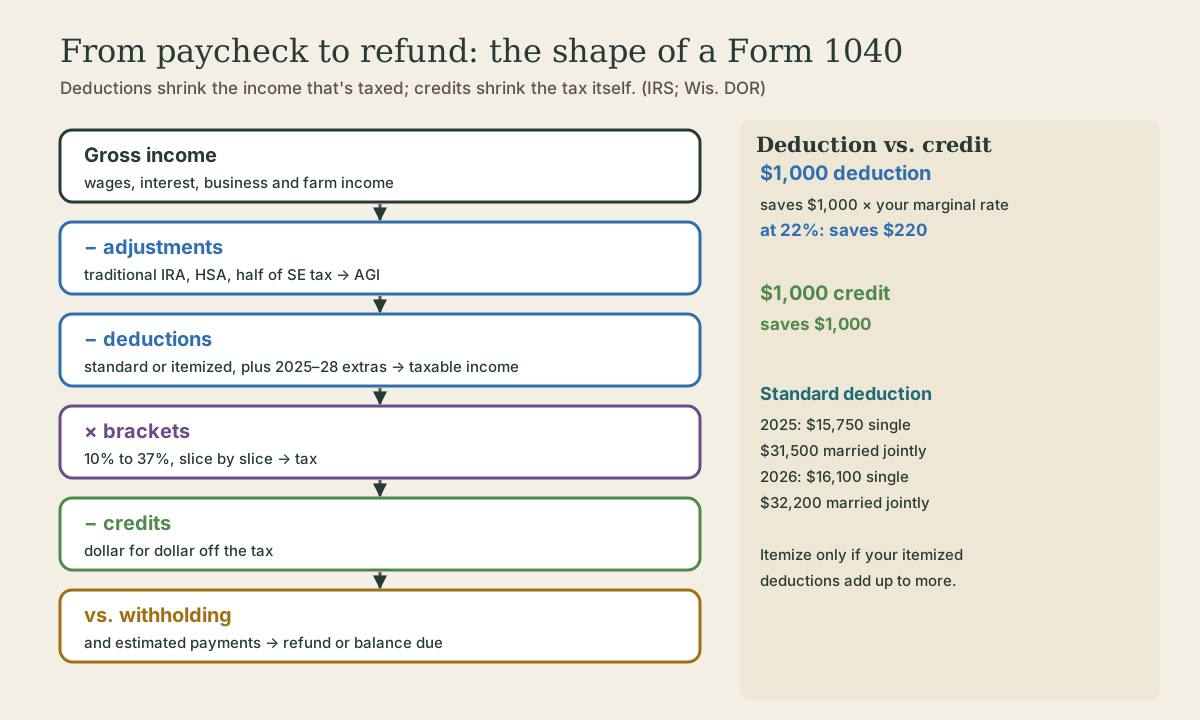
The path from gross income to refund on a Form 1040: adjustments to get AGI, the standard deduction or itemizing to get taxable income, brackets to get tax, credits off the tax dollar for dollar, then withholding and estimates against it. Why a $1,000 deduction saves $220 in the 22% bracket while a $1,000 credit saves $1,000, and the new 2025–2028 federal deductions for tips, overtime, car-loan interest, and seniors.
- 4 min
- 6 steps
- 3 questions
- Lesson 2 of 9
In this lesson
- The path
- Standard or itemized
- Deductions versus credits
- The new federal deductions
- Try it
Picking up where you left off.
Every individual return follows the same path, and almost every tax-saving move works by changing one step of it. Knowing which step a deduction or credit touches tells you what it’s actually worth.
The path
- Gross income: wages, interest, dividends, business and farm profit, and so on.
- Minus adjustments (“above the line”): traditional IRA and HSA contributions, half of self-employment tax, student loan interest, and a few others. The result is adjusted gross income (AGI). Many phase-outs, and Wisconsin’s return, start from AGI 1.
- Minus deductions: the standard deduction or your itemized deductions, whichever is larger. The result is taxable income.
- Apply the brackets (previous lesson) to get the tax.
- Minus credits: subtracted from the tax itself.
- Compare with what you’ve already paid, both withholding from paychecks and estimated payments, to get your refund or balance due.
Standard or itemized
The standard deduction for 2025 is $15,750 single, $31,500 married filing jointly, and $23,625 head of household; for 2026 it’s $16,100, $32,200, and $24,150 2. Itemized deductions (mortgage interest, state and local taxes up to a cap, charitable gifts, large medical bills) only help if they add up to more than that. Most households take the standard deduction.
One planning trick follows from it: if your itemized deductions are close to the line, bunch them, for example by making two years of charitable gifts in one year, itemizing that year, and taking the standard deduction the next.
Quick check
For 2025 that bar is $15,750 single or $31,500 married filing jointly.
Deductions versus credits
- A deduction lowers taxable income, so it saves the deduction times your marginal rate. In the 22% bracket, a $1,000 deduction saves $220.
- A credit comes straight off the tax. A $1,000 credit saves $1,000, whatever your bracket.
- Some credits are refundable: if they exceed your tax, you get the difference as a refund. The adoption credit, for instance, is now partly refundable, up to $5,000 3. Non-refundable credits can only bring the tax down to zero.
That’s why a credit is generally worth several times a deduction of the same size.
Quick check
A deduction lowers taxable income, so it saves the deduction times your marginal rate.
The new federal deductions
The 2025 federal tax law (the One Big Beautiful Bill Act, which the IRS now calls the Working Families Tax Cuts 3) added four temporary deductions, claimed on a new Schedule 1A for tax years 2025 through 2028, whether or not you itemize 1:
| Deduction | Limit | Phases out above (MAGI) |
|---|---|---|
| Qualified tips | up to $25,000 | $150,000 ($300,000 joint) |
| Overtime, the “half” of time-and-a-half | up to $12,500 | $150,000 ($300,000 joint) |
| Interest on a loan for a new, U.S.-assembled personal vehicle (loans after 2024) | up to $10,000 | $100,000 ($200,000 joint) |
| Seniors 65 and older | $6,000 each ($12,000 couple) | $75,000 ($150,000 joint) |
Tips and overtime are still subject to Social Security and Medicare tax, and employers still withhold income tax on them; the deduction comes on the return 1. Wisconsin has not adopted any of the four, so those amounts stay taxable on the state return 1.
Quick check
Those amounts stay taxable on the Wisconsin return, and Social Security and Medicare still apply to them federally.
Try it
On last year’s 1040, label each line by step: income, adjustments, AGI, deduction, taxable income, tax, credits, payments. Then add up what you could have itemized and see how far it is from the standard deduction. That tells you whether bunching or a bigger retirement contribution (an adjustment) would move the number more.
Lesson complete
Nice work.
Sources for this lesson
- 1Wisconsin Tax Update – Fall 2025. Wisconsin Department of Revenue. 2025. verified2025 Wis. Act 15 widens the 4.4% bracket for tax years after 2024: single/head of household/fiduciary top $50,480 (from $29,370), married joint $67,300 (from $39,150), married separate $33,650. 2025 rates: single 3.5% to $14,679, 4.4% $14,680-$50,479, 5.3% $50,480-$323,289, 7.65% $323,290+; joint 3.5% to $19,579, 4.4% $19,580-$67,299, 5.3% $67,300-$431,059, 7.65% $431,060+. New retirement income subtraction: age 67+ may subtract up to $24,000 of eligible retirement plan and IRA income ($48,000 if both spouses 67+ on a joint return), but then may not claim any Wisconsin income tax credit that year; nonresidents ineligible. Adoption subtraction raised to $15,000 per child. Wisconsin follows the IRC as of Dec. 31, 2022 with exceptions, depreciation under IRC of Jan. 1, 2014, has not adopted federal bonus depreciation or the OBBB, except auto-adopted items (IRC 179 limit to $2.5 million, 529 changes, HSA telehealth, child and dependent care credit). Wisconsin has not adopted the federal 2025-2028 deductions for tips (up to $25,000), overtime (up to $12,500 of the premium half), car loan interest (up to $10,000, new U.S.-assembled vehicles, loans after 2024), or seniors ($6,000 per person 65+, phasing out over $75,000/$150,000 MAGI); those federal deductions are claimed on Schedule 1A and income remains subject to Social Security and Medicare tax.
- 2IRS releases tax inflation adjustments for tax year 2026, including amendments from the One Big Beautiful Bill. Internal Revenue Service (Rev. Proc. 2025-32). 2025. verifiedStandard deduction: tax year 2025 under OBBB $15,750 single or married filing separately, $31,500 married filing jointly, $23,625 head of household; 2026 $16,100, $32,200, $24,150. 2026 brackets: 10% to $12,400 single ($24,800 MFJ); 12% over $12,400 ($24,800); 22% over $50,400 ($100,800); 24% over $105,700 ($211,400); 32% over $201,775 ($403,550); 35% over $256,225 ($512,450); 37% over $640,600 ($768,700). Personal exemptions remain zero, made permanent by OBBB. 2026 estate basic exclusion $15,000,000; annual gift exclusion $19,000; health FSA $3,400.
- 3Working Families Tax Cuts (One Big Beautiful Bill provisions). Internal Revenue Service. verifiedThe IRS's hub for the 2025 law it calls the Working Families Tax Cuts (One Big Beautiful Bill Act). Includes Trump Accounts for children (no funding before July 4, 2026; one-time $1,000 federal contribution for eligible children; up to $5,000 a year in contributions); up to $5,000 of the adoption credit refundable from 2025; child and dependent care credit rate up to 50% from 2026 on $3,000/$6,000 of expenses; HSA expansions.