Social Security and Medicare Tax
The 7.65% that comes off every paycheck: 6.2% for Social Security, up to a wage base of $184,500 in 2026, and 1.45% for Medicare with no limit, matched dollar for dollar by your employer. Why the total rate falls for high earners, the extra 0.9% Medicare tax above $200,000, what happens with two jobs, and why the employer's half is really part of your pay.
- 3 min
- 8 steps
- 2 questions
- Lesson 5 of 9
In this lesson
- Two taxes, two rates
- Social Security up to a cap
- Medicare: no cap, and an extra 0.9%
- A flat tax that falls at the top
- Two jobs and the wage base
- The employer’s half is your pay, too
- Try it
Picking up where you left off.
Every paycheck loses 7.65% before income tax is even considered. That’s FICA, named for the Federal Insurance Contributions Act: the payroll taxes that fund Social Security and Medicare 1.
Two taxes, two rates
- Social Security (old-age, survivors, and disability insurance): 6.2% from the employee and 6.2% from the employer, 12.4% in all.
- Medicare (hospital insurance): 1.45% from each, 2.9% in all 1.
On a $2,000 paycheck that’s $124 for Social Security and $29 for Medicare taken from you, and the same $153 paid by your employer on top. Unlike income tax withholding, nothing on your W-4 changes these amounts.
Social Security up to a cap
Social Security tax applies only up to an annual wage base. In 2026 it’s $184,500, up from $176,100 in 2025 2. Someone earning at or above the base pays the maximum, $11,439 for the year, and their employer pays the same; pay above the base owes no more Social Security tax 2.
Quick check
That’s $11,439. Medicare’s 1.45% applies to all $250,000, plus 0.9% on the $50,000 above $200,000.
Medicare: no cap, and an extra 0.9%
Medicare tax has no wage limit: 1.45% on every dollar 2. And on wages over $200,000 in a year, employers must also withhold an Additional Medicare Tax of 0.9%, with no employer match 1. The employer starts at $200,000 no matter your filing status, but the tax you actually owe is figured on your return with thresholds of $200,000 single, $250,000 married filing jointly, and $125,000 married filing separately 2. A married couple each earning $150,000 owes 0.9% on the $50,000 over $250,000, even though neither employer withheld it.
A flat tax that falls at the top
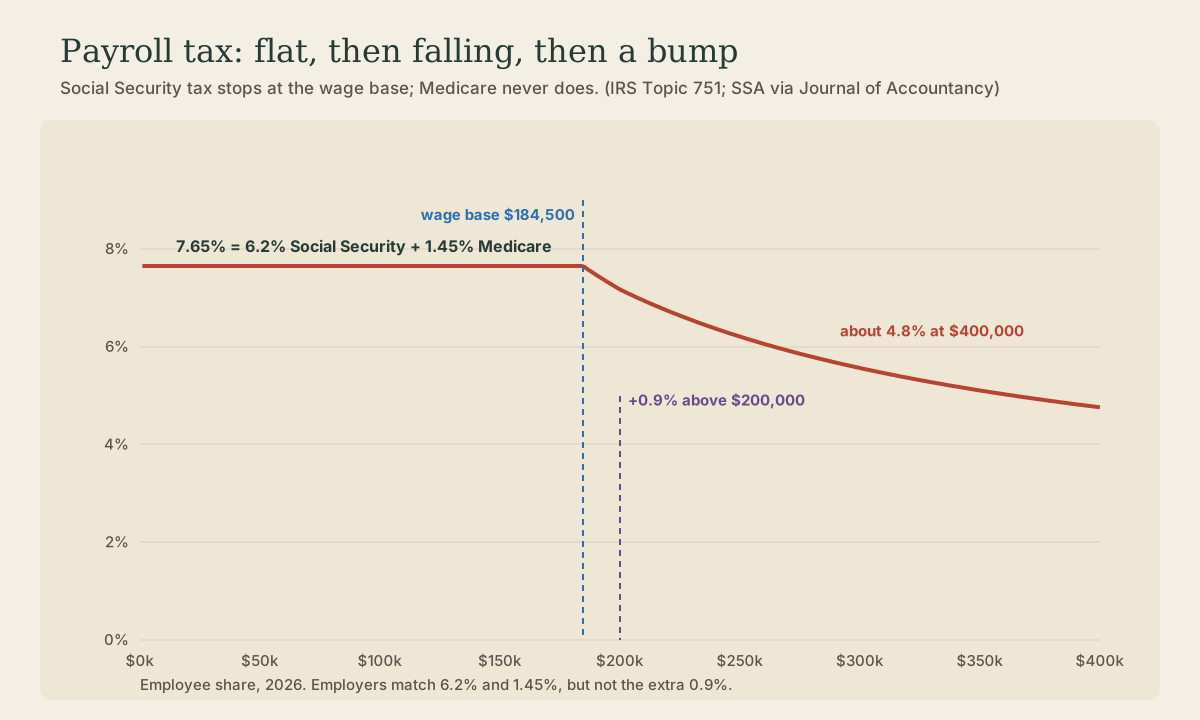
Put those together and FICA is a flat 7.65% for most workers, then the rate falls above the wage base, since only Medicare continues. At $400,000 of wages the employee’s FICA comes to about 4.8% of pay. Income tax brackets climb with income; payroll tax does the opposite at the top.
Two jobs and the wage base
Each employer applies the wage base separately; neither knows about the other job. If your combined wages pass the base, both may keep withholding 6.2%, and you’ll have paid too much Social Security tax. You claim the excess as a credit on your income tax return. If a single employer withheld too much, though, that employer has to fix it; it can’t be claimed on your return 3. (Wages count against the wage base first if you also have self-employment income 4.)
Quick check
Each employer applies the wage base separately, so the excess from having two employers is claimed back on your income tax return.
The employer’s half is your pay, too
The employer’s matching 7.65% never appears on your pay stub, but it’s part of what it costs to employ you. That’s why a job offer at a given wage is worth more than the same amount as an independent contractor: the self-employed pay both halves, as the next lesson shows 4.
Try it
On your last pay stub, multiply gross pay by 0.062 and 0.0145 and check them against the Social Security and Medicare lines. Then find your year-to-date Social Security wages: if you’re near $184,500, watch for that line to stop.
Lesson complete
Nice work.
Sources for this lesson
- 1Topic no. 751, Social Security and Medicare withholding rates. Internal Revenue Service. verifiedFICA: Social Security 6.2% each for employer and employee (12.4% total); Medicare 1.45% each (2.9% total). Employers withhold 0.9% Additional Medicare Tax on wages over $200,000 in a calendar year regardless of filing status; no employer match for it.
- 2Social Security wage base and COLA announced for 2026. Journal of Accountancy (AICPA). 2025. verifiedSSA: up to $184,500 of earnings subject to Social Security tax in 2026, up from $176,100 in 2025; at or above the base, employee and employer each pay $11,439. Medicare 1.45% each, no wage limit. Additional 0.9% over $200,000 ($250,000 joint, $125,000 separate). Self-employed pay 12.4% up to the base plus 2.9%, with a deduction for half. COLA 2.8% for 2026; earnings test limit $65,160 in the year of full retirement age.
- 3Topic no. 608, Excess Social Security and RRTA tax withheld. Internal Revenue Service. verifiedWith two or more employers and total wages over the wage base, total Social Security tax withheld may exceed the maximum; the excess may be claimed as a credit against income tax on the return. If a single employer withheld too much, the employer must fix it (or file Form 843); it can't be claimed as a credit.
- 4Self-employment tax (Social Security and Medicare taxes). Internal Revenue Service. verifiedSE tax rate 15.3% (12.4% Social Security, 2.9% Medicare); wages count against the Social Security wage base first; additional 0.9% Medicare above $200,000 single, $250,000 joint, $125,000 separate. The employer-equivalent half of SE tax is deductible in figuring AGI; it affects income tax only. Self-employed health insurance deduction.