Wisconsin Income Tax
How the Wisconsin return works for 2025: four brackets from 3.5% to 7.65%, with the 4.4% bracket widened to $50,480 single and $67,300 joint by 2025 Act 15; a worked example ($60,000 taxable, about $2,594 before credits); why Wisconsin starts from federal AGI but follows the federal code only as of 2022 and skipped the 2025 federal deductions and bonus depreciation; the sliding-scale standard deduction; and the new subtraction of up to $24,000 of retirement income at 67 and the credit trade-off that comes with it.
- 4 min
- 6 steps
- 3 questions
- Lesson 3 of 9
In this lesson
- The brackets
- Starting from federal AGI
- The standard deduction
- The new retirement subtraction
- Try it
Picking up where you left off.
Wisconsin taxes income on its own return, Form 1, with its own rates, its own standard deduction, and a growing list of ways it differs from the federal return. For 2025 the rates came down in the middle, and there’s a new break for retirees.
The brackets
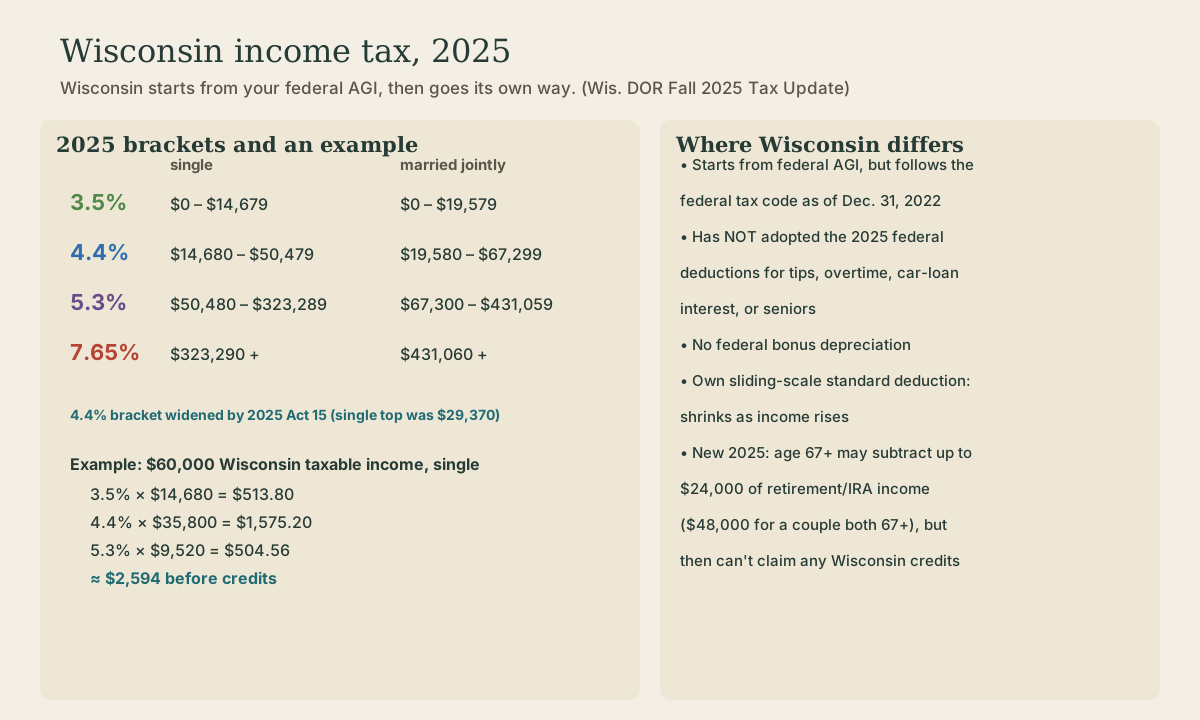
Wisconsin has four brackets. For 2025 1:
| Rate | Single, head of household | Married filing jointly |
|---|---|---|
| 3.5% | $0 – $14,679 | $0 – $19,579 |
| 4.4% | $14,680 – $50,479 | $19,580 – $67,299 |
| 5.3% | $50,480 – $323,289 | $67,300 – $431,059 |
| 7.65% | $323,290 and up | $431,060 and up |
The big change is the 4.4% bracket. 2025 Wisconsin Act 15 stretched it from a top of $29,370 to $50,480 for single filers and from $39,150 to $67,300 for joint filers, so a wide band of middle income moved from 5.3% to 4.4% 1. The thresholds are indexed to inflation from an August 2024 base going forward 1.
Worked single example, $60,000 of Wisconsin taxable income:
- 3.5% × $14,680 = $513.80
- 4.4% × $35,800 = $1,575.20
- 5.3% × $9,520 = $504.56
- ≈ $2,594 before credits.
Quick check
For married joint filers it now ends at $67,300.
Starting from federal AGI
Form 1 starts from your federal AGI, then adds and subtracts. The reason for many of those adjustments is that Wisconsin follows the federal tax code as of December 31, 2022, with a list of exceptions, not the code as it stands today 1. In practice:
- The 2025 federal deductions for tips, overtime, car-loan interest, and seniors don’t apply on the Wisconsin return 1.
- No federal bonus depreciation, and depreciation generally follows the federal code of January 1, 2014. A farm or business can end up with different depreciation schedules on the two returns 1.
- Some federal changes are adopted automatically: the Section 179 expensing limit (now $2.5 million), 529 plan rules, HSA rules, and the federal child and dependent care credit 1.
Quick check
Wisconsin follows the federal tax code as of 2022, with a list of exceptions that doesn’t include the new deductions.
The standard deduction
Wisconsin’s standard deduction works differently from the federal one: it’s a sliding scale. It’s largest at low incomes and shrinks as income rises, reaching zero for higher earners. Look up your amount in the standard deduction table in the Form 1 instructions for the year; tax software does it automatically.
The new retirement subtraction
New for 2025: a Wisconsin resident who is at least 67 by year’s end can subtract up to $24,000 of eligible retirement income (payments from qualified retirement plans and IRAs that aren’t already excluded), or up to $48,000 on a joint return if both spouses are 67 or older 1.
The catch: anyone who claims it can’t claim any Wisconsin income tax credit that year, and those credits can’t be carried forward 1. For someone with large credits (homestead, itemized deduction, or school property tax credits, for example), the subtraction may not be worth it. Run the return both ways. Part-year residents prorate the limit, and nonresidents can’t claim it 1.
The adoption expense subtraction also went up, from $5,000 to $15,000 per child 1.
Quick check
Run the return both ways: for some people the credits are worth more than the subtraction.
Try it
Pull last year’s Wisconsin Form 1 next to your federal 1040. Find where Form 1 picks up your federal AGI, list every addition and subtraction, and check which bracket your last dollar fell in. If you or a parent will be 67 soon, sketch the retirement subtraction against the credits you’d give up.
Lesson complete
Nice work.
Sources for this lesson
- 1Wisconsin Tax Update – Fall 2025. Wisconsin Department of Revenue. 2025. verified2025 Wis. Act 15 widens the 4.4% bracket for tax years after 2024: single/head of household/fiduciary top $50,480 (from $29,370), married joint $67,300 (from $39,150), married separate $33,650. 2025 rates: single 3.5% to $14,679, 4.4% $14,680-$50,479, 5.3% $50,480-$323,289, 7.65% $323,290+; joint 3.5% to $19,579, 4.4% $19,580-$67,299, 5.3% $67,300-$431,059, 7.65% $431,060+. New retirement income subtraction: age 67+ may subtract up to $24,000 of eligible retirement plan and IRA income ($48,000 if both spouses 67+ on a joint return), but then may not claim any Wisconsin income tax credit that year; nonresidents ineligible. Adoption subtraction raised to $15,000 per child. Wisconsin follows the IRC as of Dec. 31, 2022 with exceptions, depreciation under IRC of Jan. 1, 2014, has not adopted federal bonus depreciation or the OBBB, except auto-adopted items (IRC 179 limit to $2.5 million, 529 changes, HSA telehealth, child and dependent care credit). Wisconsin has not adopted the federal 2025-2028 deductions for tips (up to $25,000), overtime (up to $12,500 of the premium half), car loan interest (up to $10,000, new U.S.-assembled vehicles, loans after 2024), or seniors ($6,000 per person 65+, phasing out over $75,000/$150,000 MAGI); those federal deductions are claimed on Schedule 1A and income remains subject to Social Security and Medicare tax.