Withholding and the W-4
Income tax is pay-as-you-go: your employer sends part of every paycheck to the IRS and the state based on the forms you fill out when hired. How the federal W-4 has worked since its 2020 redesign (no more allowances, five steps, only two required), when to raise or lower withholding, why two jobs or two earners usually means too little withheld, Wisconsin's own WT-4 with its exemptions, and why a big refund is just an interest-free loan to the government.
- 4 min
- 7 steps
- 2 questions
- Lesson 4 of 9
In this lesson
- What comes out of a paycheck
- The W-4 since 2020
- Two jobs, two earners
- Wisconsin’s WT-4
- Refund or balance due
- Try it
Picking up where you left off.
The US income tax is pay-as-you-go: tax is due as you earn income, not just in April. For most people that happens through withholding: the employer takes tax out of every paycheck and sends it in 1. How much comes out depends on forms you fill out when hired.
What comes out of a paycheck
Two very different things come out:
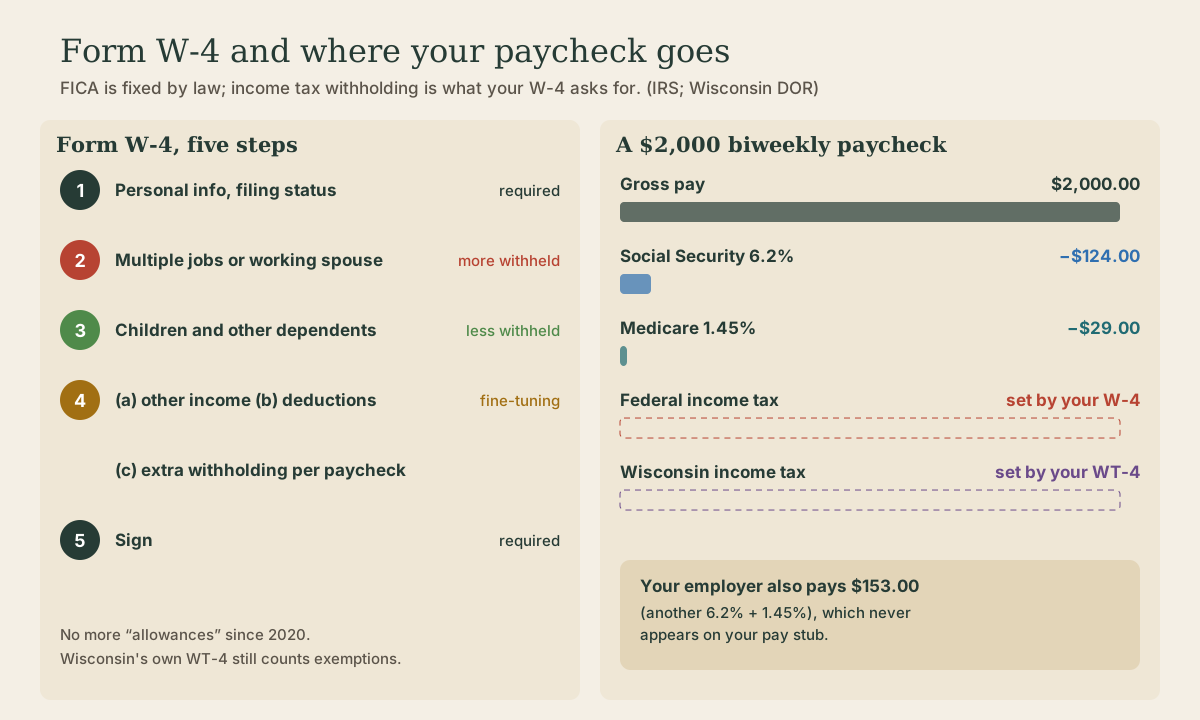
- Social Security and Medicare (FICA). Fixed by law: 6.2% and 1.45% of pay, with the employer paying a matching 7.65% on top 2. Nothing you put on a form changes them. (Next lesson.)
- Income tax withholding, federal and state. This is an estimate of the income tax you’ll owe for the year, and it’s set by your W-4 (federal) and WT-4 (Wisconsin). At tax time the return settles up: too much withheld and you get a refund, too little and you owe.
The W-4 since 2020
The federal Form W-4 was redesigned in 2020. The old form used withholding allowances, tied to the personal exemption; once a change in law eliminated personal exemptions, allowances stopped making sense and were dropped 3. The new form has five steps, and only two are required 3:
- Personal information and filing status. Required. Fill in only this and sign, and withholding assumes your filing status’s standard deduction and tax rates, with no other adjustments.
- Multiple jobs or a working spouse. Raises withholding.
- Dependents. Enter child tax credit and other dependent credits to lower withholding.
- Other adjustments: (a) other income without withholding, like interest or dividends; (b) deductions beyond the standard deduction; (c) an extra amount to withhold every paycheck.
- Sign. Required.
An old W-4 from before 2020 is still valid; you don’t need a new one unless something changes 3.
Two jobs, two earners
Step 2 is where most underwithholding comes from. Each employer withholds as if its job were your only income, giving it a full standard deduction and starting it in the lowest brackets. But your return gets one standard deduction, and the combined income climbs into higher brackets. So with two jobs, or two working spouses, more should usually be withheld than either job would withhold alone, or you’ll likely owe when you file, and possibly a penalty 3. The IRS’s online Tax Withholding Estimator is the most accurate way to set this up 3.
The same goes for side income. Instead of paying quarterly estimates on, say, a small sawmill business or rental income, a wage earner can just add an extra amount in Step 4(c) 1.
Quick check
Each employer withholds as if its job were your only income, with a full standard deduction and the low brackets; together that’s usually too little.
Wisconsin’s WT-4
Wisconsin has its own form, the WT-4, and it still works the old way, with exemptions: one for yourself, one for your spouse, and one for each dependent, plus a line for an additional amount per pay period 4. If you have more than one employer, the form tells you to claim fewer exemptions, or none, at the jobs other than your main one, so that total withholding lands closer to what you’ll owe. The instructions’ rule of thumb: about 90% of your net Wisconsin tax should be withheld 4.
Refund or balance due
A big refund feels like a bonus, but it’s your own money coming back. If you have more withheld than necessary you get it back when you file, but without interest 3. Some people like the forced savings. The opposite mistake costs more: owe too much at filing and you may face an underpayment penalty, which can apply even if you end up due a refund after late estimated payments 1.
Quick check
It works as forced savings, but the money earns nothing while the government holds it.
Try it
Pull your last pay stub and find the four withholding lines: federal income tax, Wisconsin income tax, Social Security, and Medicare. Check that Social Security is 6.2% and Medicare 1.45% of gross pay. Then run the IRS Tax Withholding Estimator with your pay stub and last year’s return, and see whether you’re on track for a refund, a balance due, or close to even.
Lesson complete
Nice work.
Sources for this lesson
- 1Estimated taxes. Internal Revenue Service. verifiedTax must be paid as income is earned, by withholding or estimated payments. Individuals generally must pay estimated tax if they expect to owe $1,000 or more. Wage earners can instead raise withholding on Form W-4 (Step 4c). Penalty generally avoided if owing under $1,000 or if paid at least 90% of this year's tax or 100% of last year's, whichever is smaller; can be charged even if due a refund. Payments can be made more often than quarterly.
- 2Topic no. 751, Social Security and Medicare withholding rates. Internal Revenue Service. verifiedFICA: Social Security 6.2% each for employer and employee (12.4% total); Medicare 1.45% each (2.9% total). Employers withhold 0.9% Additional Medicare Tax on wages over $200,000 in a calendar year regardless of filing status; no employer match for it.
- 3FAQs on the 2020 Form W-4. Internal Revenue Service. verifiedRedesigned W-4 drops withholding allowances (once tied to the personal exemption, now zero). Five steps: only Step 1 (personal information, filing status) and Step 5 (signature) required. Increase withholding for multiple jobs or a working spouse (Step 2) or other income (Step 4a); decrease for credits like the child tax credit (Step 3) or deductions beyond the standard deduction (Step 4b); extra withholding in Step 4(c). Pre-2020 W-4s stay valid. Overwithholding earns no interest. Multiple jobs matter because brackets rise and only one standard deduction applies per return; the Tax Withholding Estimator is the most accurate tool.
- 4Form WT-4, Employee's Wisconsin Withholding Exemption Certificate/New Hire Reporting (copy hosted by Sauk County). Wisconsin Department of Revenue. verifiedWisconsin's own withholding certificate: exemptions for yourself, spouse, and each dependent, an additional amount per pay period, or complete exemption if no Wisconsin liability last year or expected this year. With more than one employer, claim fewer or no exemptions at the others so total withholding comes closer to your liability. Generally 90% of the net tax should be withheld.