Self-Employment Tax and Quarterly Estimates
Work for yourself, whether a side business, a farm, or contract work, and you pay both halves of Social Security and Medicare: 15.3% on 92.35% of net profit, owed once net earnings hit $400. A worked example ($40,000 profit, $5,651.82 of SE tax, half deductible), why there's no withholding so you pay quarterly, the 2026 due dates, the safe harbors that prevent penalties, the special farmer rule, and Wisconsin's $500 threshold.
- 4 min
- 7 steps
- 2 questions
- Lesson 6 of 9
In this lesson
- Who is self-employed
- Both halves
- Paying as you go
- The safe harbors
- Farmers get a simpler rule
- Wisconsin estimates
- Try it
Picking up where you left off.
An employee splits Social Security and Medicare with the employer. Someone who works for themselves is both, and pays both shares.
Who is self-employed
For tax purposes you’re self-employed if you’re a sole proprietor (including an independent contractor), a partner in a partnership, a member of a single-member LLC, or otherwise in business for yourself 1. That includes a farm reported on Schedule F, a side business selling eggs, firewood, or furniture, and 1099 contract work. You usually owe self-employment (SE) tax once net earnings reach $400 for the year, and you owe it even if you already collect Social Security 1.
Both halves
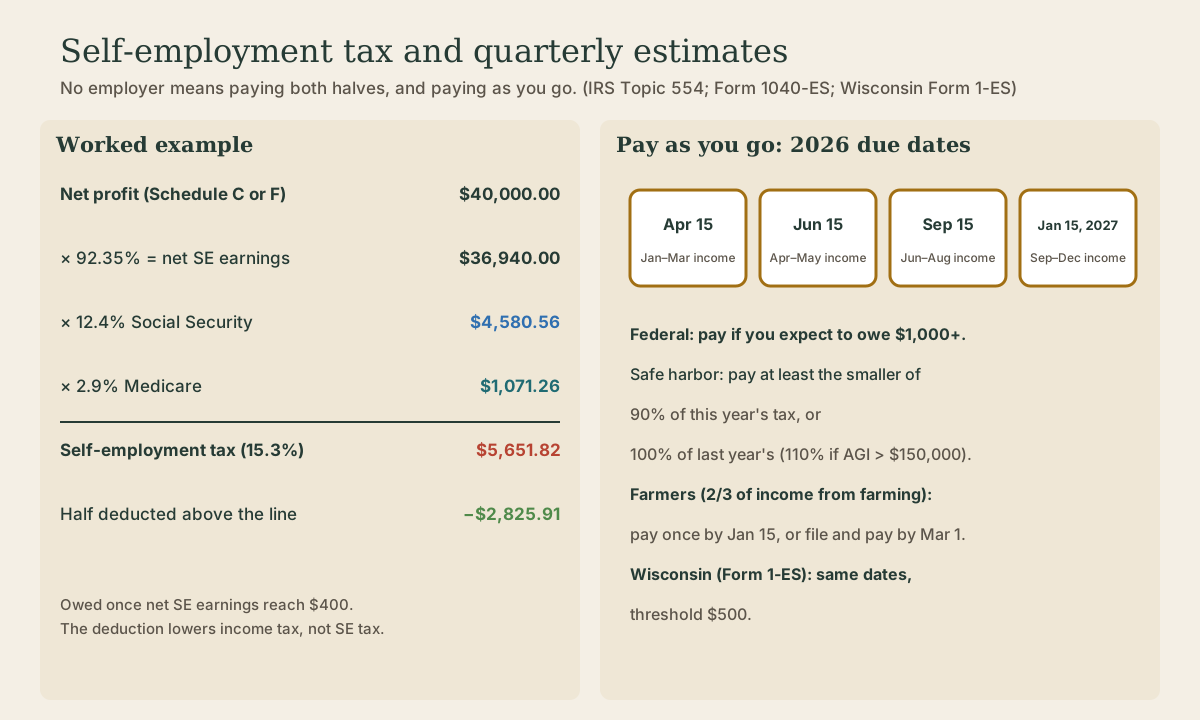
The SE tax rate is 15.3%: 12.4% for Social Security and 2.9% for Medicare, the employee’s and employer’s shares combined 2. Two adjustments soften it:
- It applies to 92.35% of net earnings, not 100% 1. (The 7.65% knocked off mirrors the fact that an employee never pays tax on the employer’s share.)
- You deduct half of the SE tax in figuring adjusted gross income. That lowers your income tax, but not the SE tax itself 2.
The Social Security part stops at the wage base, $184,500 in 2026; the Medicare part applies to all net earnings 3 1. If you also have a job, your wages use up the wage base first 2.
Worked through for $40,000 of net profit:
| Step | Amount |
|---|---|
| Net profit | $40,000.00 |
| × 92.35% = net SE earnings | $36,940.00 |
| × 12.4% Social Security | $4,580.56 |
| × 2.9% Medicare | $1,071.26 |
| SE tax | $5,651.82 |
| Deduction for half, in figuring AGI | −$2,825.91 |
That $5,651.82 comes on top of regular income tax on the profit. It’s easy to forget in a first year of self-employment.
Quick check
And half of it, about $2,826, is deducted in figuring adjusted gross income.
Paying as you go
Tax is due as income is earned, and nobody withholds from self-employment income, so you pay estimated tax instead. Individuals generally must make estimated payments if they expect to owe $1,000 or more in federal tax when they file 4. Estimated payments cover income tax and SE tax together 4.
The year has four payment periods. For 2026 the due dates are April 15, June 15, and September 15, 2026, and January 15, 2027. You can skip the January payment if you file and pay in full by February 1, 2027 5. Paying more often than quarterly is fine as long as each period’s total is covered 4.
If you also have a job, there’s an easier route: raise your W-4 withholding (Step 4c) to cover the business income and skip estimates entirely 4.
The safe harbors
You generally avoid an underpayment penalty if you owe less than $1,000 at filing, or if your withholding and on-time estimates add up to at least the smaller of 4:
- 90% of this year’s tax, or
- 100% of last year’s tax, or 110% if last year’s AGI was over $150,000 5.
The prior-year rule is the easy one: divide last year’s total tax by four and pay that each quarter. Even if business booms and you owe more in April, there’s no penalty. Note that a late payment can be penalized even if you end up due a refund 4.
Quick check
100% of last year’s tax is a safe harbor (110% if last year’s AGI was over $150,000), even if this year’s tax turns out higher.
Farmers get a simpler rule
If at least two-thirds of your gross income comes from farming (or fishing), you can skip the quarterly schedule: either pay all your estimated tax by January 15 or file your return and pay everything by March 1 5. Farmers also use 66⅔% in place of the 90% test, and the 110% rule doesn’t apply to them 5.
Wisconsin estimates
Wisconsin has its own version, Form 1-ES. You must pay Wisconsin estimated tax if you expect to owe at least $500 after withholding and credits, with safe harbors of 90% of this year’s tax or 100% of last year’s. The dates match the federal ones, and farmers and fishers get the same pay-by-January or file-by-March option. Payments can be made free online through the Department of Revenue 6.
Try it
If you have any self-employment income, estimate this year’s net profit and run it through the table above. Add your expected income tax, compare the total to last year’s tax, and set four calendar reminders for the due dates with a quarter of the safe-harbor amount on each.
Lesson complete
Nice work.
Sources for this lesson
- 1Topic no. 554, Self-employment tax. Internal Revenue Service. verifiedSelf-employed: sole proprietors, independent contractors, partners, single-member LLCs. SE tax usually due with net earnings of $400 or more; generally on 92.35% of net earnings (gross income minus ordinary and necessary business expenses). Rate 12.4% Social Security plus 2.9% Medicare. Social Security part capped each year; all net earnings subject to Medicare. Due even when already receiving Social Security. Optional methods for losses or small income.
- 2Self-employment tax (Social Security and Medicare taxes). Internal Revenue Service. verifiedSE tax rate 15.3% (12.4% Social Security, 2.9% Medicare); wages count against the Social Security wage base first; additional 0.9% Medicare above $200,000 single, $250,000 joint, $125,000 separate. The employer-equivalent half of SE tax is deductible in figuring AGI; it affects income tax only. Self-employed health insurance deduction.
- 3Social Security wage base and COLA announced for 2026. Journal of Accountancy (AICPA). 2025. verifiedSSA: up to $184,500 of earnings subject to Social Security tax in 2026, up from $176,100 in 2025; at or above the base, employee and employer each pay $11,439. Medicare 1.45% each, no wage limit. Additional 0.9% over $200,000 ($250,000 joint, $125,000 separate). Self-employed pay 12.4% up to the base plus 2.9%, with a deduction for half. COLA 2.8% for 2026; earnings test limit $65,160 in the year of full retirement age.
- 4Estimated taxes. Internal Revenue Service. verifiedTax must be paid as income is earned, by withholding or estimated payments. Individuals generally must pay estimated tax if they expect to owe $1,000 or more. Wage earners can instead raise withholding on Form W-4 (Step 4c). Penalty generally avoided if owing under $1,000 or if paid at least 90% of this year's tax or 100% of last year's, whichever is smaller; can be charged even if due a refund. Payments can be made more often than quarterly.
- 5Form 1040-ES, Estimated Tax for Individuals (2026). Internal Revenue Service. verified2026 due dates: April 15, June 15, September 15, 2026, and January 15, 2027 (skip the January payment if the return is filed and paid by February 1, 2027). Higher income: if 2025 AGI over $150,000 ($75,000 married filing separately), use 110% of last year's tax instead of 100%. Farmers and fishers with at least two-thirds of gross income from farming or fishing: use 66 2/3% instead of 90%, and either pay all estimated tax by January 15, 2027 or file and pay by March 1, 2027.
- 62025 Form 1-ES Instructions: Estimated Income Tax for Individuals, Estates, and Trusts. Wisconsin Department of Revenue. verifiedPay Wisconsin estimated tax if you expect to owe at least $500 after withholding and credits and withholding is less than the smallest of 90% of this year's tax, 100% of last year's, or 90% annualized. 2025 installments April 15, June 16, September 15, 2025 and January 15, 2026. Farmers and fishers (two-thirds of gross income) may pay in full by January 15 or file and pay by March 2. Pay online at tap.revenue.wi.gov/pay.