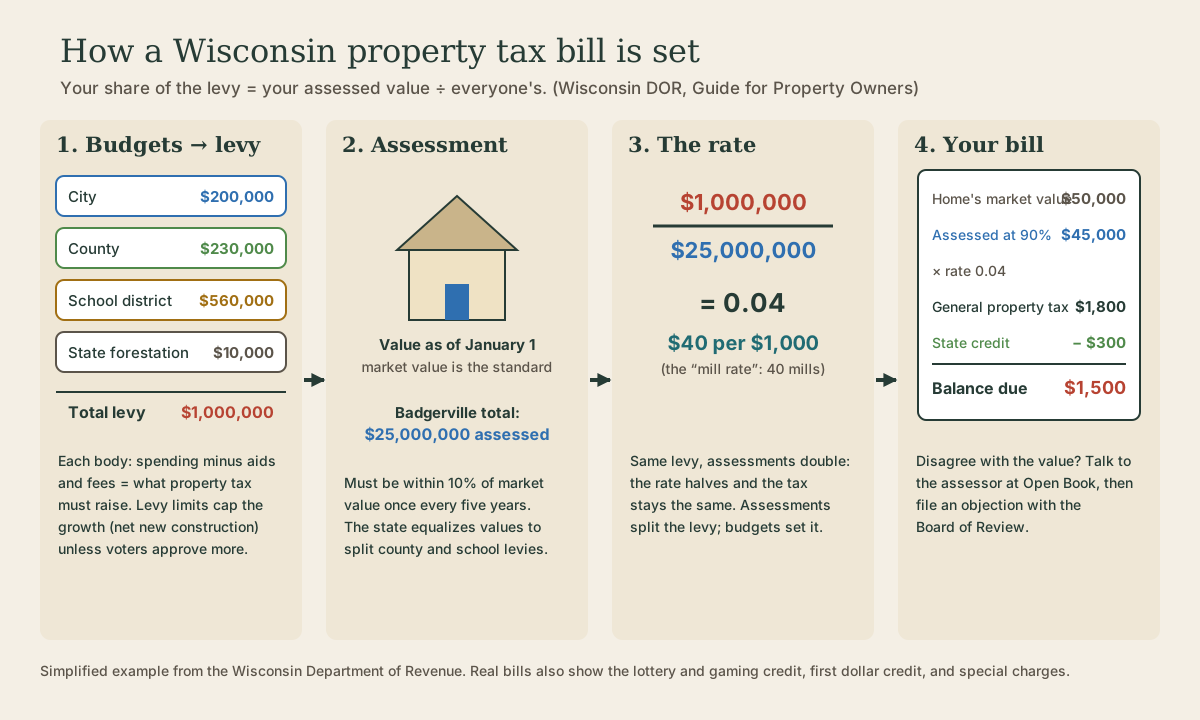
How Wisconsin Property Tax Is Set
Your property tax isn't a percentage someone picks. Each local government and school district budgets its spending, subtracts state aid and fees, and the rest becomes its levy. The assessor values every property as of January 1, the levy is divided by the total assessed value to get the mill rate, and your bill is your assessed value times that rate. Why a higher assessment doesn't by itself raise your taxes, how equalization keeps neighboring towns fair, the levy limits that cap growth, and how to appeal at Open Book and the Board of Review.
- 5 min
- 7 steps
- 3 questions
- Lesson 7 of 9
In this lesson
- The levy comes first
- Assessment divides it up
- From levy to rate
- Limits on the levy
- If you think your assessment is wrong
- Try it
Picking up where you left off.
Every December, Wisconsin homeowners open a property tax bill, and many assume the number reflects a tax rate someone in Madison picked. It doesn’t. A property tax bill is built backward from local budgets, and once you see how, a lot of common worries (like “my assessment went up, so my taxes will too”) turn out to be only partly true.
The levy comes first
Each year, every body with taxing power over your property, your city, village, or town; your county; your school district; your technical college; and the state’s small forestation tax, adopts a budget. It totals its expected spending, subtracts what it expects from state aid, shared revenue, fees, and other sources, and whatever is left must be raised from property tax. That amount is the levy 1.
In other words, the total property tax collected is set by budgets, not by property values. Your municipality’s treasurer then collects the tax for all the bodies at once: municipality, school, county, and state 1.
Assessment divides it up
The local assessor places a value on every taxable property, and that assessed value decides what share of the levy your property carries. By law, assessments of non-farm property are based on market value as of January 1. The state recognizes that no municipality can reassess everyone at market value every year, so it requires each municipality’s assessments to be within 10 percent of market value at least once every five years 1. (Farmland is the big exception: it’s assessed on its value for farming, not its market value, which the constitution allows 1.)
Because towns assess at different percentages of market value, the Department of Revenue also computes an equalized value for every municipality, an estimate of its full market value. Equalized values, not local assessments, are used to split county, school, and technical college levies among the municipalities that share them, so a town that assesses low doesn’t dodge its share 1.
From levy to rate
The tax rate is just the levy divided by the total assessed value, usually stated in dollars per $1,000 of value, the mill rate 1. The Department of Revenue’s own example uses the imaginary city of Badgerville 1:
- The city levies $200,000, the county $230,000, the school district $560,000, and the state forestation tax $10,000: $1,000,000 in all.
- Badgerville’s total assessed value is $25,000,000.
- Rate: $1,000,000 ÷ $25,000,000 = 0.04, or $40 per $1,000.
- A home worth $50,000, assessed at 90 percent of market value, is assessed at $45,000. Its tax: $45,000 × 0.04 = $1,800, less a $300 state credit, for $1,500 due.
Now the key point. If the town revalues and every assessment doubles while the levy stays the same, the rate is cut in half 1. Your bill changes only if your property’s value rose faster or slower than everyone else’s. A higher assessment shifts more of the levy to you only relative to your neighbors; what raises everyone’s taxes is a higher levy.
Quick check
$1,000,000 ÷ $25,000,000 = 0.04, or $40 per $1,000. A home assessed at $45,000 owes $1,800 before credits.
Quick check
The levy is fixed by budgets; doubling every assessment halves the rate. Bills shift only if your value changed more or less than your neighbors’.
Limits on the levy
The state caps how fast local levies can grow. A municipality may generally increase its levy over the previous year only by the percentage growth in its equalized value from net new construction, new buildings minus demolitions. With no new construction, the allowable increase is zero 2 3. There are exceptions, such as certain debt payments, and voters can approve going over the limit in a referendum 2.
Quick check
With no new construction, the allowable increase is zero, apart from exceptions such as some debt service.
If you think your assessment is wrong
The appeal process starts each spring or summer when the assessment roll is finished. First comes Open Book, a period when you can review your assessment and talk with the assessor informally; the assessor can still fix errors then. After it closes, any change requires a formal appeal to the Board of Review, which begins at least seven days after Open Book. You must file a written objection form, and you’ll need evidence of your property’s market value as of January 1, such as recent sales of comparable homes 1.
Remember what you’re appealing: your value, not your tax. Arguing that taxes are too high belongs at budget hearings, where the levy is actually set.
Try it
Find your most recent property tax bill. Look for the assessed value, the “average assessment ratio,” and the estimated fair market value; the bill shows how much went to each taxing body this year and last. Divide each body’s tax by your assessed value to see its share of the rate. Which body takes the largest share?
Lesson complete
Nice work.
Sources for this lesson
- 12026 Guide for Property Owners (PB-060). Wisconsin Department of Revenue. 2026. verifiedArticle VIII of the state constitution requires uniform taxation; agricultural and undeveloped land need not be uniform. Assessed value determines your share of the levy; non-agricultural assessments based on market value as of January 1; each municipality must be within 10% of market value once every five years (average assessment ratio 90-110%). DOR assesses manufacturing property. Equalized values (all at market value) apportion state, county, school, and technical college levies among municipalities; over 100 statutory uses. Revaluation example: same levy, doubled assessments, rate halves. Open Book precedes Board of Review; BOR starts at least seven days after the roll opens; objection forms required. Levy: each governing body's budget minus aids and other revenue; forestation state tax $.1697 per $1,000 (as stated). Tax rate = levy / assessed value; Badgerville example: levies city $200,000, county $230,000, school $560,000, state $10,000 = $1,000,000 over $25,000,000 = 0.04, $40 per $1,000; $50,000 home assessed at 90% = $45,000 x .04 = $1,800, minus $300 state credit = $1,500. Town, village, or city treasurer collects for all. Part of the state credit is the school levy tax credit. First dollar credit: every parcel with an improvement, equal to school tax on a set value, calculated by DOR. Homestead credit: income-based, owners and renters; renters count part of rent. WHEDA property tax deferral loans for elderly homeowners. No veterans exemption, but WDVA veterans and surviving spouses property tax credit. Wisconsin almost unique in taxes raised at the state level but spent locally.
- 2Levy Limits Explanation and Strategies. League of Wisconsin Municipalities. verifiedA municipality may increase its levy over the prior year by the percentage increase in equalized value from net new construction; with no new construction, the allowable increase is zero. 2023 Act 12: for TIF districts created after October 1, 2024, only 90% of their new construction counts. Fee revenue for garbage, fire, snow plowing, street sweeping, or storm water reduces the allowable levy if those services were levy-funded in 2013. Levies may exceed the limit if approved by referendum. Debt service on certain debt is exempt; unused levy capacity can be carried forward within limits.
- 3Net New Construction Report. Wisconsin Department of Revenue, Equalization Bureau. verifiedNet new construction is new construction reduced by demolition or destruction of buildings; levy limit percent = current year net new construction divided by prior year equalized value; TID-adjusted figures count 90% of new construction within a TID.