Property Tax Credits: Lottery, First Dollar, Homestead
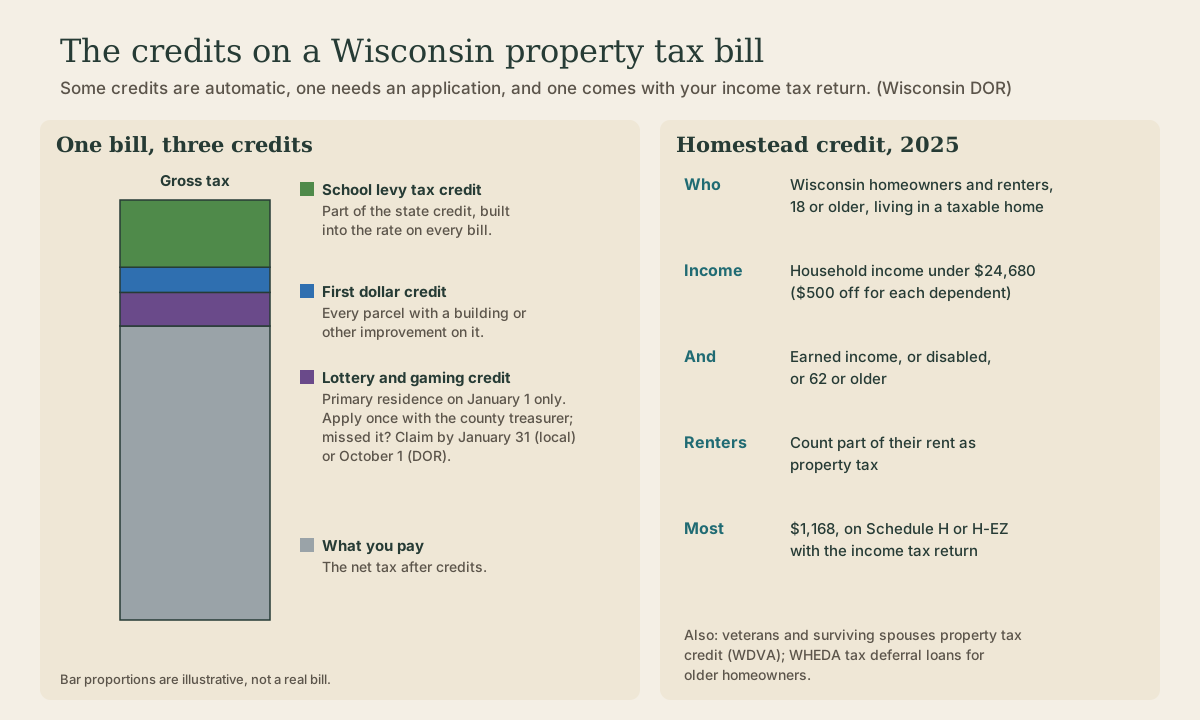
Wisconsin shaves several credits off property tax bills. The school levy tax credit is built into every bill. The first dollar credit goes to every parcel with a building on it. The lottery and gaming credit goes only to your primary residence, and only if you've applied, so it's worth checking your bill for it. The homestead credit, claimed on your income tax return, helps homeowners and renters with household income under $24,680 for 2025, up to $1,168. Plus the veterans credit and WHEDA's tax deferral loans.
- 5 min
- 7 steps
- 3 questions
- Lesson 8 of 9
In this lesson
- The school levy tax credit
- The first dollar credit
- The lottery and gaming credit
- The homestead credit
- Other help
- Try it
Picking up where you left off.
Look at a Wisconsin property tax bill and below the total you’ll see lines that reduce it. Each is a state program, and they work very differently: some are automatic, one has to be applied for, and one isn’t on the bill at all.
The school levy tax credit
The biggest is built in. The state pays part of every municipality’s school property taxes through the school levy tax credit, which is part of the “state credit” on your bill 1. You don’t apply for it; it’s already reflected in the net rate printed on the bill. It’s one reason the Department of Revenue calls Wisconsin “almost unique” among states in how much tax it raises at the state level but spends locally 1.
The first dollar credit
The first dollar credit goes to the owner of every parcel that has at least one improvement, a house, a cabin, a barn. It equals the school tax on a certain amount of the improvement’s value, an amount the Department of Revenue sets each year so the available money covers all the claims. It appears on the bill as a reduction, split evenly across installments if you pay in parts 1.
The lottery and gaming credit
The lottery and gaming credit is paid from a separate state fund filled by the Wisconsin Lottery, on-track betting, and bingo. Each November the state divides the available money by the number of expected claims to set a maximum credit value; your credit is that value (or your home’s value, if lower) times your school tax rate 2.
It goes only to a primary residence: you must be a Wisconsin resident who owns the home and lives in it as of January 1. Rentals, business property, vacant land, and garages don’t qualify, and an owner can normally claim only one home 2. Unlike the other credits, it has to be applied for, with your county treasurer (or city treasurer in some cities). When you buy a home, the credit stays with the property if the previous owner lived there on January 1, and you should file your own application 2.
If your home qualified but the credit isn’t on your bill, you can apply to your town, village, or city treasurer by January 31 and get it credited or refunded, or file a late claim with the Department of Revenue by October 1 2. If you sell, move out, or start renting the home, you’re supposed to notify the county treasurer within 30 days 2.
Quick check
One primary residence per owner, with rare exceptions. Every improved parcel gets the first dollar credit instead.
Quick check
The treasurer will credit your bill or refund you if you’ve already paid.
The homestead credit
The homestead credit isn’t on the property tax bill. You claim it with your Wisconsin income tax return on Schedule H (or the simpler H-EZ), and it’s paid to you directly. It’s meant to soften property taxes and rent for people with lower incomes, and renters qualify too, counting part of their rent as property tax 3 1.
For 2025 you may qualify if 3:
- you owned or rented a home subject to Wisconsin property tax, were a Wisconsin resident all year, and were 18 or older;
- your household income was under $24,680 (household income counts taxable and some nontaxable income, minus $500 for each dependent);
- you had earned income, were disabled, or were 62 or older; and
- no one else could claim you as a dependent (unless you were 62 or older).
The credit depends on how your property taxes and rent compare to your income, up to a maximum of $1,168 3.
Quick check
Renters count part of their rent as property tax. The maximum credit is $1,168.
Other help
Wisconsin has no property tax exemption for veterans, but eligible veterans and surviving spouses can claim the state’s veterans and surviving spouses property tax credit, run by the Department of Veterans Affairs. Older homeowners can borrow to pay property taxes through WHEDA’s property tax deferral loan program, repaid when the home is sold or they move 1.
Try it
Check your own bill for three lines: the first dollar credit, the lottery and gaming credit, and the state credit. If the lottery credit is missing and you lived there on January 1, you have until January 31 to claim it from your treasurer.
Lesson complete
Nice work.
Sources for this lesson
- 12026 Guide for Property Owners (PB-060). Wisconsin Department of Revenue. 2026. verifiedArticle VIII of the state constitution requires uniform taxation; agricultural and undeveloped land need not be uniform. Assessed value determines your share of the levy; non-agricultural assessments based on market value as of January 1; each municipality must be within 10% of market value once every five years (average assessment ratio 90-110%). DOR assesses manufacturing property. Equalized values (all at market value) apportion state, county, school, and technical college levies among municipalities; over 100 statutory uses. Revaluation example: same levy, doubled assessments, rate halves. Open Book precedes Board of Review; BOR starts at least seven days after the roll opens; objection forms required. Levy: each governing body's budget minus aids and other revenue; forestation state tax $.1697 per $1,000 (as stated). Tax rate = levy / assessed value; Badgerville example: levies city $200,000, county $230,000, school $560,000, state $10,000 = $1,000,000 over $25,000,000 = 0.04, $40 per $1,000; $50,000 home assessed at 90% = $45,000 x .04 = $1,800, minus $300 state credit = $1,500. Town, village, or city treasurer collects for all. Part of the state credit is the school levy tax credit. First dollar credit: every parcel with an improvement, equal to school tax on a set value, calculated by DOR. Homestead credit: income-based, owners and renters; renters count part of rent. WHEDA property tax deferral loans for elderly homeowners. No veterans exemption, but WDVA veterans and surviving spouses property tax credit. Wisconsin almost unique in taxes raised at the state level but spent locally.
- 2Lottery and Gaming Credit: Common Questions. Wisconsin Department of Revenue. verifiedDirect property tax relief funded by lottery, pari-mutuel on-track betting, and bingo proceeds in a segregated fund. Must be a Wisconsin resident who owns and uses the dwelling as primary residence on the January 1 certification date; one primary residence; not business, rental, vacant land, garages. Credit = maximum credit value (MCV, set each November from available funds and expected claims, or the property's value if lower) x school tax rate. Apply with the county (or city) treasurer; if missing from the bill, claim from the municipal treasurer by January 31 or file a late claim with DOR by October 1. Credit stays with the property when sold; notify the treasurer within 30 days (Form LC-400) when it no longer qualifies. Every parcel with an improvement gets the first dollar credit, but that doesn't make it eligible for the lottery credit.
- 3Homestead Credit, Tax Year 2025 (Fact Sheet 1116). Wisconsin Department of Revenue. 2026. verifiedSoftens property taxes and rent for lower-income residents; Schedule H or H-EZ. Must have owned or rented a dwelling subject to Wisconsin property tax, be a full-year resident, 18 or older, household income under $24,680, and have earned income, be disabled, or be 62 or older; can't be someone's dependent (unless 62+); no farmland preservation or veterans property tax credit claimed; not entire year in tax-exempt housing. Maximum credit $1,168. Household income includes taxable and certain nontaxable income, less $500 per qualifying dependent. Last updated February 23, 2026.