The Spring-Election Clock
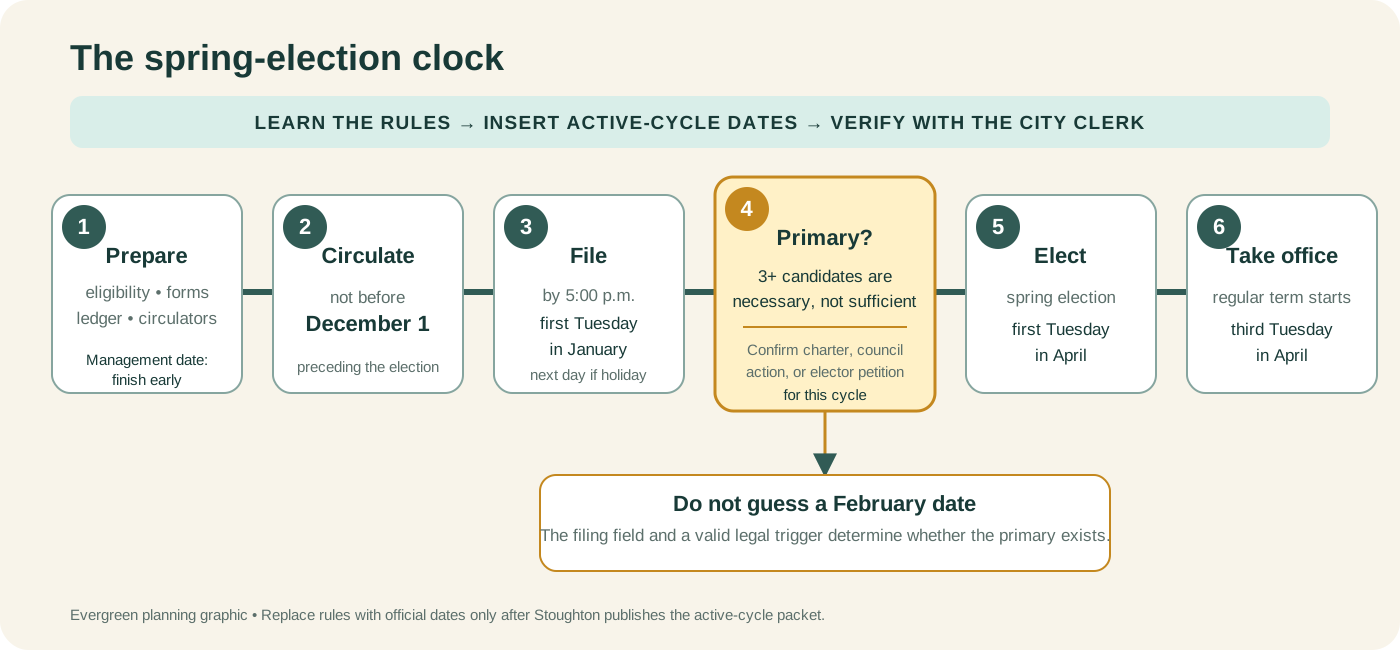
The spring election clock for a Stoughton mayoral run: preparing before circulation, nomination papers from December 1, filing by 5 p.m. on the first Tuesday in January, when a February primary is actually triggered, the April election, and the term starting the third Tuesday in April.
- 7 min
- 10 steps
- 3 questions
- Lesson 16 of 21
In this lesson
- Current snapshot: July 14, 2026
- The six checkpoints
- Build a runway without guessing dates
- Practical drill: make the one-page control sheet
Picking up where you left off.
Wisconsin municipal races run on a spring clock, separate from the November partisan cycle. For a Stoughton mayoral candidacy, memorize the sequence before memorizing dates:
Prepare → Circulate → File → Primary if triggered → Elect → Take office
Only some of those checkpoints have the same calendar date every year. The safe habit is to learn the legal rules, then replace them with the exact dates and instructions in the active-cycle packet from the Stoughton City Clerk and Wisconsin Elections Commission 1 2.
This lesson is educational, not legal advice. Election rules, forms, and local procedures can change. Confirm the live cycle with the filing officer before acting.
Current snapshot: July 14, 2026
Dane County’s 2026 reporting page lists Tim Swadley with the leading total, while the City’s official mayor page identifies him as the current mayor 3 4. The Dane County page’s disclaimer treats municipal figures as unofficial, so ask the Stoughton City Clerk for the legal certification. The City also says the mayor serves a four-year term 4.
Putting those two facts together makes spring 2030 the expected next regular mayoral race. That is an inference, not an announced election cycle. A vacancy, legal change, charter change, or corrected local record could alter the practical path. As of this lesson’s verification date, there is no reason to invent exact 2030 filing or election dates. Wait for the City Clerk’s cycle-specific notice and packet 5.
The six checkpoints
1. Prepare before circulation opens
Autumn is for decisions that do not require petition signatures: verify eligibility and residence, speak with the Clerk, obtain current forms, choose a consistent ballot name, set up recordkeeping, recruit trained circulators, and proof the EL-169 header. Do not treat preparation as campaigning without consequences: receiving a contribution, making a campaign disbursement, or filing nomination papers can trigger committee-registration duties 2.
Rule of thumb: be administratively ready at least eight weeks before circulation may begin. That is a planning buffer, not a statutory deadline.
2. Circulate no earlier than the legal opening
For a regular spring election, Wisconsin law says nomination papers may not circulate before December 1 preceding the election 6. A signature collected early is not rescued by filing it later. The active packet should state the opening date and identify the correct version of EL-169.
Think D1 = Door opens: December 1 is the earliest ordinary opening, not a promise that every future local circumstance is unchanged.
Quick check
Signatures collected early don’t count.
3. File by the statutory deadline
Nomination papers for a regular spring election are due to the proper filing officer by 5:00 p.m. on the first Tuesday in January, together with the other required ballot-access material 6. For Stoughton municipal office, begin with the City Clerk and follow the Clerk’s current submission instructions 1.
If that Tuesday is a holiday, the statutory deadline moves to the next day. A separate 72-hour extension can apply to non-incumbents when an incumbent fails to file without having submitted the timely statutory noncandidacy notice 6. Treat both as Clerk-administered exceptions, not self-granted time: rely on the Clerk’s published determination and the active WEC notice before using either one 1 2.
Do not plan to arrive at 4:58 p.m. A complete packet filed several business days early leaves time to correct a problem that is legally correctable. Get a dated receipt or other confirmation of delivery and retain a complete scan.
4. Treat the February primary as conditional
The familiar shortcut—“three candidates means a primary”—is incomplete for a Wisconsin city office. For one mayoral seat, three or more candidates are necessary but not sufficient. State law allows a city primary only when the field exceeds twice the number to be elected, but a trigger must also exist 7. For a single seat:
- If two or fewer candidates file, no primary may be held for that office.
- If three or more file, a primary may occur if a majority of the city governing body orders one for that election within the statutory window.
- A city may instead have a charter ordinance that requires a primary whenever three or more candidates file.
- Electors may trigger a primary through a timely petition meeting the statute’s signature threshold and form requirements.
The statute places the governing-body and elector-petition decisions within three days after the nomination-paper deadline 7. Therefore, do not print a February date on campaign material merely because a third candidate appears. Ask the Clerk whether Stoughton has an applicable charter provision, council action, or valid petition for that cycle. When properly triggered, the spring primary is held on the third Tuesday in February and narrows the field for April 7.
Quick check
Three or more candidates is necessary but not sufficient for a city primary.
5. Vote at the spring election
The regular spring election is held on the first Tuesday in April. Use the live Stoughton election notice for the exact date, polling information, and any local changes 5. The legal filing deadline and Election Day are connected by a long compliance interval: campaign-finance reports, attributions, and recordkeeping do not wait until April.
6. Begin the term on the statutory start date
Winning Election Night is not the same as beginning the term. Results proceed through canvass and certification, and city officers must qualify for office. Wisconsin law provides that the regular term of a mayor begins on the third Tuesday in April in the election year 8. The oath is a separate qualifying requirement; coordinate it with the Clerk rather than improvising a ceremony 8.
Quick check
The oath must be taken and filed within 10 days after notice of election.
Build a runway without guessing dates
Let F be the filing deadline confirmed in the active packet. Build backward:
- F − 8 weeks: forms and eligibility checked; circulator list drafted.
- F − 6 weeks: EL-169 header reviewed; collection routes and indoor backup locations ready.
- Circulation opening: begin only when the legal window opens.
- F − 2 weeks: audit every sheet and compare the valid-signature estimate with the official minimum, ordinary initial-review maximum, and Clerk instructions for additional signatures.
- F − 3 business days: internal target for a complete filing.
- F: legal deadline; no unfinished task should remain.
This creates two clocks: the legal clock, which cannot move, and the management clock, which finishes early. A campaign that uses only the legal clock has no recovery time.
Practical drill: make the one-page control sheet
Create a sheet with six rows: circulation opens, filing deadline, primary decision confirmed, primary if triggered, spring election, term begins. For each row add four columns:
- The rule in plain language.
- The exact active-cycle date, left blank until officially published.
- The authoritative source and the date you checked it.
- The person responsible for confirming completion.
Then add a red banner: “Three candidates do not automatically prove a city primary.” Finally, schedule a Clerk check at three moments: before money moves, before any EL-169 circulates, and before the packet is filed. That one-page sheet becomes the control panel for the rest of the campaign.
Lesson complete
Nice work.
Sources for this lesson
- 1City Clerk. City of Stoughton, Wisconsin. verifiedOfficial Clerk contact page. The Clerk is the first stop for cycle-specific local candidate instructions. Cited at: official filing contact.
- 2Local Candidates. Wisconsin Elections Commission. verifiedCurrent municipal ballot-access manuals, checklists, forms, and candidate guidance. Cited at: current municipal-candidate materials; local candidate guidance.
- 32026 Spring Election Results — Stoughton Mayor. Dane County Clerk. 2026. verifiedStable Dane County reporting page listing 3,534 votes for Tim Swadley and 106 write-in votes. Although the race heading includes "Official Canvass," the page-wide disclaimer says municipal results are unofficial; obtain the legal certification from the Stoughton City Clerk. Cited at: 2026 Stoughton mayor results.
- 4Mayor. City of Stoughton, Wisconsin. verifiedOfficial description of the mayor's local responsibilities, current officeholder, and contact information. Cited at: current mayor; term.
- 5Upcoming Election. City of Stoughton, Wisconsin. verifiedCurrent local election dates, polling hours, and voter information; changes with each election. Cited at: current election notices.
- 6Wisconsin Statutes § 8.10 — Nominations for Spring Election. Wisconsin State Legislature. verifiedNomination-paper circulation, filing deadlines, signatures, and filing procedure. Cited at: § 8.10(2); § 8.10; § 8.10(2)(a).
- 7Wisconsin Statutes § 8.11 — Spring Primary. Wisconsin State Legislature. verifiedConditions under which a city spring primary is held and how candidates advance. Cited at: § 8.11(1); § 8.11(1)(a)–(c).
- 8Wisconsin Statutes § 62.09 — City Officers. Wisconsin State Legislature. verifiedQualifications, oath, term commencement, and mayoral powers and duties. Cited at: § 62.09(5)(a); § 62.09(4).