Campaign Finance Basics
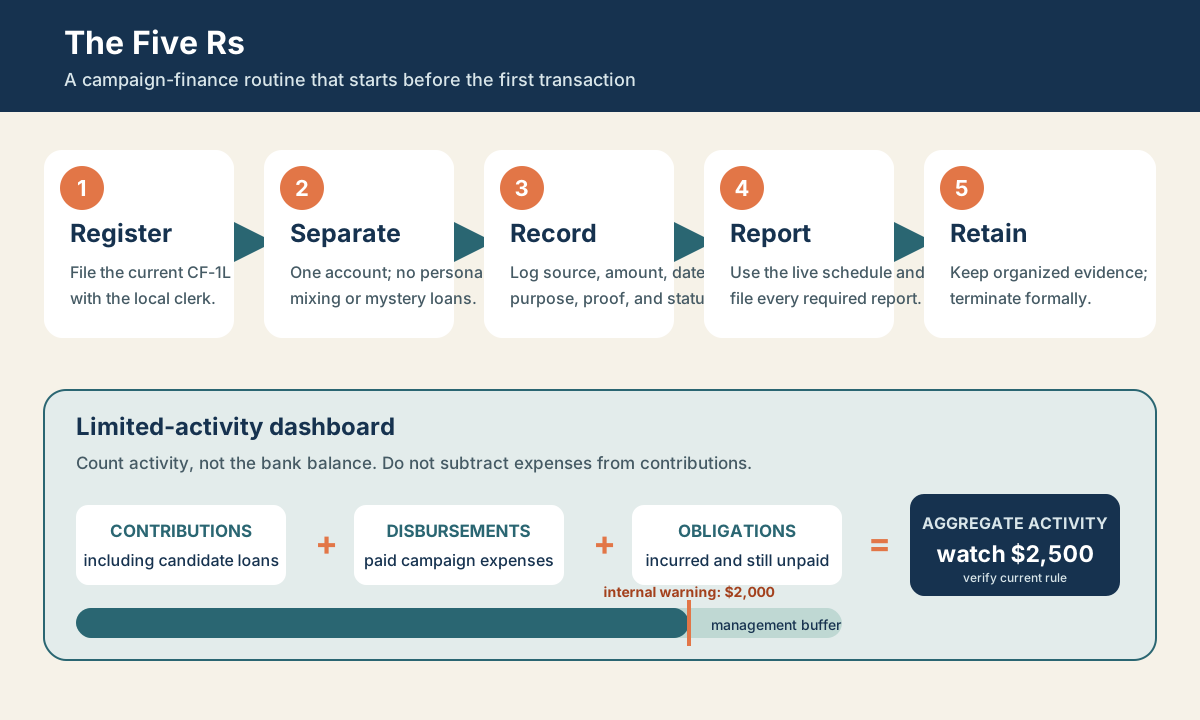
Wisconsin campaign finance for a local candidate as five habits: register before money moves, keep a separate account, record both sides of the $2,500 limited-activity test, report on the live calendar with proper attribution, and retain records and terminate correctly.
- 7 min
- 8 steps
- 3 questions
- Lesson 19 of 21
In this lesson
- R1 — Register before the campaign operates
- R2 — Separate campaign and personal activity
- R3 — Record both sides of the $2,500 test
- Know limits and prohibited sources before asking
- R4 — Report on the live calendar
- R5 — Retain, reconcile, and close correctly
- Five-minute treasurer drill
Picking up where you left off.
Campaign finance is public bookkeeping with legal consequences. The useful mental model is not “forms at the end” but Five Rs from the start: Register, Separate, Record, Report, Retain. Wisconsin’s Ethics Commission publishes the statewide rules and forms; a Stoughton mayoral candidate files local registration and reports with the City Clerk, not with the Ethics Commission 1. Use the city’s official Clerk page for the current local contact 2.
This lesson is a planning guide, not legal advice. Forms, reporting dates, population figures, and limits can change. Before accepting money, spending, or filing for ballot access, obtain the active-cycle packet and written instructions from the Clerk.
R1 — Register before the campaign operates
Use the current CF-1L Local Candidate Registration Statement to identify the candidate, committee, treasurer, bank, and exemption choice. The state overview describes a $0 registration threshold: registration is triggered when a person meets any listed condition, including receiving a contribution, making a campaign disbursement, filing nomination papers, or holding office 1. The current CF-1L is linked from the Ethics Commission, but the completed local form belongs with the local filing officer 3.
Practical rule: make registration the gate. Do not collect a first check, buy a domain, reimburse a volunteer, or order signs and plan to repair the paperwork later. Ask the Clerk to confirm receipt and keep a dated copy. Name a treasurer who will actually reconcile records; the title is not ceremonial.
R2 — Separate campaign and personal activity
Use a dedicated campaign account and a campaign-only ledger. Never use the account as a personal wallet, and do not treat a candidate-funded purchase as invisible. Candidate contributions and loans are campaign activity; candidate loans also count toward the limited-activity calculation 4.
Create a simple approval path:
- A purchase is proposed with a campaign purpose.
- The treasurer checks the balance, source restrictions, and exemption total.
- One authorized account pays it.
- The receipt and invoice are attached to a ledger entry.
- A second person reviews the monthly reconciliation.
This is internal control, not a statutory recipe. It prevents double payments, missing receipts, and the dangerous sentence, “I think I paid that personally.”
R3 — Record both sides of the $2,500 test
A qualifying local candidate committee may claim the limited-activity exemption from periodic reports while its aggregate activity stays within the rule. The test is not revenue minus expenses. It counts contributions accepted plus disbursements made; incurred debts and obligations are included. Candidate contributions and loans count too 4.
Use this dashboard:
Aggregate activity = contributions + disbursements + unpaid obligations not already counted
Avoid double-counting an invoice as both a paid disbursement and an unpaid obligation. The ledger should show its status.
Threshold drill. Suppose the committee has $1,350 in outside contributions, a $600 candidate loan, $400 in paid expenses, and a $175 unpaid printer invoice. Its aggregate activity is:
$1,350 + $600 + $400 + $175 = $2,525
The bank may still contain $1,550, but the exemption test is already over $2,500. The Ethics Commission says a local candidate’s exemption continues until the committee exceeds the threshold, changes status, or dissolves. After exceeding it, an amended registration should be filed within 10 days and reports for that calendar year are required 4.
Rule of thumb: set an internal warning at $2,000, not $2,499. That $500 buffer is a management choice, not law; it gives the treasurer time to price an order, include an obligation, and prepare reporting.
Minimum ledger fields are date, payer or contributor, full name and address where required, amount, method, purpose, invoice or receipt link, deposit date, obligation status, and running exemption total. Reconcile the ledger to the bank statement every month and weekly during the final six weeks.
Quick check
The test adds contributions, disbursements, and obligations, including candidate loans.
Know limits and prohibited sources before asking
Contribution limits apply cumulatively across the primary-and-election campaign, whether or not a primary is contested 5. The current official table uses the office’s applicable population:
- For a local district of 25,000 or fewer, the listed individual and candidate-committee limit is $500.
- For a local district of 20,000 or fewer, the listed PAC-and-other-person limit is $400.
- Above those cutoffs, formulas apply, subject to caps.
For mayor, the district is citywide, but do not infer the controlling population from a search result. The official table specifies the latest federal census or the census information on which the district is based. Ask the Clerk which population figure and limit table govern the active cycle, then put those verified limits in the donor form and treasurer checklist.
Screen the source as well as the amount. Corporations, associations, labor unions, and American Indian tribes may not contribute to candidate committees, and foreign-national contributions are prohibited. An anonymous donation may not exceed $10; if one greater than $10 is accepted, the entire anonymous donation must go to a charity or the Wisconsin Common School Fund. Cash above $100 is not accepted as cash and must instead use a negotiable instrument such as a check 6. When uncertain, pause the deposit and ask the filing officer.
Quick check
An anonymous gift over $10 must go entirely to charity or the Common School Fund.
R4 — Report on the live calendar
An exemption excuses periodic reports, not registration or records. A nonexempt local spring candidate follows the Ethics Commission’s local schedule for the year on the ballot. A local candidate without a spring primary does not file a pre-primary report; continuing and pre-election obligations still depend on the committee’s status and current schedule 7. Do not copy dates from a prior race. Enter the Clerk-confirmed deadlines in two calendars, with reminders 14, 7, and 2 days before each filing.
Communications are part of compliance too. When a committee pays for express advocacy, the Ethics Commission generally requires a readable attribution identifying the full committee, commonly “Paid for by [registered committee name].” The rules include format requirements and limited exceptions for certain small items and electronic communications 8. Put attribution review on the proofing checklist before printing or publishing.
Quick check
Format rules and limited exceptions apply.
R5 — Retain, reconcile, and close correctly
Keep contribution records, deposit images, invoices, receipts, bank statements, approvals, reports, amendments, and filing confirmations organized and legible for the required retention period, including while exempt 4. Ask the Clerk for the precise retention rule that applies to the committee; do not delete records just because election day passed.
A committee also does not disappear when the campaign ends. Pay or resolve obligations, reconcile the account, dispose of any residual funds only by an allowed method, file every due report, and use the current termination process. The Ethics Commission currently identifies CF-13 attached to CF-2L or CF-2LE for local committee termination 1. Until termination is accepted, keep monitoring filing duties.
Five-minute treasurer drill
For each proposed transaction, say the Five Rs aloud:
- Register: Is the committee’s current CF-1L on file?
- Separate: Will one campaign account handle it?
- Record: Who, when, how much, why, and what proof?
- Report: Does it change exemption status or a due report?
- Retain: Where will the permanent evidence live?
If any answer is “unknown,” stop the transaction. In campaign finance, a short pause is cheaper than reconstruction.
Lesson complete
Nice work.
Sources for this lesson
- 1Candidate Committee Overview. Wisconsin Ethics Commission. verifiedCurrent overview of registration, reporting, records, and termination for candidate committees. Cited at: Local Candidates; Who Needs to Register a Candidate Committee?; Committee Termination.
- 2City Clerk. City of Stoughton, Wisconsin. verifiedOfficial Clerk contact page. The Clerk is the first stop for cycle-specific local candidate instructions. Cited at: official contact.
- 3CF-1L Local Candidate Registration Statement. Wisconsin Ethics Commission. verifiedCurrent fillable local candidate registration form at verification; always retrieve a fresh copy for the active cycle. Cited at: current form.
- 4Limited Activity Exemption. Wisconsin Ethics Commission. verified$2,500 aggregate-activity threshold, recordkeeping, amendment, and termination guidance. Cited at: Exemption Eligibility; Maintaining Records During Exemption.
- 5Contribution Limits. Wisconsin Ethics Commission. verifiedCurrent limit tables; local-office limits depend on the applicable population bracket. Cited at: Limits for All State and Local Offices.
- 6Prohibited Contributions. Wisconsin Ethics Commission. verifiedRules for prohibited sources, anonymous contributions, cash, and foreign nationals. Cited at: Corporations and Unions; Limit on Anonymous Contributions; Limit on Cash Contributions.
- 7Campaign Finance Report Periods. Wisconsin Ethics Commission. verifiedCurrent reporting calendar; dates vary by year and by whether a primary is held. Cited at: When is a Committee Required to File?.
- 8Attribution Requirements. Wisconsin Ethics Commission. verifiedCurrent paid-for-by requirements and limited exceptions for campaign communications. Cited at: Which Communications Require an Attribution?; Attribution Formats.