Gathering and Auditing Nomination Signatures
Collecting nomination signatures that survive review: getting the official minimum and maximum, sizing a buffer from your own error rate, locking the EL-169 header, checking every signer row, the circulator's certification, and a same-day audit.
- 7 min
- 8 steps
- 3 questions
- Lesson 18 of 21
In this lesson
- Retrieve the official minimum and initial-review maximum
- Calculate a quality-based buffer
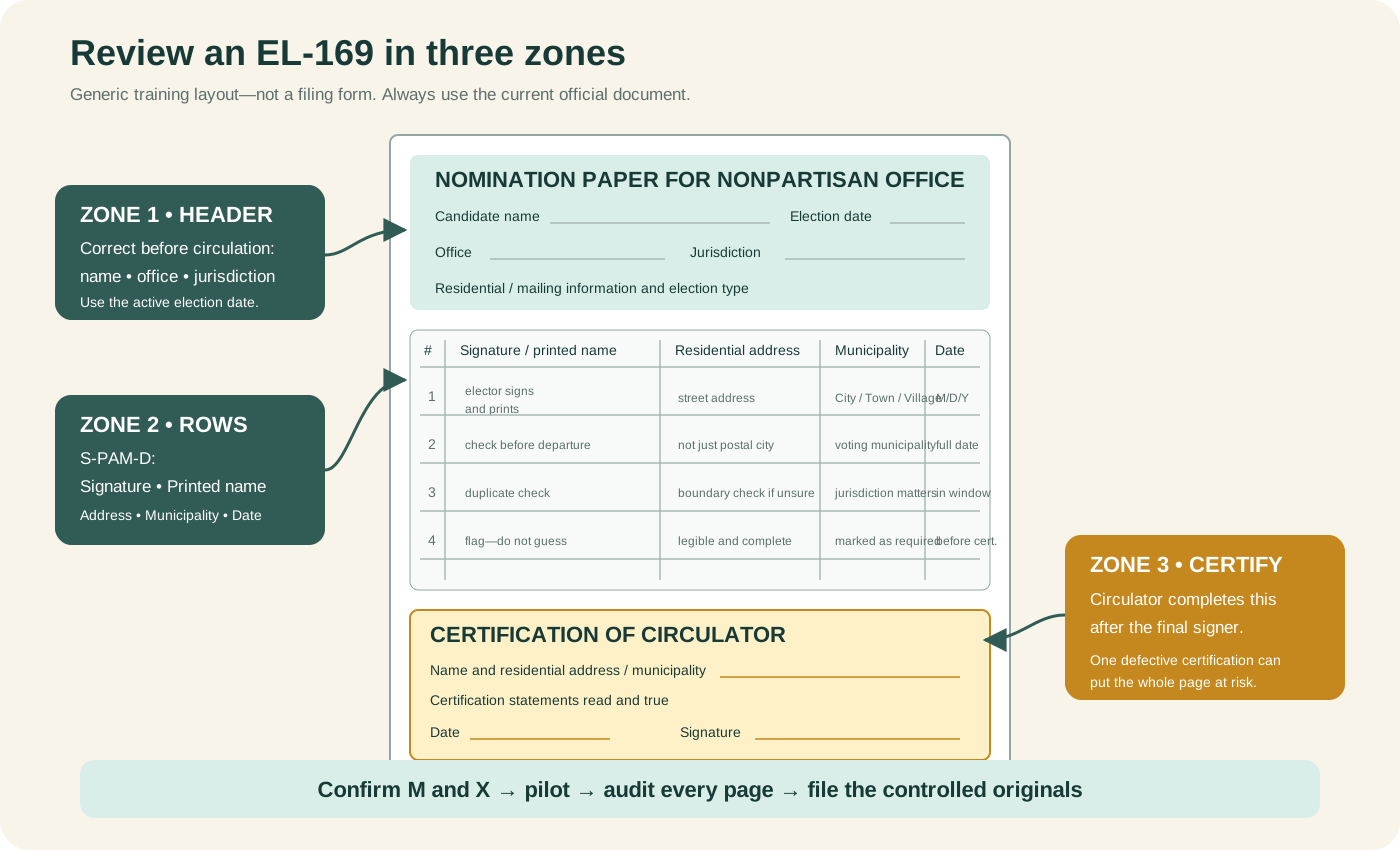
- Zone 1: lock the header before circulation
- Zone 2: inspect every signer row
- Zone 3: protect the circulator certification
- Use a same-day audit loop
- Validation drill
Picking up where you left off.
Nomination papers are legal records, not a popularity poll. They must show enough valid support and be organized for official review:
Confirm the range → prepare the page → train the circulator → inspect every line → file only the controlled set
This lesson does not state a Stoughton mayoral signature number. Statutory ranges depend on the office and city classification 1. The available 2025 Stoughton packet is for alderperson, not a future mayoral race 2. Until the Clerk confirms a cycle-specific mayoral range, any number would be an assumption.
This is educational material, not legal advice. Use the current EL-169, candidate checklist, statutes, and written direction from the Stoughton City Clerk 3 4.
Retrieve the official minimum and initial-review maximum
Use a five-step source check before setting a collection target:
- Name the office and cycle. Write “Mayor, City of Stoughton” and the regular spring-election year.
- Obtain the active local packet. Ask for the minimum, initial-review maximum, circulation opening, deadline, and instructions for additional signatures.
- Download the current WEC municipal checklist and EL-169. Record each document’s revision date 3.
- Cross-check the law. Locate the part of § 8.10 the filing officer says applies, including the classification used 1.
- Preserve the answer. Save the dated source. Record the minimum as M and ordinary initial-review maximum as X.
If the packet, checklist, and verbal answer disagree, do not choose the most convenient number. Send the conflict to the Clerk and request clarification in writing.
Calculate a quality-based buffer
The official minimum is not a sensible collection target because some lines may fail review. Build a planning target from your own observed error rate:
where:
- M is the Clerk-confirmed minimum valid signatures;
- r is the fraction of lines flagged in an early quality audit; and
- R is a small operational reserve, such as one clean sheet’s capacity.
Then compare T with X, the ordinary initial-review maximum. Wisconsin law expressly contemplates a candidate submitting more than that number: under § 8.10(7), the filing officer initially reviews a statutory subset and may examine additional submitted signatures when the first set does not contain the required minimum 1. The exact selection and review procedure belongs to the filing officer. If T exceeds X, or if collection produces additional valid pages, ask the Clerk how to order, label, and submit them. Do not discard otherwise valid signatures merely to force the packet down to X without Clerk direction.
Rule of thumb: estimate the buffer after a pilot, not from folklore. “Always collect 25 percent extra” can be too little or unnecessarily burdensome. Past X, extra signatures may not be part of the first review, but they can still matter under § 8.10(7); follow the current packet and Clerk’s instructions.
Quick check
T = ⌈M / (1 − r)⌉ + R.
Zone 1: lock the header before circulation
The top of every EL-169 identifies what the signer is supporting. Complete it under the current form instructions before circulation. Check candidate name, residential and mailing information, election type, election date, title of office, and jurisdiction. The spring-election date—not a speculative primary date—normally belongs where the form requests the election date; follow the live packet 3.
Match the candidate name on the CF-1L and EL-162. Number pages, inspect print margins, and send a clean sample to the Clerk before making circulation copies. Never assume a signed header can be repaired.
Remember H-O-J: Header, Office, Jurisdiction.
Zone 2: inspect every signer row
For a citywide mayoral office, signers must be qualified electors of the jurisdiction the mayor would represent 1. A Stoughton mailing address is not automatically proof that a residence lies in the City of Stoughton; nearby town addresses can share a postal city. When uncertain, flag the address for boundary verification rather than assuring the signer it counts.
Each row should be legible and complete under the current EL-169 instructions and Wisconsin’s signer requirements 1:
- the elector’s own signature;
- the elector’s legibly printed name next to it;
- full residential address;
- municipality of residence for voting purposes, marked as town, village, or city as required; and
- month, day, and year of signing.
Only signatures made during the lawful circulation window can count. A missing or impossible date, an incomplete address, an out-of-jurisdiction residence, or a duplicate signature for the same office can put a line at risk 1 3. Do not “fix” a signer’s entry from memory. Mark it for review and follow the official correction rules or recollect a clean signature while the window remains open.
Use S-PAM-D at the door: Signature, Printed name, Address, Municipality, Date. Check the row before the signer leaves.
Quick check
S-PAM-D: Signature, Printed name, Address, Municipality, Date.
Zone 3: protect the circulator certification
The circulator is not a courier. The current EL-169 certification requires the circulator to be legally qualified under the form, personally circulate the page and obtain its signatures, know the signers are electors of the jurisdiction, know their residences and signing dates, intend to support the candidate, and acknowledge the penalty for a false certification 3. The candidate may circulate, but every circulator must meet the current qualification language.
After the last signature on a page is collected, the circulator completes the certification with name, residential address and municipality, certification date, and signature. The certification date cannot precede a signer’s date on that sheet. An incomplete or premature certification can endanger every line on the page.
Train with P-A-S-T:
- P — Personally present and obtain the signatures.
- A — After collection, certify the page.
- S — Sign the certification completely.
- T — Tell the truth about what the certification asserts.
Quick check
The certification must also be dated after the last signature.
Use a same-day audit loop
Assign each page a number and a circulator. When a page returns, a reviewer who did not circulate it checks all three zones with a colored pencil or audit copy—never by writing over original signer information. Record each line as clean, flagged, or duplicate check needed. Maintain a separate signer index to detect repeat names and addresses.
Return flagged pages for official guidance or clean recollection promptly. Do not wait until filing day. Have the document controller inventory every sheet, distinguish the initial-review set from any additional sheets as the Clerk directs, and scan the exact originals delivered. Never remove otherwise valid extras solely because the total exceeds X without first following the filing officer’s instructions 1.
Validation drill
Assume the correct header and circulation window have already been confirmed. For each entry, choose clean or flag for review:
| Entry | What you see |
|---|---|
| A | Signature, readable City of Stoughton residence, municipality marked City, full date |
| B | Stoughton postal address, but municipality box left blank |
| C | Complete address and municipality, but no signing year |
| D | Complete row; same elector already appears on another page for this office |
| E | Complete row dated after the circulator’s certification date |
| F | Complete row, but residence appears just outside the city boundary |
Answer key: A is the model. Flag B for municipality, C for date, D for duplicate review, E for certification chronology, and F for jurisdiction. “Flag” means the campaign should not count the line as safely valid until official rules resolve it.
Finally inspect the page certification. A sheet of ten perfect signer rows with an unsigned circulator certificate is not ten safe signatures. Review Header → Rows → Certification, plan from M, compare the target with X, and let the current filing-officer procedure govern any additional signatures.
Lesson complete
Nice work.
Sources for this lesson
- 1Wisconsin Statutes § 8.10 — Nominations for Spring Election. Wisconsin State Legislature. verifiedNomination-paper circulation, filing deadlines, signatures, and filing procedure. Cited at: § 8.10(3); § 8.10(7); § 8.10(4); § 8.10(4)(b); § 8.10(2) and (4).
- 22025 Stoughton Alderperson Candidate Packet. City of Stoughton, Wisconsin. 2024. verifiedHistorical local example containing forms and instructions. It is alderperson-specific and must not substitute for a future mayoral packet.
- 3Local Candidates. Wisconsin Elections Commission. verifiedCurrent municipal ballot-access manuals, checklists, forms, and candidate guidance. Cited at: EL-169 instructions; nomination-paper guidance; EL-169.
- 4City Clerk. City of Stoughton, Wisconsin. verifiedOfficial Clerk contact page. The Clerk is the first stop for cycle-specific local candidate instructions.