Register, Declare, Nominate, Disclose
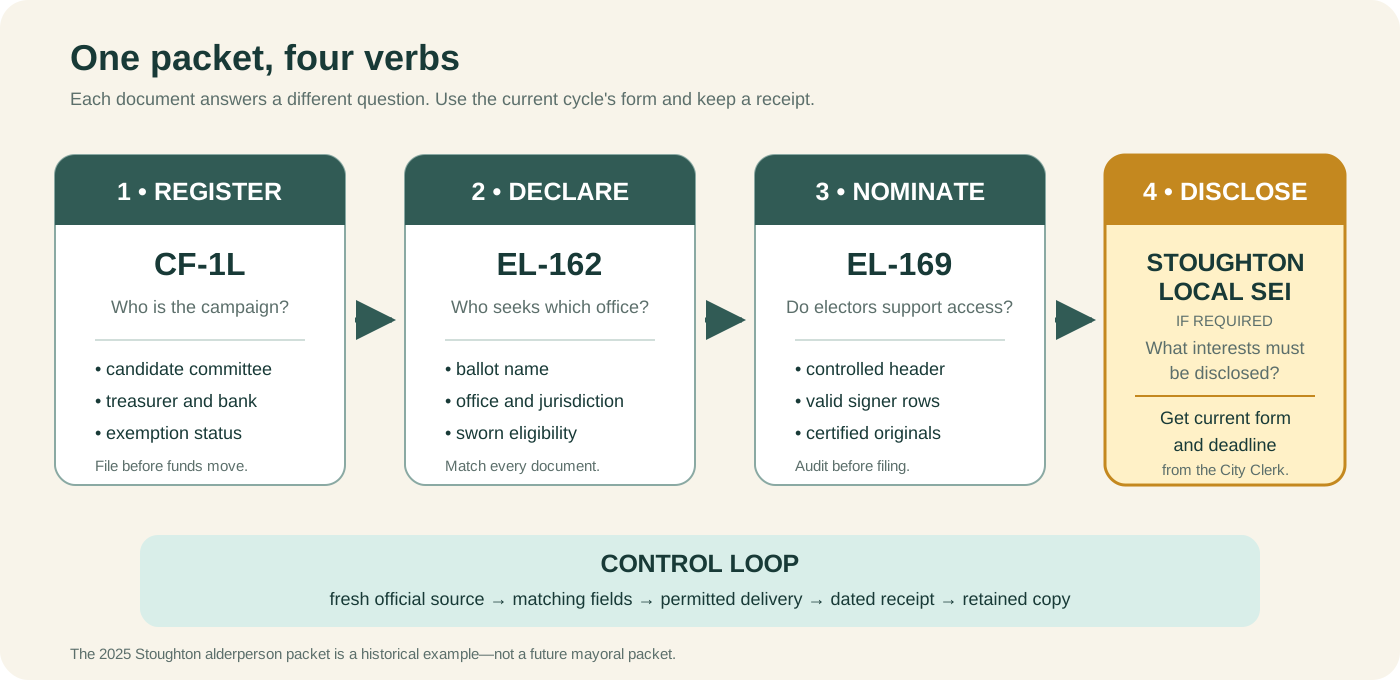
The ballot-access packet as four verbs: register the committee (CF-1L), declare candidacy (EL-162), nominate with electors (EL-169), and disclose local interests on Stoughton's own form, with cross-document consistency as the main control.
- 7 min
- 8 steps
- 3 questions
- Lesson 17 of 21
In this lesson
- 1. Register the campaign: CF-1L
- 2. Declare the candidacy: EL-162
- 3. Nominate with electors: EL-169
- 4. Disclose local interests: Stoughton’s form
- Build one controlled packet
- Preflight checklist
- Practical drill: find the mismatch
Picking up where you left off.
A municipal ballot-access packet is easier to manage as four verbs:
Register → Declare → Nominate → Disclose
The first three are the standard Wisconsin municipal-candidate filings. Stoughton’s 2025 alderperson packet added a local public statement of economic interests; confirm whether the active mayoral cycle does the same. Each document answers a different question; none substitutes for another. Submit the current required filings to the Stoughton City Clerk, the local filing officer, under the instructions and deadline for the active mayoral cycle 1 2 3.
Forms, revision dates, delivery rules, and local deadlines can change. Download fresh copies only after the Clerk releases the active-cycle packet. This lesson is educational, not legal advice.
1. Register the campaign: CF-1L
The CF-1L Local Candidate Registration Statement creates or updates the candidate committee’s official record. It identifies the candidate, office, committee, treasurer, financial institution, and any limited-activity exemption claimed. Use the current fillable form supplied by the Wisconsin Ethics Commission 4.
The registration trigger is broader than “I have started advertising.” State guidance says a local candidate must register as soon as practicable after filing nomination papers, receiving a contribution, or making a disbursement to support the candidacy. The municipal ballot-access checklist also requires a current registration before raising or spending campaign funds 5 6. Register early enough that no campaign transaction occurs first.
Local candidates file the CF-1L with the local filing officer—not with the Wisconsin Ethics Commission 3. Keep a copy of the signed form and record the date the Clerk received it. If the treasurer, bank, address, or exemption status changes, use a current CF-1L to amend the registration.
The limited-activity exemption is not permission to ignore records. It can excuse periodic reports while the committee remains eligible, but contributions, candidate loans, disbursements, and incurred obligations all count toward the current aggregate-activity threshold. The Ethics Commission currently states that the exemption is available only while aggregate activity does not exceed $2,500 in a calendar year 7. Maintain a ledger from the first transaction even if you expect a tiny campaign.
Mnemonic: R = Record before resources move.
Quick check
Local candidates file it with the City Clerk, not the Ethics Commission.
2. Declare the candidacy: EL-162
The EL-162 Declaration of Candidacy is the candidate’s sworn declaration for a specific office. It is about the candidate’s identity, desired ballot name, residence, office, jurisdiction, and eligibility—not about campaign money and not about petition support. Retrieve the current EL-162 through the Wisconsin Elections Commission or the Clerk’s packet 6.
Copying is where preventable errors begin. Write the candidate name the same way on the CF-1L, EL-162, and every EL-169 header. Use Mayor, the correct City of Stoughton jurisdiction, and the election date specified by the active packet. Do not use the February primary date where a form requests the spring election date. Follow the form’s current signature, oath, witness, and delivery instructions exactly; do not rely on how an older form was signed.
Before signing, run a N-O-J check:
- N — Name: identical ballot-name treatment across the packet.
- O — Office: correct title, with no alder district accidentally carried over.
- J — Jurisdiction: City of Stoughton, not a mailing municipality or school district.
Quick check
EL-169 is the nomination paper; CF-1L registers the committee.
3. Nominate with electors: EL-169
The EL-169 Nomination Paper for Nonpartisan Office demonstrates support from enough qualified electors of the jurisdiction. Unlike the other forms, it must be prepared before circulation, carried into the community, signed during the lawful window, certified page by page by circulators, audited, and filed as original papers 6.
Never begin with a blank or guessed header. Populate the candidate name, residential and mailing information, election type and date, office, and jurisdiction exactly as the active instructions require. Ask the Clerk to review a clean sample before anyone signs it. Once signatures attach to a defective header, recreating the page means recollecting those signatures.
The next lesson covers signer and circulator validity. At the packet level, remember three controls:
- Use the current official EL-169.
- Circulate only during the authorized window.
- File the signed originals by the deadline and keep scans for your records.
Mnemonic: N = Names nominate; neat pages survive review.
4. Disclose local interests: Stoughton’s form
Stoughton has used a City of Stoughton Public Statement of Economic Interests in its municipal candidate packet under the city’s ethics rules. The form asks for disclosures or a waiver declaration and is returned to the City Clerk 1 8. Treat it as a separate local requirement, not as part of the CF-1L.
There is an important currency warning: the packet available in the course references is the 2025 Stoughton alderperson packet. It is useful evidence of the city’s filing workflow, but it is not a future mayoral packet. Do not reuse its dates, office label, signature range, or form copies. Ask the Clerk for the current mayoral statement, who must file it, its deadline, whether a waiver option remains available, and how amendments are handled.
Mnemonic: D = Disclose on the City’s current document.
Build one controlled packet
Create a folder named with the office and cycle, then use four subfolders matching the four verbs. For every document, preserve:
- the blank original and its revision date;
- the completed review copy;
- the signed filing copy;
- proof of delivery or a Clerk receipt; and
- correspondence answering any question about the form.
Use a packet index with five columns: document, official source, revision date, due date, and receipt. If any cell is blank, the packet is not ready. “I downloaded this last year” is not an official source, and “first Tuesday in January” is not an exact due date until the live cycle confirms it.
Preflight checklist
Run this check at least three business days before your internal filing target:
- [ ] The Clerk confirmed the office is expected on the active cycle’s ballot.
- [ ] Every form came from the current Clerk/WEC/Ethics source, not an old packet.
- [ ] Candidate name, office, jurisdiction, residence, and election date agree across forms.
- [ ] The CF-1L was filed before campaign receipts or spending, and any amendment is current.
- [ ] The campaign ledger includes contributions, candidate loans, spending, and obligations.
- [ ] The EL-162 is complete and executed under its current instructions.
- [ ] The Clerk reviewed a sample EL-169 header before circulation.
- [ ] Nomination pages are originals, page-numbered, audited, and reconciled to the confirmed minimum, initial-review maximum, and Clerk instructions for any additional signatures.
- [ ] If the Clerk requires a local statement of economic interests, the current form is complete under the Clerk’s instructions.
- [ ] Delivery method is permitted, the internal deadline is early, and a receipt plan exists.
Practical drill: find the mismatch
Imagine the CF-1L says “Alex M. Rivera,” the EL-162 requests “Alex Rivera,” and the EL-169 says “A. Rivera.” The EL-169 also lists the spring-primary date, and the local disclosure is copied from the 2025 alderperson packet.
Do not ask which single form is “close enough.” Stop the packet. Ask the Clerk how the ballot name must be made consistent, replace the guessed election date with the date required by the current form, and obtain the current Stoughton disclosure if the Clerk requires it. The drill’s lesson is simple: cross-document consistency is a ballot-access control, not cosmetic proofreading.
Register, Declare, Nominate, Disclose—then prove that every part came from the right cycle and reached the right filing officer on time.
Quick check
Cross-document consistency is a ballot-access control, not cosmetic proofreading.
Lesson complete
Nice work.
Sources for this lesson
- 12025 Stoughton Alderperson Candidate Packet. City of Stoughton, Wisconsin. 2024. verifiedHistorical local example containing forms and instructions. It is alderperson-specific and must not substitute for a future mayoral packet. Cited at: historical local packet; local statement and instructions.
- 2City Clerk. City of Stoughton, Wisconsin. verifiedOfficial Clerk contact page. The Clerk is the first stop for cycle-specific local candidate instructions.
- 3Candidate Committee Overview. Wisconsin Ethics Commission. verifiedCurrent overview of registration, reporting, records, and termination for candidate committees. Cited at: local candidates file with their local filing officer; local filing procedure.
- 4CF-1L Local Candidate Registration Statement. Wisconsin Ethics Commission. verifiedCurrent fillable local candidate registration form at verification; always retrieve a fresh copy for the active cycle.
- 5Campaign Finance Information for Filing Officers. Wisconsin Ethics Commission. verifiedCurrent local filing procedure, forms, and links to municipal ballot-access checklists. Cited at: candidate registration requirements.
- 6Local Candidates. Wisconsin Elections Commission. verifiedCurrent municipal ballot-access manuals, checklists, forms, and candidate guidance. Cited at: municipal ballot-access checklist; EL-169 and municipal checklist.
- 7Limited Activity Exemption. Wisconsin Ethics Commission. verified$2,500 aggregate-activity threshold, recordkeeping, amendment, and termination guidance.
- 8Code of Ordinances, Stoughton, Wisconsin. City of Stoughton and CivicPlus Municode. verifiedOnline municipal code, codified through Ordinance No. 039-2025 as of verification; confirm later amendments with the Clerk. Cited at: current municipal code.