Can You Run? Eligibility and Residency
The four checks before running for Stoughton mayor (CARE): qualified-elector status, actual residence inside the city at election time, voting rights after a felony sentence, and the separate constitutional pardon rule for holding office, with worked cases and a verification script.
- 7 min
- 8 steps
- 3 questions
- Lesson 3 of 21
In this lesson
- Gate 1: qualified-elector status
- Gate 2: actual residence inside Stoughton
- Gate 3: voting rights after a felony sentence
- Gate 4: the separate pardon rule for office
- Worked cases
- Your ten-minute verification script
- Final eligibility card
Picking up where you left off.
The baseline rule for a Wisconsin city office is compact but easy to oversimplify. At the time of election, a candidate must be a citizen of the United States and Wisconsin, an elector of the city, and actually residing there 1. For Stoughton mayor, “there” means inside the City of Stoughton, not merely in a Stoughton ZIP code, school district, or nearby town.
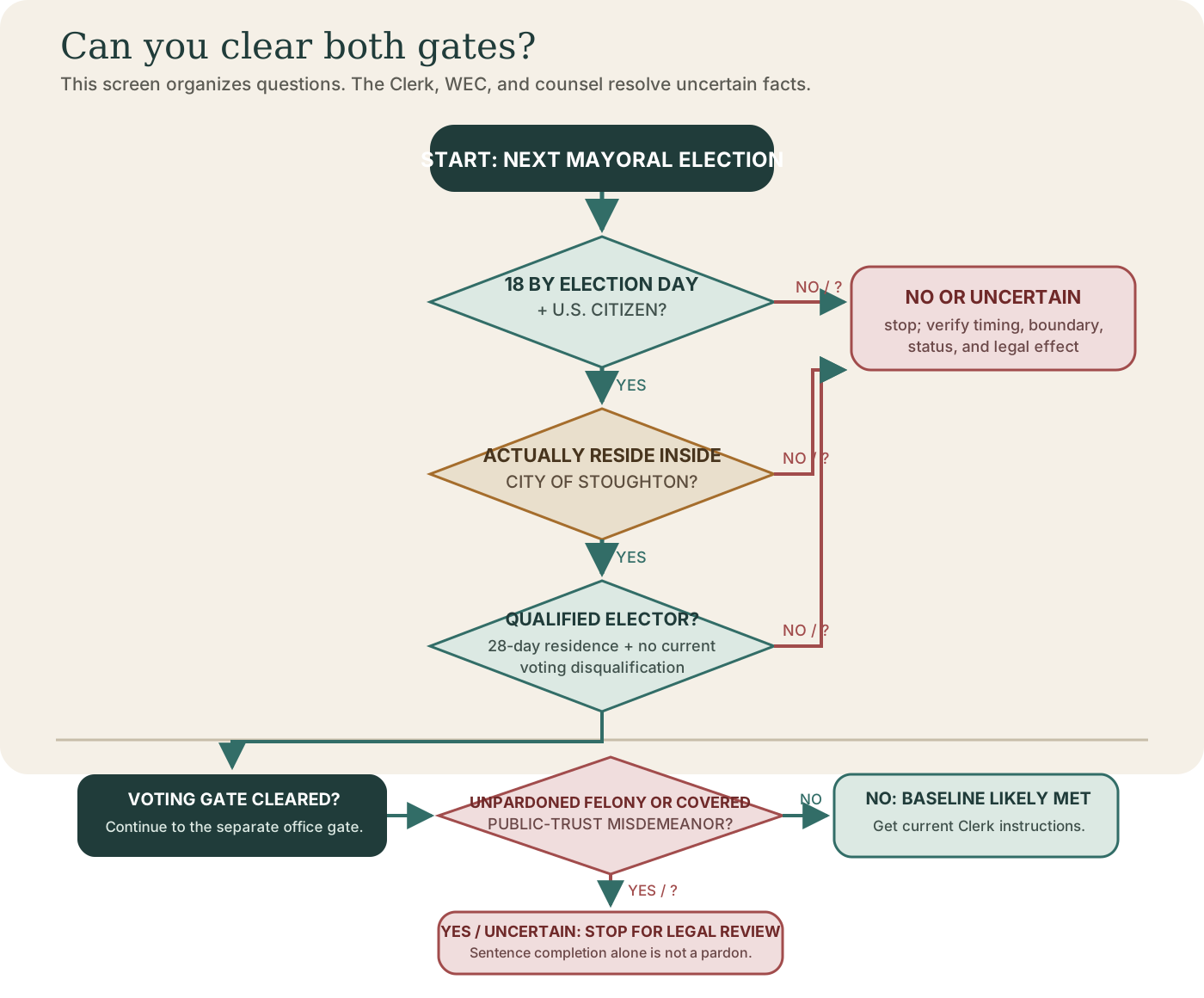
Use CARE to remember the four checks:
- C - Citizenship and age for qualified-elector status.
- A - Actual residence inside the city.
- R - Right to vote, including the 28-day residence rule and no current voting disqualification.
- E - Eligibility for office, a separate conviction-and-pardon check that is stricter than voting eligibility in an important set of cases.
This is educational, not legal advice. The City Clerk administers local filings, and the Wisconsin Elections Commission publishes current municipal candidate guidance 2 3. Ask before spending money or collecting signatures if any fact is uncertain.
Gate 1: qualified-elector status
Stoughton’s voter-registration guidance says a qualified voter must be a United States citizen, be at least 18 by Election Day, and have lived at the current address for at least 28 consecutive days before the election. A person must also not be currently disqualified from voting 4.
For a straightforward case, test four facts:
- Age: Will you be 18 on or before the mayoral election?
- Citizenship: Are you a United States citizen?
- Duration: Will your qualifying residence satisfy the 28-consecutive-day rule before that election?
- Voting status: Are you currently serving a felony sentence, subject to an applicable court adjudication of voting incompetence, or otherwise disqualified?
Wisconsin law does not permit denial merely because someone is alleged to be incapable of understanding the electoral process; the incompetence disqualification requires a Wisconsin adjudication 5. Do not infer it from a diagnosis, disability, need for assistance, or guardianship label alone. If a court order’s voting effect is unclear, take the order to the Clerk and qualified counsel.
Voter registration is a useful practical check, but do not use an old registration record as proof that every candidate requirement is satisfied. A move, name change, boundary issue, or unresolved disqualification may require correction. Check your record, then give the Clerk your exact residential address and election date.
Quick check
Plus U.S. citizenship, age 18 by Election Day, and no current disqualification.
Gate 2: actual residence inside Stoughton
Section 62.09 tests city-office residence at the time of election 1. A plan to move after winning is not enough. A mailing address that says “Stoughton” is not enough. The legal question is whether the place you actually reside is within the incorporated city’s boundary.
Create a small residency evidence file before filing:
- your exact street address, including unit number;
- the City or county map result showing the parcel inside Stoughton;
- the date you established the residence;
- your current voter-registration record; and
- the Clerk’s confirmation if the boundary or timing is not obvious.
Keep the file private. It is a way to catch a mistake early. Complex facts - temporary absence, multiple homes, a recent move, institutional residence, or disputed intent - go directly to the Clerk and qualified counsel.
Quick check
Nearby town addresses share the postal city.
Gate 3: voting rights after a felony sentence
Wisconsin’s voting rule and office-holding rule must be kept separate.
For voting, a person convicted of a felony is disqualified while serving the sentence, including applicable probation, parole, or extended supervision. Voting eligibility is restored after completion of the sentence under Wisconsin law; the person may still need to register again. The Elections Commission’s candidacy memorandum describes this voting-right restoration and then warns that a different constitutional rule controls candidacy 6.
Memory aid:
Sentence complete may reopen the voting gate. It does not automatically reopen the office gate.
If sentence status is unclear, do not rely on the phrase “off paper” alone. Obtain the relevant discharge documentation and ask the Clerk, WEC, or counsel what it establishes.
Gate 4: the separate pardon rule for office
For state or local elective office, Wisconsin’s constitution bars a person’s name from the ballot after a felony conviction in any court within the United States unless that conviction has been pardoned. The rule also reaches specified misdemeanors involving a violation of public trust. Completing the sentence, regaining the right to vote, or re-registering does not substitute for the required pardon 6.
That produces a result many short checklists miss:
| Situation | Voting question | Office-holding question |
|---|---|---|
| Currently serving a felony sentence | Voting disqualification applies | Not eligible under the candidate rules |
| Sentence completed, no pardon | Voting eligibility may be restored | Felony still bars state/local candidacy without a pardon |
| Pardon obtained | Recheck registration and all other voter rules | Recheck the pardon and candidate facts with officials or counsel |
Do not guess whether a conviction or clemency document qualifies. WEC directs candidates with conviction questions to appropriate legal guidance 6.
Quick check
Restored voting rights don’t reopen the office gate.
Worked cases
Case A: the ZIP-code trap
Jordan’s mailing address ends in “Stoughton, WI 53589,” but the parcel is in an adjacent town. Jordan is 40, registered, and has no disqualifying record.
Result: Stop at actual residence. A postal label does not establish city residence. Jordan should verify the municipal boundary with the Clerk and would need to actually reside inside the city by the legally required time before relying on eligibility.
Case B: a recent move
Alex moves to a home clearly inside Stoughton 35 days before the spring election and otherwise meets the voter requirements.
Result: The arithmetic appears to clear a 28-day rule: 35 - 28 = 7 days of cushion. Alex should still confirm the exact residence start date, election date, registration steps, and city-office rule with the Clerk. “Appears to” is not a filing decision.
Case C: voting rights restored, no pardon
Riley completed every part of a felony sentence years ago, re-registered, and lawfully votes. Riley has never received a pardon.
Result: Voting eligibility does not resolve candidacy. Under the separate office rule summarized by WEC, the unpardoned felony remains a bar to state or local elective office. Riley needs individualized legal guidance, not a nomination-paper strategy.
Your ten-minute verification script
Send a short email or make a call before acting:
I am considering candidacy for Mayor of Stoughton in the next regular election. My residential address is [address], and I established residence there on [date]. Please confirm which official should verify that the address is inside the city, which current candidate checklist and forms apply, and whether any additional local eligibility or disclosure requirement applies. I understand you cannot provide personal legal advice; please identify the authoritative source or referral for any question you cannot decide.
For a legal edge case, use a secure channel and ask who can give a professional answer; do not casually email sensitive records.
Final eligibility card
Before moving to ballot access, write yes, no, or needs verification beside each statement:
- I will meet age and citizenship requirements on Election Day.
- My actual residence is inside the City of Stoughton.
- I will satisfy the qualified-elector residence period.
- No current condition disqualifies me from voting.
- No unpardoned felony or covered public-trust misdemeanor bars my candidacy.
- The Clerk has identified the current, office-specific candidate materials.
Any “needs verification” is a task, not a failure. Resolve it before fundraising, circulating nomination papers, printing literature, or publicly announcing that you are legally eligible. Once every gate is supported by an authoritative answer, the campaign course can focus on the next problem: reaching the ballot lawfully.
Lesson complete
Nice work.
Sources for this lesson
- 1Wisconsin Statutes § 62.09 — City Officers. Wisconsin State Legislature. verifiedQualifications, oath, term commencement, and mayoral powers and duties. Cited at: subsec. (2)(a).
- 2City Clerk. City of Stoughton, Wisconsin. verifiedOfficial Clerk contact page. The Clerk is the first stop for cycle-specific local candidate instructions. Cited at: official contact.
- 3Local Candidates. Wisconsin Elections Commission. verifiedCurrent municipal ballot-access manuals, checklists, forms, and candidate guidance. Cited at: local-candidate materials.
- 4Register to Vote. City of Stoughton, Wisconsin. verifiedOfficial local summary of qualified-elector requirements and voter-registration procedure. Cited at: eligibility requirements.
- 5Wisconsin Statutes § 6.03 — Disqualification of Electors. Wisconsin State Legislature. verifiedCurrent statutory voting disqualifications, including sentence status and a Wisconsin court adjudication of incapacity. Cited at: subsec. (3).
- 6Memorandum Regarding Felony Convictions and Candidacy. Wisconsin Elections Commission. verifiedWEC guidance distinguishing restored voting eligibility after sentence completion from the pardon requirement for holding state or local office after specified convictions. Cited at: voting rights and candidacy distinction; Wisconsin Constitution art. XIII, sec. 3 guidance; filing-officer guidance.
Previous: The Common Council and How the Mayor Works With It