Election Day and Taking Office
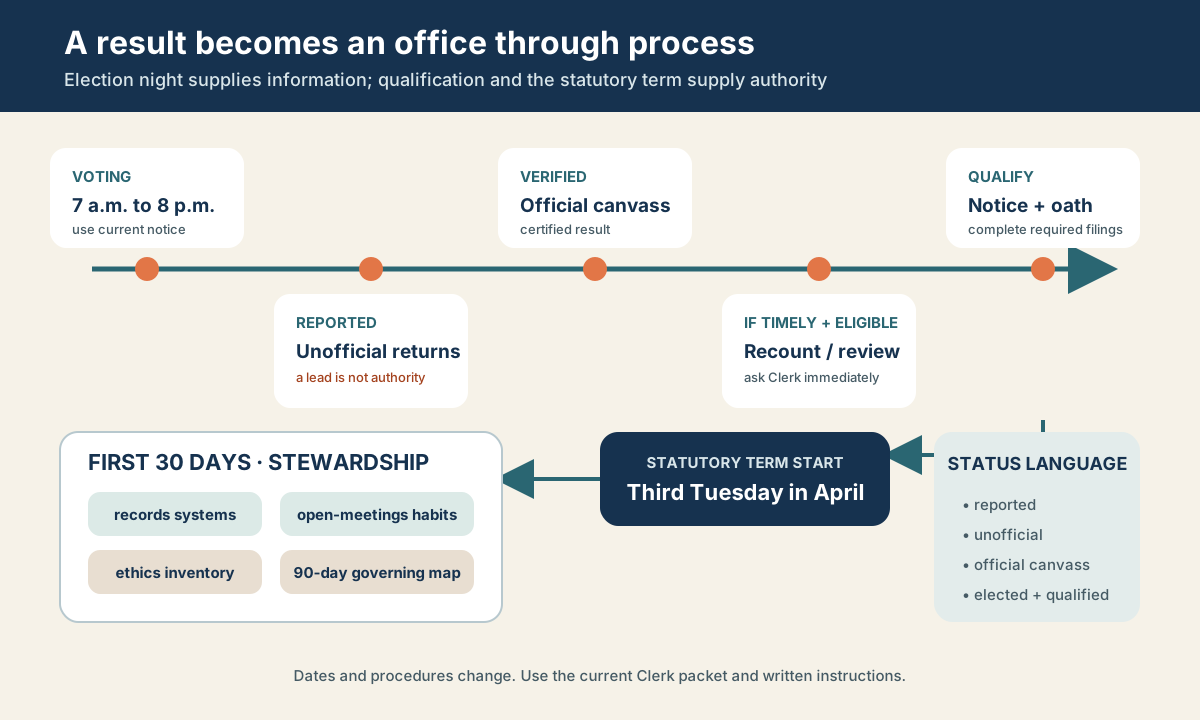
Election day and the transition: keeping campaign work out of regulated voting space (LANES), observer rules, the ladder from reported to official results, win, close-race, and loss paths, the oath within 10 days, and a first 30 days built on records, open meetings, and ethics.
- 7 min
- 8 steps
- 3 questions
- Lesson 21 of 21
In this lesson
- Confirm the actual election path
- Keep campaign work and observation in separate lanes
- Attribution compliance does not grant location permission
- From 8:00 p.m. to an official result
- Follow the correct win, close-race, or loss path
- The first 30 days: switch from advocacy to stewardship
- Final scenario drill
Picking up where you left off.
On election day, officials administer voting, observers watch within formal rules, and campaigns operate outside regulated voting space. Use LANES: Lawful activity, Assigned roles, No electioneering near voting, Evidence preserved, Status not assumed.
This is education, not legal advice. The Clerk’s active-cycle packet controls changing local dates, places, boundaries, procedures, and forms.
Confirm the actual election path
A spring primary is not automatic. Wisconsin law sets both the field-size condition and the council-action, charter-ordinance, or elector-petition paths that can trigger a city primary 1. Obtain the Clerk’s written confirmation; announcements are not a qualified field.
Stoughton’s election page describes the regular spring primary as the third Tuesday in February, if necessary, and the spring election as the first Tuesday in April. It also says polling locations are open 7:00 a.m. to 8:00 p.m. on election days 2. Those are the current general rules, not a substitute for the dated notice for your election.
Build a one-page control sheet 30 days before voting:
- election date, polling locations, and Clerk contact;
- relevant absentee and election-day milestones;
- named campaign lead, observer lead, legal/compliance contact, and data lead;
- electioneering map or boundary instruction;
- observer training, check-in, and conduct instructions;
- approved reminder messages and literature;
- unofficial-results source; and
- one authorized results spokesperson.
The 2025 Stoughton alderperson packet illustrates local instructions but covers another office and cycle. Use it for questions, never as a future mayoral rulebook 3.
Keep campaign work and observation in separate lanes
An observer is not a campaign operative inside the voting room, and a candidate on that election’s ballot cannot serve as an observer. Other observers complete the check-in procedure, follow the designated election official’s directions and observation areas, do not disrupt or electioneer, and do not initiate conversations with voters 4. Current WEC and Clerk training controls the details.
A campaign worker may send lawful reminders and answer with official sources from lawful locations. Signs, literature, candidate apparel, persuasion, and directed voter contact stay outside the restricted area. Assign and train roles in advance rather than switching casually.
The candidate may vote and receive public information but should not hover, direct inspectors, or stage polling-place publicity. Route questions through the campaign lead to the Clerk.
Do not memorize an old distance or assume every entrance is identical. Get the Clerk’s boundary description and inspect assigned locations. When unsure, move farther away and ask.
Quick check
Observers check in, follow the officials’ directions, and don’t electioneer or start conversations with voters.
Attribution compliance does not grant location permission
Advocacy may need a readable attribution, generally “Paid for by” plus the full registered committee name; format rules and limited exceptions apply 5. Proof every version before use.
But a perfect disclaimer does not permit polling-place electioneering. Ask:
- Content: Does the communication have the required attribution?
- Location and timing: May this communication be used here, now, in this manner?
Both must be yes. Give volunteers only approved versions.
From 8:00 p.m. to an official result
At poll close, stop turnout messages, preserve logs, and use the official reporting source. A lead is not a win. Use this ladder:
- reported: a source has posted numbers;
- unofficial: election-night totals are available but not canvassed;
- official canvass: the authorized canvass has completed and published the result;
- subject to further process: a timely recount or court proceeding may still matter;
- elected and qualified: the winner has completed the required steps to take office.
In 2026, Dane County’s results page listed Tim Swadley with 3,534 votes and write-ins with 106, but its page-wide disclaimer labels municipal results unofficial 6. Use the Stoughton City Clerk’s canvass or certification for the legal outcome; a race heading or election-night page alone is not enough.
In a close result, preserve reports, avoid rumor, and ask the Clerk immediately for current recount eligibility, deadline, petition, venue, and fee rules. A representative observes under those rules; the candidate never independently handles ballots.
Quick check
A lead is not a win until the canvass is complete.
Follow the correct win, close-race, or loss path
If the canvass confirms a win: thank voters without claiming power. Get the Clerk’s written checklist for notice, oath, other filings, orientation, records, and transition. Within 10 days after notice of election, the winner must take and file the official oath 7. Wisconsin law starts the regular mayoral term on the third Tuesday in April 7.
If the margin is close: use one spokesperson, official source, and question log. Separate arithmetic discrepancies from claims, get prompt advice, and continue financial recordkeeping.
If the canvass confirms a loss: acknowledge the official result, remove material as required, resolve bills, file reports, and terminate properly. Preserve research for civic work or a future race.
In all three paths, campaign records remain campaign records. Do not merge donor, supporter, or canvass data into city systems.
The first 30 days: switch from advocacy to stewardship
Winning changes the information rules. The safest first month is a compliance-and-listening sprint.
Days 1–7: systems and boundaries
Complete oath and qualification steps. Meet the Clerk and relevant city leadership. Establish official email, calendar, records storage, and request-routing practices. Do not conduct city business through disappearing messages. A communication about public business may become a public record even when created on a personal account or device; use city systems and ask the legal custodian before deleting anything 8.
Days 8–14: open-government habits
Take Wisconsin open-meetings training. Learn notice, agenda, closed-session, and quorum rules. Avoid a serial text or call chain that effectively builds agreement among members outside a noticed meeting; the DOJ guidance addresses risks commonly described as walking quorums 9. Put policy discussion into the proper public process and ask counsel before unusual meeting arrangements.
Days 15–21: ethics inventory
List employers, clients, property, investments, organizational roles, close family interests, campaign relationships, and promised appointments that could intersect with city matters. Wisconsin’s local-official standards restrict using office for private benefit and acting on matters involving specified financial interests 10 11. Disclosure or recusal can be fact-specific; request advice before participating, not after a vote.
Days 22–30: governing map
Observe or meet each major department and map the next 90 days of council, committee, budget, appointment, and intergovernmental work. For every campaign promise, write: the lawful mayoral role, other required decision-makers, cost source, public step, and first measurable update. Publish fewer commitments, with clearer status.
Quick check
Put policy discussion into the noticed public process.
Final scenario drill
At 8:20 p.m., a volunteer texts a screenshot showing a 42-vote lead and asks to post “WE WON.” Apply LANES:
- Lawful activity: voting is over, but communications and attribution rules still apply.
- Assigned roles: only the designated spokesperson posts.
- No electioneering near voting: volunteers have left restricted locations.
- Evidence preserved: save the official-source link, not only the screenshot.
- Status not assumed: write “Unofficial results currently show a lead; we will await the official canvass.”
That sentence may feel restrained. Restraint is the first transition skill. Election night rewards speed; public office rewards process.
Lesson complete
Nice work.
Sources for this lesson
- 1Wisconsin Statutes § 8.11 — Spring Primary. Wisconsin State Legislature. verifiedConditions under which a city spring primary is held and how candidates advance. Cited at: Spring primary.
- 2Upcoming Election. City of Stoughton, Wisconsin. verifiedCurrent local election dates, polling hours, and voter information; changes with each election. Cited at: Regularly Scheduled Elections; Election Day Hours.
- 32025 Stoughton Alderperson Candidate Packet. City of Stoughton, Wisconsin. 2024. verifiedHistorical local example containing forms and instructions. It is alderperson-specific and must not substitute for a future mayoral packet. Cited at: historical local example.
- 4Election Observers 101 — Wisconsin Administrative Code Chapter EL 4. Wisconsin Elections Commission. 2025. verifiedOfficial training deck on statewide observer eligibility, check-in, conduct, locations, communications, warnings, and removal under Chapter EL 4, effective August 1, 2025. Cited at: eligibility; EL 4.03-4.05.
- 5Attribution Requirements. Wisconsin Ethics Commission. verifiedCurrent paid-for-by requirements and limited exceptions for campaign communications. Cited at: Attribution Formats; Attribution Examples.
- 62026 Spring Election Results — Stoughton Mayor. Dane County Clerk. 2026. verifiedStable Dane County reporting page listing 3,534 votes for Tim Swadley and 106 write-in votes. Although the race heading includes "Official Canvass," the page-wide disclaimer says municipal results are unofficial; obtain the legal certification from the Stoughton City Clerk. Cited at: 2026 Stoughton mayor results.
- 7Wisconsin Statutes § 62.09 — City Officers. Wisconsin State Legislature. verifiedQualifications, oath, term commencement, and mayoral powers and duties. Cited at: subsec. (4)(a); subsec. (5)(a).
- 8Wisconsin Public Records Law. Wisconsin Department of Justice. verifiedOfficial compliance resources and current DOJ guide for records access, retention, and electronic communications. Cited at: official public-records resources.
- 9Wisconsin Open Meetings Law. Wisconsin Department of Justice. verifiedOfficial compliance resources and current DOJ guide for public notice, open sessions, and walking quorums. Cited at: official guide.
- 10Standards of Conduct for Local Government Officials. Wisconsin Ethics Commission. verifiedPlain-language overview of Wisconsin's local governmental ethics rules. Cited at: local governmental ethics overview.
- 11Wisconsin Statutes § 19.59 — Codes of Ethics for Local Government Officials. Wisconsin State Legislature. verifiedState standards governing private benefit, financial interests, and official action by local officials. Cited at: standards of conduct.
Further reading
- City Clerk. City of Stoughton, Wisconsin. verifiedOfficial Clerk contact page. The Clerk is the first stop for cycle-specific local candidate instructions.