Running a Campaign in a Small City
A Stoughton campaign built on evidence: separating facts, assumptions, and tests; an issue log from agendas and budgets; reading the 2026 result at the right scale; capacity math for door-knocking; messages that respect mayoral authority; and field rules that protect trust.
- 8 min
- 8 steps
- 3 questions
- Lesson 20 of 21
In this lesson
- Build an issue log before a platform
- Read one real result without inventing a theory
- Convert time into a testable contact plan
- Make a message that respects mayoral authority
- Field rules that protect trust
- A 30-day pre-campaign lab
- Weekly campaign drill
Picking up where you left off.
A small-city campaign should begin with evidence, not folklore. “Doors always win,” “spring turnout is low,” and “everyone is on Facebook” may sound plausible, but none is a Stoughton plan until it is measured. The better method is FAT: Facts, Assumptions, Tests.
- A fact has a source: an agenda, budget, official result, city map, or rule.
- An assumption is a planning estimate: doors per hour, volunteer retention, or response rate.
- A test produces new evidence: one canvass shift, ten message interviews, or a forum rehearsal.
Label all three. This keeps confidence from outrunning knowledge.
Before public campaign activity, fundraising, spending, or filing nomination papers, confirm with the Clerk whether registration has been triggered. Wisconsin’s candidate overview describes a $0 registration threshold when any listed trigger occurs 1.

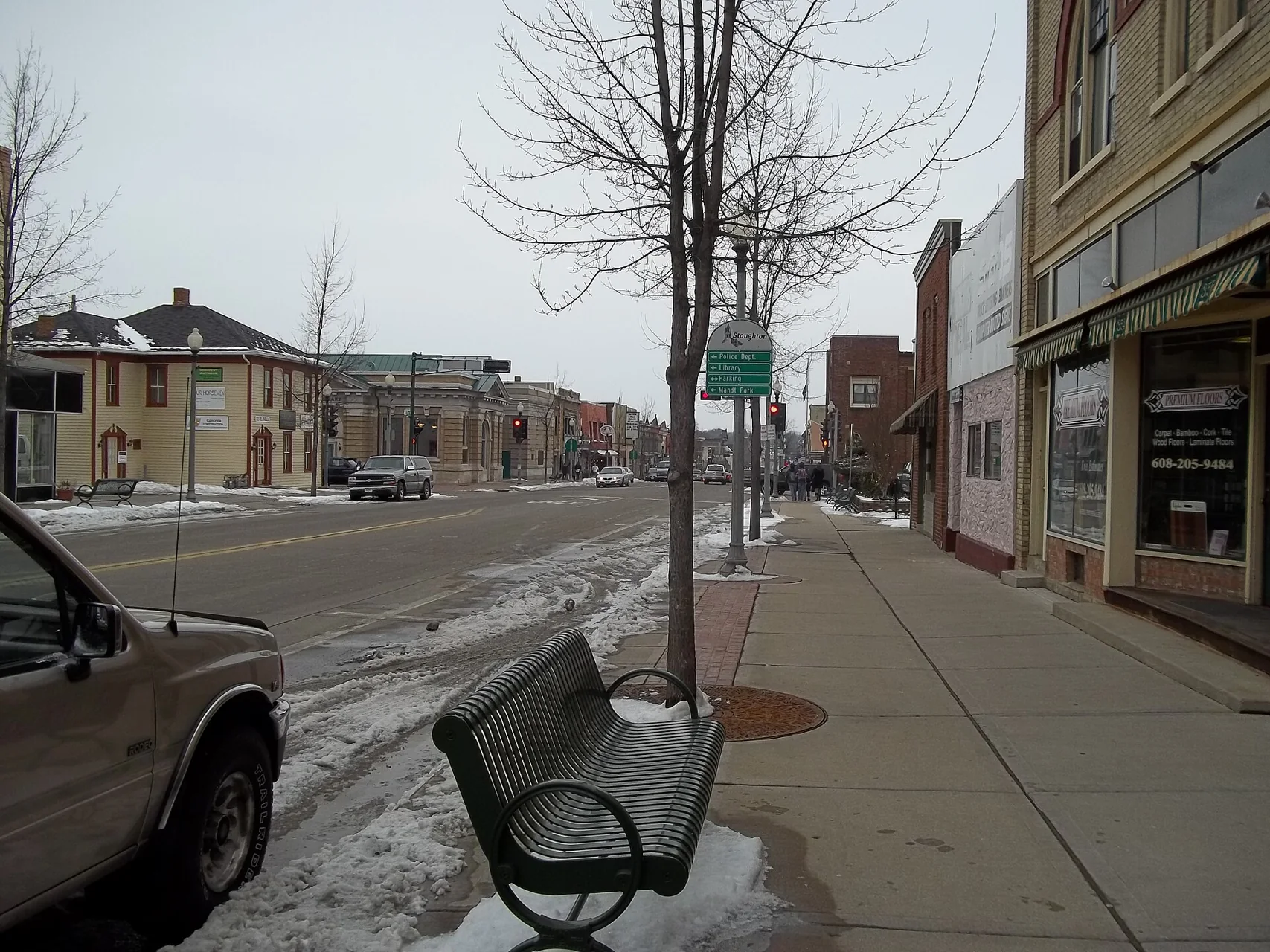
Use the photograph to plan a present-day observation walk: note crossings, sidewalks, loading, frontage, and transitions into residential blocks. Date every observation. A 2011 image can suggest where to look; it cannot establish current conditions 2.
Build an issue log before a platform
Stoughton’s Agenda Center publishes notices, agendas, packets, and minutes for the Common Council and other bodies 3. Use the official budget archive to check adopted budgets and capital-planning documents rather than relying on campaign summaries 4. Pair both with the city’s WSTO Video On Demand archive for council, Plan Commission, Finance Committee, and other meetings 5. Video reveals questions and uncertainty; documents anchor exact proposals and recorded action.
Create one row per issue:
| Field | What to capture |
|---|---|
| Source | body, meeting date, agenda item, packet page, video timestamp |
| Decision stage | briefing, referral, recommendation, council vote, implementation |
| Constraint | cost, law, staffing, timing, intergovernmental dependency |
| Perspectives | strongest fair version of each stated position |
| Mayor’s role | chair, appointment, budget review, liaison, advocate, or no direct power |
| Open question | what a resident still needs explained |
| Next source | staff report, ordinance, budget page, minutes, or responsible official |
Do not turn the public-comment microphone into a campaign prop. Observe to learn. When a meeting ends, write three sentences: what was decided, what was not decided, and what happens next. That habit is more valuable than collecting applause lines.
Read one real result without inventing a theory
Dane County’s stable 2026 reporting page lists 3,534 votes for Tim Swadley and 106 write-in votes, or 3,640 votes recorded in that contest 6. Its page-wide disclaimer treats municipal results as unofficial, so use these numbers as a planning-scale snapshot—not legal certification. For the legal result, ask the Stoughton City Clerk. The total is also not automatically turnout: voters may leave a contest blank, and turnout needs a separate denominator and election-level total. It does not prove why anyone voted or whether a particular tactic worked.
Safe inference: plan and audit work at a scale of thousands. Unsafe inference: “3,640 doors guarantees a win.” Candidates, ballot composition, and participation can change.
Convert time into a testable contact plan
Use capacity math before setting a voter-contact promise:
attempts = canvassers × shifts per week × hours per shift × attempts per hour × weeks
Example assumptions, deliberately labeled:
- 2 canvassers
- 2 shifts per week each
- 2 hours per shift
- 12 attempted doors per hour
- 8 weeks
The model gives 2 × 2 × 2 × 12 × 8 = 768 attempted doors. If 35% produce a conversation, the planning estimate is about 768 × 0.35 = 269 conversations. At 8 attempts per hour the same plan yields 512 attempts; at 16, it yields 1,024.
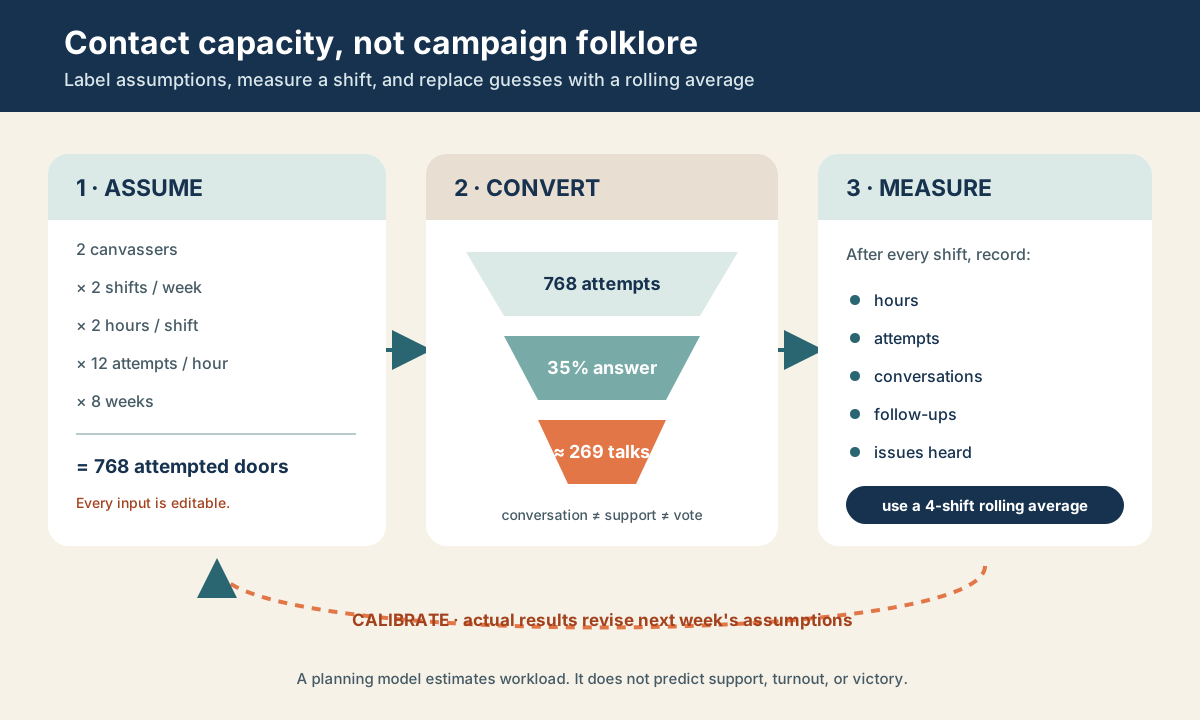
These are not performance standards. Weather, access, walk distance, conversation length, and experience change the rate. A door is not a voter; a conversation is not support. After every shift, record hours, attempts, conversations, follow-ups, and issues heard. Replace the assumption with a four-shift rolling average.
Capacity rule of thumb: schedule only 70% of theoretical volunteer hours. The other 30% absorbs cancellations, training, data cleanup, and long conversations. This is a planning buffer, not a fact about Stoughton.
Quick check
2 × 2 × 2 × 12 × 8 = 768 attempts; a door is not a voter and a conversation is not support.
Make a message that respects mayoral authority
Use PERN: Problem, Evidence, Role, Next step.
Problem: “Residents have asked how the capital plan affects street repairs.”
Evidence: “The question appears in these agenda items and budget pages.”
Role: “The mayor reviews the budget and works with the council; the mayor does not appropriate money alone.”
Next step: “I would request a plain-language project dashboard and use the public budget process to compare priorities.”
The structure prevents two common failures: promising a result the mayor cannot order and using an anecdote as if it were citywide evidence. Stoughton’s 12-member council represents four districts, while the mayor is elected at large; a mayoral message must explain how citywide leadership and council action fit together 7.
Score each proposed priority from 0 to 2 on four questions: Is it repeatedly visible in sources? Is it within meaningful mayoral influence? Can the trade-off be explained honestly? Is there a first step that can be observed? A score is a focusing device, not proof that an issue matters more than an unmeasured concern.
Quick check
Naming the mayor’s role keeps you from promising what the office can’t order.
Field rules that protect trust
Write these operating rules before recruiting volunteers:
- Respect “no soliciting,” private-property boundaries, and a resident’s request to end a conversation.
- Never imply a campaign volunteer is a city employee, election official, or news reporter.
- Do not use city staff time, equipment, logos, nonpublic information, or official channels for campaign work.
- Collect only data the campaign can protect and use lawfully. Explain why contact information is requested.
- Offer accessible ways to participate: readable literature, a phone or email option, and events that do not require stairs or long standing.
- Correct a factual error publicly in the same channel where it spread.
- Review printed and paid digital advocacy for the required attribution. The Ethics Commission generally expects “Paid for by” plus the full registered committee name, subject to current format rules and exceptions 8.
For signs, canvassing locations, text messages, email, volunteer data, and election-day activity, obtain current written guidance. Ethical instincts help; they do not replace law.
Quick check
And never imply a volunteer is a city employee or election official.
A 30-day pre-campaign lab
This lab produces a go/no-go decision, not a campaign launch. Confirm registration boundaries before doing anything public or spending money.
Days 1–7 — Map the office. Read three recent council agendas and one committee packet. Watch 60 minutes of WSTO video. Add ten issue-log rows. For each, identify what the mayor can and cannot do.
Days 8–14 — Listen without pitching. Hold ten structured conversations across different parts of the city. Ask the same four questions: What works? What is frustrating? What decision do you not understand? What would a trustworthy update look like? Record themes, not gossip.
Days 15–21 — Test capacity. With no campaign advocacy unless properly registered, run two logistics-only route tests or comparable volunteer exercises. Measure travel, access, weather, and data-entry time. Build low, middle, and high capacity cases.
Days 22–30 — Synthesize. Draft three PERN messages. Cite the source behind every factual sentence. Rehearse a 30-second answer, a two-minute answer, and a respectful “I do not know yet.” Ask two skeptical readers to underline promises outside mayoral authority.
The deliverable is one page: three evidenced issues, office limits, a realistic capacity range, Clerk questions, and reasons to run or wait. Deciding to wait can be a successful result.
Weekly campaign drill
Every Sunday, classify the dashboard:
- Facts: actual hours, contacts, donations, costs, deadlines, sourced issue updates.
- Assumptions: future volunteer hours, response rates, persuasion goals.
- Tests: one change to route, script, event, or follow-up process.
If the campaign cannot distinguish those columns, it is not learning. The goal is not to imitate a generic “small-town campaign.” It is to build a lawful, measurable Stoughton campaign whose claims match the office and whose plan improves when evidence changes.
Lesson complete
Nice work.
Sources for this lesson
- 1Candidate Committee Overview. Wisconsin Ethics Commission. verifiedCurrent overview of registration, reporting, records, and termination for candidate committees. Cited at: Who Needs to Register a Candidate Committee?.
- 2Jumonji. Main Street Stoughton Wisconsin. Wikimedia Commons. 2011. verifiedPhotograph of downtown Stoughton released under CC BY 3.0; the streetscape is historical and should not be treated as current business information. Cited at: license and date.
- 3Agenda Center. City of Stoughton, Wisconsin. verifiedOfficial notices, agendas, packets, and minutes for the Common Council, committees, boards, and commissions. Cited at: official agendas and minutes.
- 4City Budget. City of Stoughton, Wisconsin. verifiedOfficial archive of adopted budgets and related capital-planning documents; verify that the selected document covers the intended fiscal year. Cited at: budget documents.
- 5WSTO Video On Demand. WSTO TV, City of Stoughton. verifiedOfficial on-demand archive for City Council, Plan Commission, Finance Committee, and other local-government meetings. Cited at: meeting archive.
- 62026 Spring Election Results — Stoughton Mayor. Dane County Clerk. 2026. verifiedStable Dane County reporting page listing 3,534 votes for Tim Swadley and 106 write-in votes. Although the race heading includes "Official Canvass," the page-wide disclaimer says municipal results are unofficial; obtain the legal certification from the Stoughton City Clerk. Cited at: 2026 Stoughton mayor results.
- 7City Council. City of Stoughton, Wisconsin. verifiedOfficial council roster and description of the 12 alderpersons, four districts, staggered terms, agendas, and meeting video. Cited at: official council structure.
- 8Attribution Requirements. Wisconsin Ethics Commission. verifiedCurrent paid-for-by requirements and limited exceptions for campaign communications. Cited at: Attribution Examples.