The Common Council and How the Mayor Works With It
Stoughton's 12-member Common Council and how the mayor works with it: districts and staggered terms, how an idea becomes action (PAVE), the mayor's tie vote, and the vote math for quorum, confirmations, and veto overrides.
- 7 min
- 11 steps
- 3 questions
- Lesson 2 of 21
In this lesson
- The council Stoughton elects
- Sort authority before debating policy
- What the mayor does at the council table
- Vote math: four different questions
- From disagreement to a usable decision
- WSTO observation lab: follow one item, not a whole meeting
Picking up where you left off.
The mayor is Stoughton’s chief executive; the Common Council is its legislative body. Neither side is a decorative extra. Wisconsin law vests the city’s corporate authority in the mayor and council and gives the council broad management and control of city property, finances, highways, services, and public business, subject to state and federal law 1 2.
The practical result is shared power with different jobs: a mayor still needs process and votes, while a council majority still depends on lawful administration.
The council Stoughton elects
Stoughton’s council has 12 alderpersons across four districts. The official roster groups three alderpersons under each district. Alderpersons are elected by voters in their districts to three-year, staggered terms, so only part of the body normally turns over in one election 3. The mayor is elected at large by the whole city to a four-year term 4.
An alderperson has a district constituency and one ordinary legislative vote. The mayor has a citywide constituency, presides, executes, recommends, appoints, and may vote only in the limited tie situation described below.
Staggering creates continuity, not automatic agreement. A new mayor enters a council where most alderpersons may already have history with the issues, staff, and one another. Before proposing a major change, learn that history from packets, minutes, and direct conversations.
Sort authority before debating policy
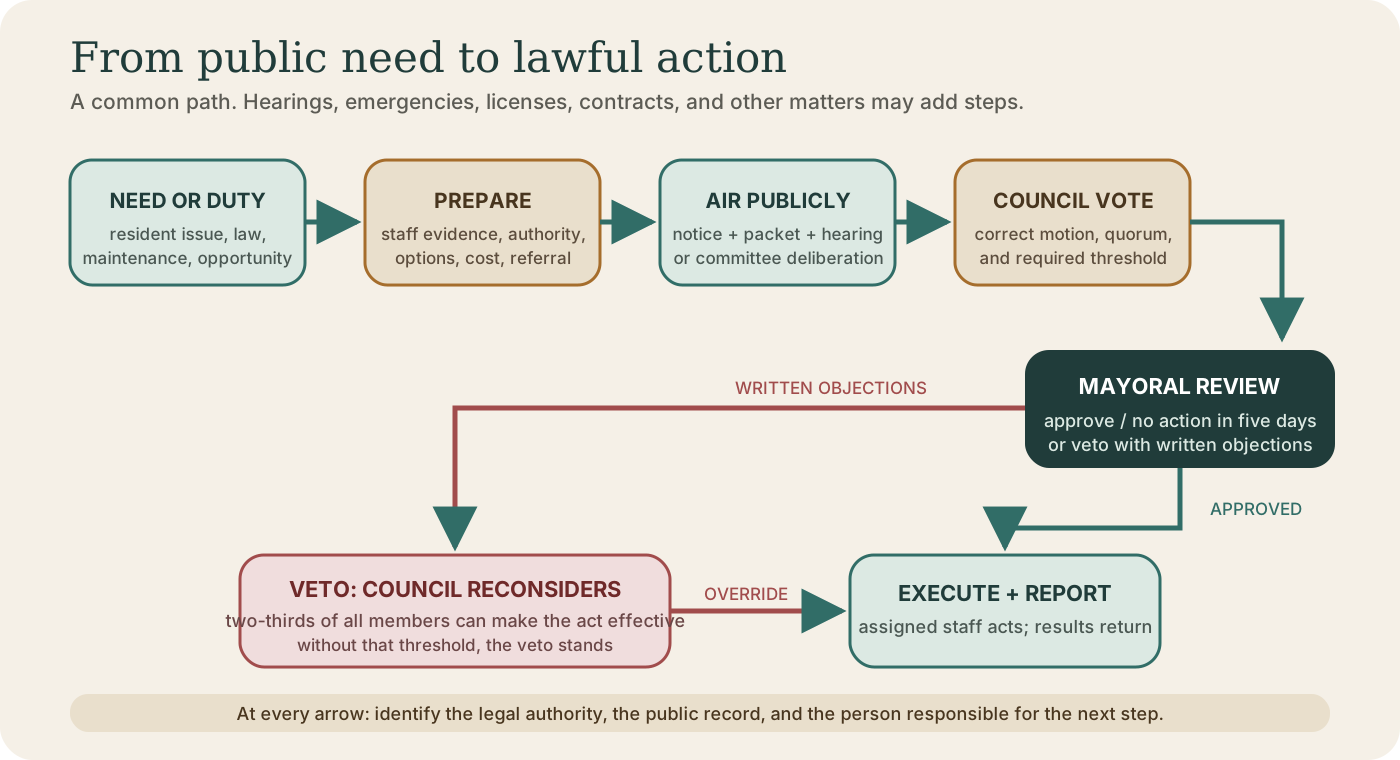
Use the mnemonic PAVE to ask how an idea becomes action:
- P - Prepare. Staff, the mayor, an alderperson, a committee, or another authorized body develops the facts and a lawful option.
- A - Air publicly. The item is properly noticed, placed on an agenda, documented, and deliberated under the applicable public-meeting rules.
- V - Vote. The council applies the correct threshold; the mayor ordinarily presides rather than votes.
- E - Execute. After approval and any required mayoral review, staff and officers carry out the action and report results.
Some matters add statutory, hearing, referral, or emergency steps. Check the current municipal code, council rules, and legal advice for the item 5.
What the mayor does at the council table
When present, the mayor presides and may provide information or recommend measures 1. Presiding means protecting an understandable process: identify the motion, recognize speakers, keep discussion connected to the noticed item, call the vote, and state the result under the city’s rules.
The mayor is part of the common council in the statutory structure, but is not counted in determining a quorum and may vote in case of a tie. If the mayor casts that tie vote, the vote is counted when deciding whether the required number voted for or against the measure 2. Put simply: the mayor is not an ordinary thirteenth vote.
Vote math: four different questions
Vote thresholds are easy to misstate because members present and the full membership are not interchangeable. The examples below assume all 12 alderperson positions are filled and no one is legally disqualified from the matter.
1. Is there a quorum?
For a city with more than five alderpersons, two-thirds of the members is a quorum. The mayor is not counted 2.
12 alderpersons x 2/3 = 8 alderpersons
So seven alderpersons plus the mayor is not a quorum. Eight alderpersons is. A quorum authorizes the body to conduct business; it does not tell you how many affirmative votes a particular motion needs.
Quick check
Seven alderpersons plus the mayor is not a quorum.
2. Is there an ordinary tie?
Suppose eight alderpersons are present and an ordinary motion, under the applicable rule, needs a simple majority of votes cast.
- At 4 yes - 4 no, the mayor may cast a tie-breaking vote. A mayoral yes makes the counted result 5-4; a mayoral no makes it 4-5.
- At 5 yes - 3 no, there is no tie, so the mayor does not vote.
- At 4 yes - 3 no - 1 abstention, do not improvise. The effect depends on the governing rule and the nature of the item.
The statute lets the council determine much of its procedure, while prescribing special rules for certain matters 2. Always identify the motion and its legal threshold before counting.
Quick check
A tie vote by the mayor counts toward the required number.
3. Does a confirmation have a full-membership majority?
State law requires a majority of all members for a confirmation, not merely a majority of the people in the room 2. With 12 alderperson positions, the working target is seven favorable votes.
- 6 yes - 5 no - 1 absent: six is short of seven, and there is no tie for the mayor to break.
- 6 yes - 6 no: the mayor may cast the tie vote; if the mayor votes yes, the counted total reaches seven.
4. Can the council override a veto?
The Clerk submits covered council acts to the mayor. Approval makes the act effective; if the mayor neither approves nor disapproves within five days, the Clerk certifies that fact and the act takes effect. A veto requires written objections filed with the Clerk. The council may then make the act effective over the objections with a two-thirds vote of all members 1.
With 12 alderpersons, the ordinary full-membership calculation is:
12 x 2/3 = 8 favorable alderperson votes
Seven yes votes do not become enough because fewer members attended. A 6-6 tie also cannot satisfy an eight-vote supermajority.
These examples teach the general-law arithmetic, not case-specific legal advice. Vacancies, recusals, abstentions, a special statute, or a current local rule can change the analysis or create a disputed question. For a consequential vote, the Mayor should have the Clerk or City Attorney confirm the exact denominator and threshold before the meeting, then state it on the record.
Quick check
The denominator is the full membership, so absences don’t lower the target.
From disagreement to a usable decision
The mayor’s strongest council skill is not “winning every vote.” It is producing a process in which members can identify the decision, evidence, tradeoffs, and next step. Before an agenda item reaches the floor, use a one-page decision brief:
| Heading | One-sentence test |
|---|---|
| Decision | What exactly will a yes vote authorize? |
| Authority | Which statute, ordinance, policy, or budget line permits it? |
| Evidence | What facts support action, and what remains uncertain? |
| Options | What are the realistic alternatives, including no action? |
| Cost | What are the immediate and continuing resource effects? |
| Implementation | Who owns the next step, by when, and how will council learn the result? |
This is a comprehension check, not a substitute for a staff report. If the six lines cannot be completed, the item may not be ready for a clean vote.
WSTO observation lab: follow one item, not a whole meeting
Open the city’s WSTO Video On Demand archive, which includes City Council and other local-government meetings 6. Pair the video with the matching agenda or packet in the Agenda Center 7.
Choose one substantive agenda item and create a seven-line transcript of the process:
- The agenda’s exact description of the item.
- Who introduces or explains it.
- The motion, written as precisely as you can hear it.
- One factual question and the answer source.
- One value or tradeoff question.
- The vote tally, including absences or abstentions if stated.
- The assigned next action.
Replay the item and grade the process: Could a resident tell what was being decided? Was the motion clear? Did speakers distinguish facts from preferences? Was the result stated? This is how PAVE - prepare, air, vote, execute - looks under real conditions.
Next comes candidate eligibility, including the crucial distinction between voting-right restoration and eligibility to hold Wisconsin office.
Lesson complete
Nice work.
Sources for this lesson
- 1Wisconsin Statutes § 62.09 — City Officers. Wisconsin State Legislature. verifiedQualifications, oath, term commencement, and mayoral powers and duties. Cited at: subsec. (7)(a); subsec. (8)(b); subsec. (8)(c).
- 2Wisconsin Statutes § 62.11 — Common Council. Wisconsin State Legislature. verifiedCouncil authority, quorum, presiding officer, and mayoral voting rule. Cited at: subsec. (5); subsec. (1); subsecs. (1) and (3)(b); subsec. (3); subsec. (3)(b).
- 3City Council. City of Stoughton, Wisconsin. verifiedOfficial council roster and description of the 12 alderpersons, four districts, staggered terms, agendas, and meeting video. Cited at: Members and Overview.
- 4Government of Stoughton. City of Stoughton, Wisconsin. verifiedOfficial overview of Stoughton's mayor-council government and four-year, at-large mayoral term. Cited at: Mayor-Council form.
- 5Code of Ordinances, Stoughton, Wisconsin. City of Stoughton and CivicPlus Municode. verifiedOnline municipal code, codified through Ordinance No. 039-2025 as of verification; confirm later amendments with the Clerk. Cited at: current municipal code.
- 6WSTO Video On Demand. WSTO TV, City of Stoughton. verifiedOfficial on-demand archive for City Council, Plan Commission, Finance Committee, and other local-government meetings. Cited at: official meeting archive.
- 7Agenda Center. City of Stoughton, Wisconsin. verifiedOfficial notices, agendas, packets, and minutes for the Common Council, committees, boards, and commissions. Cited at: agendas, packets, and minutes.
Further reading
- Mayor. City of Stoughton, Wisconsin. verifiedOfficial description of the mayor's local responsibilities, current officeholder, and contact information.