
What the Mayor of Stoughton Does
The Stoughton mayor's legal role under Wis. Stat. 62.09 and the city's own job description, remembered as LEAD (laws, executive budget, appointments, deliberation); the local boards the mayor sits on; what the mayor can't do alone; and measuring the real workload from public agendas.
- 7 min
- 7 steps
- 3 questions
- Lesson 1 of 21
In this lesson
- Current office snapshot
- Remember the job with LEAD
- The Stoughton-specific portfolio
- What the mayor cannot do alone
- A workweek model you can test
- Observation lab: build a four-week workload sample
Picking up where you left off.
Stoughton’s mayor is the city’s chief executive officer, but that does not mean “solo decision-maker.” Wisconsin law gives the mayor responsibility for seeing that city ordinances and state laws are observed and enforced and that officers and employees discharge their duties. It also directs the mayor to keep the Common Council informed, recommend useful measures, and preside when present 1. The council still legislates, approves spending, and supplies many of the votes needed to turn an idea into city action.
That is the first mental model for the job:
The mayor leads an institution; the mayor does not replace it.

Current office snapshot
Checked July 14, 2026: The City of Stoughton lists Tim Swadley as its current mayor 2 and says the mayor is elected at large to a four-year term 3. Dane County’s 2026 results page lists 3,534 votes for Swadley and 106 write-in votes, but its page-wide disclaimer labels municipal results unofficial 4.
This panel is deliberately dated. Officeholders change; the legal structure usually changes more slowly. Recheck the official mayor page whenever you return to the lesson.
Remember the job with LEAD
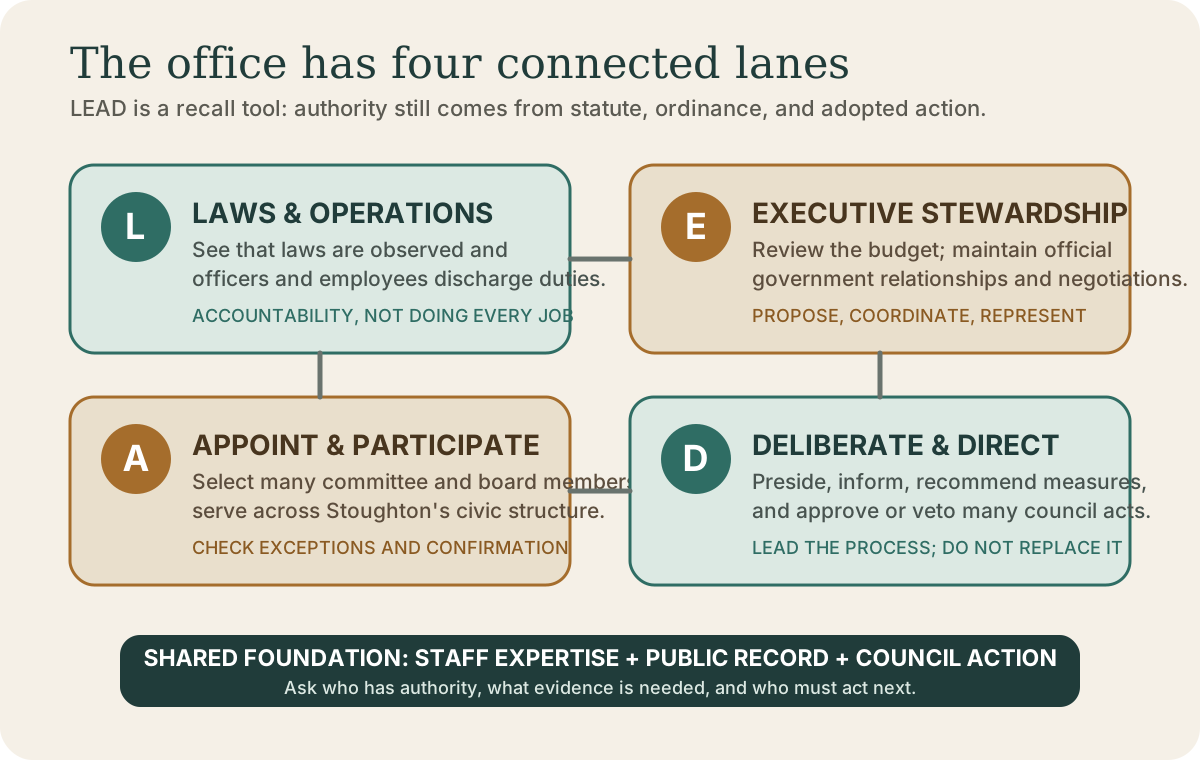
The mnemonic LEAD organizes the formal role without pretending the work is simple:
- L - Laws and operations. Take care that ordinances and applicable state laws are observed and that city officers and employees perform their duties 1. This is executive accountability. It does not mean personally doing every department’s work or ignoring professional, statutory, and civil-service boundaries.
- E - Executive budget and external relationships. Stoughton’s local description assigns the mayor review and revision of the operating budget prepared by the finance director before it goes to the Finance Committee. It also makes the mayor the city’s executive liaison in official contacts with other governments and identifies a negotiating role in business and industrial development 2.
- A - Appointments and across-city participation. The mayor appoints council committee members and most board and commission members, subject to the exceptions in law and municipal code. State law generally makes mayoral appointments subject to council confirmation unless another law provides otherwise 2 1. The mayor is also an ex officio member of council committees and serves in several specified local roles.
- D - Deliberation and direction. The mayor presides at council meetings, supplies information, recommends measures, and has a veto over many council acts. The veto is a check, not a power to enact the mayor’s preferred policy alone; the next lesson works through the council’s override power 1.
Quick check
The council legislates and appropriates; the mayor executes, recommends, presides, and appoints.
The Stoughton-specific portfolio
The local job description is more useful than the word “mayor” by itself. In addition to the budget, appointment, liaison, and ceremonial responsibilities above, Stoughton lists the mayor as:
- a member of the Board of Review and Utilities Committee;
- a member of the firefighters’ pension board;
- chair of the Plan Commission; and
- the city’s ceremonial representative when present in the city 2.
Each role asks for a different kind of judgment. A Plan Commission meeting may require reading land-use maps, staff reports, and public testimony. A Board of Review role concerns a defined legal process, not a general debate about tax policy. Budget review requires comparing service needs, revenue constraints, and downstream effects. A public event asks the mayor to represent the whole city, including residents who opposed the mayor in the last election.
The practical rule is name the hat before taking the action. Ask:
- Am I acting as chief executive, presiding officer, commission chair, committee member, appointing authority, negotiator, or ceremonial representative?
- What source grants authority in that role - statute, ordinance, adopted policy, or council action?
- Who else must act before the result is final?
This three-question pause prevents a common error: treating public visibility as legal authority.
Quick check
The mayor also sits on the Board of Review, the Utilities Committee, and the firefighters’ pension board.
What the mayor cannot do alone
A mayor can recommend an ordinance but cannot pass it alone. The mayor can shape and review an executive budget, but the council acts on appropriations. The mayor can make many appointments, but confirmation may be required. The mayor can negotiate and advocate, but a resulting agreement may still require legal review, budget authority, or council approval.
The office also depends on staff expertise. “Take care that duties are discharged” is not an instruction to become the finance director, planner, clerk, attorney, police chief, and engineer. A useful executive asks for the right evidence, defines the decision that must be made, respects who owns the technical work, and follows through. When authority is unclear, the mayor should ask the Clerk or City Attorney before acting.
Quick check
Confirmation needs a majority of all council members.
A workweek model you can test
There is no honest universal “typical week.” Meeting load changes with the budget cycle, development proposals, emergencies, appointments, and community events. Instead of guessing, build an evidence-based estimate from public records.
Here is a hypothetical planning week, not a claim about Mayor Swadley’s actual schedule:
| Work block | Simple estimate |
|---|---|
| Read a council packet | 90 minutes |
| Attend a two-hour council meeting; travel and follow-up | 3 hours |
| Prepare for and attend another board or commission | 2.5 hours |
| Three constituent or intergovernmental conversations, including notes | 2 hours |
| One community event, including travel | 2 hours |
| Visible subtotal | 11 hours |
The arithmetic is 1.5 + 3 + 2.5 + 2 + 2 = 11. It is useful because every assumption can be replaced with an observed number. It is incomplete because unposted calls, staff coordination, urgent issues, and extra reading may add time. During budget preparation or a local emergency, the pattern can be different again.
Do not infer a full-time or part-time label from this exercise. The official page does not assign one, and compensation does not prove workload. State law says compensation for an elective city office must be established before the earliest time for filing nomination papers for that term; verify the current amount and conditions with the Clerk instead of relying on an old budget or rumor 1.
Observation lab: build a four-week workload sample
Use the city’s Agenda Center for four consecutive weeks 5.
- Record every council, committee, board, and commission meeting at which the mayor is listed as chair, member, presiding officer, or ex officio member.
- For two meetings, record video length or actual start and end time. Then time yourself reading the agenda packet well enough to summarize each decision.
- Add reasonable travel and ten minutes of notes after each meeting. Keep these estimates separate from observed time.
- Read the mayor’s official responsibility list and mark work that public calendars cannot reveal: calls, appointment interviews, government liaison work, negotiation, and ceremonial requests.
- Produce a range, not one magic number: known scheduled time + measured preparation + explicitly labeled unknowns.
Finish with a one-page memo: “What would I need to rearrange in my own life to perform this office reliably for four years?” Include employment, caregiving, transportation, privacy, and the ability to respond when the schedule changes.
The point is not to talk yourself into or out of running. It is to replace the title’s prestige with an observable job. In the next lesson, you will add the other half of the system: twelve alderpersons, council procedure, vote thresholds, and the mayor’s veto.
Lesson complete
Nice work.
Sources for this lesson
- 1Wisconsin Statutes § 62.09 — City Officers. Wisconsin State Legislature. verifiedQualifications, oath, term commencement, and mayoral powers and duties. Cited at: subsec. (8); subsec. (8)(a); subsecs. (3)(e) and (8); subsec. (8)(b)-(c); subsec. (6).
- 2Mayor. City of Stoughton, Wisconsin. verifiedOfficial description of the mayor's local responsibilities, current officeholder, and contact information. Cited at: current mayor; Mayoral Responsibilities; Appointments.
- 3Government of Stoughton. City of Stoughton, Wisconsin. verifiedOfficial overview of Stoughton's mayor-council government and four-year, at-large mayoral term. Cited at: at-large election and term.
- 42026 Spring Election Results — Stoughton Mayor. Dane County Clerk. 2026. verifiedStable Dane County reporting page listing 3,534 votes for Tim Swadley and 106 write-in votes. Although the race heading includes "Official Canvass," the page-wide disclaimer says municipal results are unofficial; obtain the legal certification from the Stoughton City Clerk. Cited at: 2026 Stoughton mayor results.
- 5Agenda Center. City of Stoughton, Wisconsin. verifiedOfficial notices, agendas, packets, and minutes for the Common Council, committees, boards, and commissions. Cited at: official agendas and packets.
Further reading
- Wikideas1. Stoughton City Hall. Wikimedia Commons. 2024. verifiedPanoramic photograph dedicated to the public domain under CC0 1.0.