CodeSystem, ValueSet, and the $expand and $validate-code Operations
- 4 min
- 5 steps
- Lesson 40 of 51
In this lesson
- From terminology ideas to FHIR resources
- The CodeSystem resource
- The ValueSet resource
- Terminology operations
- Where value sets come from: VSAC
Picking up where you left off.
From terminology ideas to FHIR resources
The Terminologies course established a set of ideas that travel across every health data standard: large code systems such as SNOMED CT, LOINC, ICD, and RxNorm; the value sets that select codes for a particular use; the binding that ties a coded field to one of those value sets; and the “code + system + display” triplet that makes a coded value meaningful. FHIR does not replace any of that — it gives each idea a concrete representation as a resource or an operation. This lesson maps the familiar concepts onto the FHIR machinery that implements them.
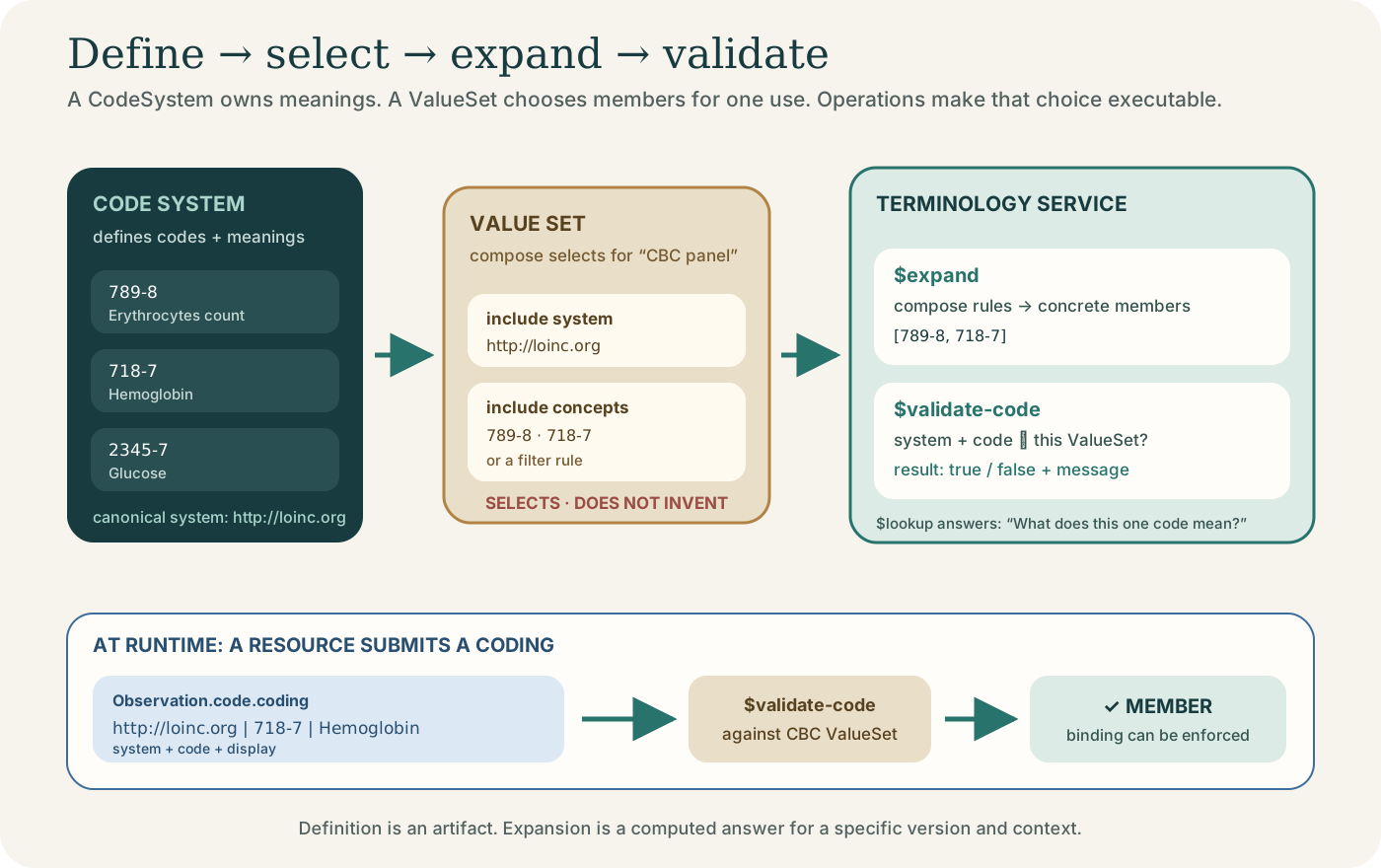
Two resources carry the load. A CodeSystem declares codes and what they mean. A ValueSet selects a subset of codes for a use. A small family of terminology operations then does the runtime work: expanding a value set into its members, and validating whether a code belongs.
The CodeSystem resource
A CodeSystem resource declares a set of codes together with their meanings —
their display text, definitions, and relationships 1. Each
code system has a canonical system URL that uniquely identifies it; this is the
same system value that appears inside every Coding (the “system” half of the
triplet).
A crucial design choice keeps FHIR practical: it does not re-publish the giant
external terminologies. SNOMED CT, LOINC, and RxNorm are referenced by their
canonical system URLs rather than copied into FHIR servers — a CodeSystem resource
can describe such a system and point to it without enumerating its hundreds of
thousands of codes 1. Only small or local code systems are
typically defined directly, with their codes listed inline in the concept
element.
CodeSystem (small, defined inline)
  url:     http://example.org/fhir/CodeSystem/lab-priority
  content: complete
  concept:
    - code: R   display: "Routine"
    - code: S   display: "STAT"
The ValueSet resource
A ValueSet resource defines a selected set of codes for a particular use
1. The selection lives in the compose element, which lists
one or more include (and optional exclude) blocks. Each block draws from a code
system identified by its system URL and either enumerates specific codes or
selects them with filters (for example, all descendants of a SNOMED CT concept).
This include/exclude composition is exactly the “select codes for a use” idea from
the Terminologies course, expressed as data.
ValueSet.compose
  include:
    - system: http://loinc.org
      concept:
        - code: "789-8"   display: "Erythrocytes [#/volume] in Blood by Automated count"
        - code: "718-7"   display: "Hemoglobin [Mass/volume] in Blood"
A coded element in a resource is bound to a value set — the binding names which value set supplies the allowed codes for that field, and the binding strength says how strictly it applies. The codes themselves still arrive as Coding or CodeableConcept values carrying system + code + display, so the value set constrains which codings are acceptable, not how they are written down.
Terminology operations
Resources describe terminology; operations let a client act on it. FHIR groups these as a terminology service 1. Three are worth knowing.
$expand runs on a ValueSet and produces the explicit, flat list of member
codes — the expansion 1. A value set
defined with filters (such as “descendants of a SNOMED CT concept”) is not a usable
pick-list until it is expanded; $expand resolves the rules against the underlying
code systems and returns the concrete codes, which is what a user interface needs to
populate a dropdown.
GET [base]/ValueSet/lab-tests/$expand

-> ValueSet with expansion.contains:
     [{ system: http://loinc.org, code: "789-8", display: "Erythrocytes..." },
      { system: http://loinc.org, code: "718-7", display: "Hemoglobin..." }]
$validate-code checks whether a given code is a valid member of a ValueSet or
of a CodeSystem 1. It answers a
yes/no question — is this code allowed here? — and returns a result boolean plus a
message. This is how a server enforces a binding when a resource is submitted.
GET [base]/ValueSet/lab-tests/$validate-code?system=http://loinc.org&code=789-8

-> Parameters: result = true
Finally, $lookup runs on a CodeSystem and returns details about a single code
— its display name and properties — when you have a code and need to know what it
means 1.
Where value sets come from: VSAC
Authoring and governing value sets by hand does not scale across an enterprise, so
the ecosystem relies on published, governed value sets. The U.S. National Library of
Medicine’s Value Set Authority Center (VSAC) publishes curated value sets —
drawn from SNOMED CT, LOINC, RxNorm, and other systems — that are maintained,
versioned, and consumed directly in FHIR terminology workflows
2. Rather than each project
defining its own “diabetes diagnoses” or “blood glucose tests” list, teams reference
a VSAC value set and let $expand and $validate-code operate against it — closing
the loop between the terminology concepts you already know and the FHIR resources and
operations that put them to work.
Lesson complete
Nice work.
Sources for this lesson
- 1HL7 FHIR Release 4 (R4), v4.0.1. HL7 International. 2019. verifiedThe normative base release of FHIR (published 2019-10-30). Cite with page locators (e.g., http.html, search.html, bundle.html). R5 (v5.0.0, 2023) is the latest release; R4 remains the most widely deployed. Cited at: codesystem.html; valueset.html; terminology-service.html; valueset-operation-expand.html; codesystem-operation-validate-code.html.
- 2Value Set Authority Center (VSAC). U.S. National Library of Medicine. verifiedAuthoritative repository for value sets (drawn from SNOMED CT, LOINC, RxNorm, etc.) supporting eCQMs and HL7 C-CDA. Cited at: Value Set Authority Center, vsac.nlm.nih.gov.