Message Profiles and Conformance Constraints
- 5 min
- 5 steps
- Lesson 11 of 51
In this lesson
- The Problem Profiles Solve
- How Profiling Constrains a Message
- Profiles versus Implementation Guides
- A Concrete Example
- The Payoff: From Loosely Conformant to Demonstrably Interoperable
Picking up where you left off.
The Problem Profiles Solve
The HL7 Version 2 base standard is deliberately permissive. A single message type such as an admission notification or a laboratory result is defined with many optional segments and optional fields, repeating components, and broad data types. This flexibility lets the standard serve countless clinical and administrative scenarios, but it comes at a cost: two systems can both claim to “support ADT” and still be unable to exchange data, because each made different choices about which optional pieces to send and how to populate them. The base standard tells you what is allowed; it rarely tells you what is required for a particular exchange. Conformance to such a loose specification is hard to state precisely and nearly impossible to test.
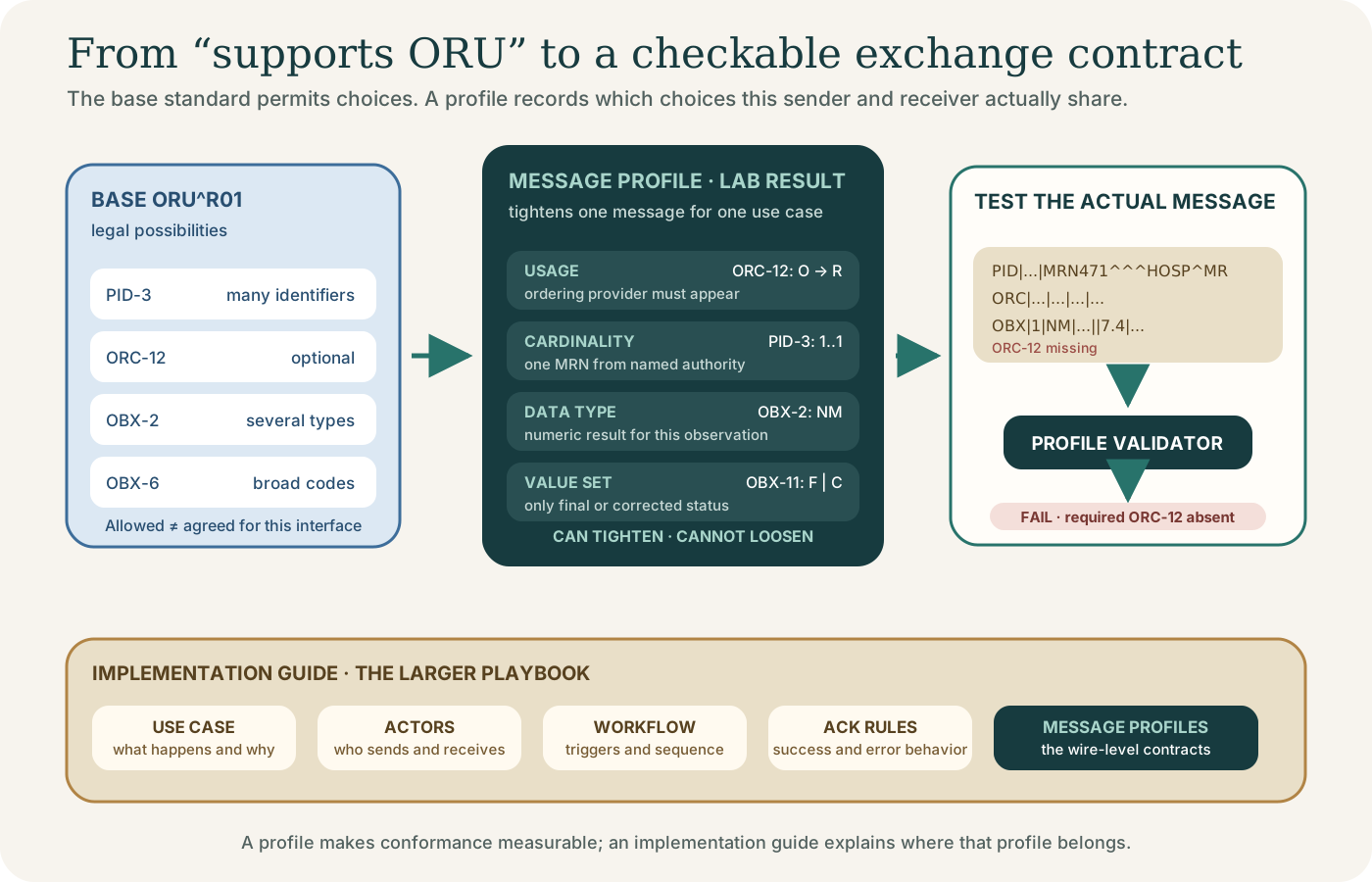
A message profile closes this gap. It is a precise and unambiguous specification of a single message definition, produced by profiling — the act of placing additional constraints on a base message definition 1. A profile never loosens the standard; it can only tighten it. Everything a profile permits must already be permitted by the base standard, so a message that conforms to a profile also conforms to the underlying standard.
How Profiling Constrains a Message
Profiling works by narrowing the choices the base standard leaves open. Several kinds of constraint are available 1:
- Usage. Each segment, field, and component carries a usage code that states whether it must, may, or must not appear. Profiling can tighten usage — for example, promoting a field the base standard marks Optional (O) to Required (R), so a conforming sender must always populate it and a conforming receiver must always process it. Usage can also be set to “not supported,” removing an element from the exchange entirely.
- Cardinality. The base standard often allows an element to repeat an unbounded number of times. A profile can narrow cardinality to an exact range — say, requiring exactly one patient-identifier repetition, or allowing at most three.
- Value sets. Coded fields in the base standard may accept any value from a large table. A profile can bind a field to a specific, smaller value set, or even fix a single constant value, so that ambiguity about codes disappears.
- Length and data type. Profiles can constrain maximum lengths and select a narrower data type or specific components within a complex data type.
Crucially, profiling also documents expectations. Beyond the machine-readable constraints, a profile records the use case, the actors, and the meaning each element carries in this exchange. Because every requirement is stated explicitly, conformance becomes measurable: a test engine can compare an actual message against the profile and report each deviation 1.
Profiles versus Implementation Guides
A message profile and an implementation guide are related but distinct. A profile constrains one message definition. An implementation guide (IG) provides the broader context for a real-world deployment and typically bundles a set of profiles covering one or more use cases 1. The IG explains the workflow, the participating actors, trigger events, acknowledgment behavior, and any local extensions, then points to the individual profiles that specify each message on the wire. In short, the profile is the precise grammar for a single message; the IG is the book that collects those grammars and explains when and why each is used.
A Concrete Example
Consider a base ORU laboratory-result message. The base standard makes the ordering-provider field optional, allows the observation-value field to use any of several data types, and places no binding on the units-of-measure code. A profile for a specific hospital-to-reference-lab exchange might:
- promote the placer order number and the ordering provider from Optional to Required, so results can always be matched back to an order;
- fix the result-status field to a small value set (for example, only “final” and “corrected”);
- bind the units field to a single coding system; and
- require exactly one patient identifier of a named assigning authority.
The same approach tightens an ADT admission message: a profile might require the attending-physician field, constrain the patient-class value set to the codes the receiving system understands, and forbid segments the receiver does not process. The result is a specification a vendor can build to without guessing.
The Payoff: From Loosely Conformant to Demonstrably Interoperable
The value of profiling is that it turns a loosely conformant standard into something demonstrably interoperable 2. Once expectations are written down as constraints, three things become possible. First, conformance testing: messages can be validated automatically against the profile before and after deployment, catching missing required fields or out-of-range codes that would otherwise surface as production failures. Second, clear vendor requirements: a procurement contract or interface specification can reference the profile rather than a vague claim of “HL7 v2 support,” so both parties know exactly what conforming software must do. Third, predictable integration: when two systems implement the same profile, the loose base standard no longer leaves room for incompatible choices.
In practice, this is how large-scale v2 interoperability is achieved. National and regional programs publish implementation guides — for laboratory reporting, immunization registries, syndromic surveillance, and admission/discharge feeds — each bundling profiles that constrain the relevant ADT, ORU, and related messages for that use case 1. Implementers build to the guide, test against its profiles, and can then state conformance as a checkable fact rather than an aspiration. Profiling is what makes the permissive v2 standard usable as a contract.
Lesson complete
Nice work.
Sources for this lesson
- 1HL7 Version 2 Conformance Methodology, Release 1. HL7 International. verifiedDefines profiling — placing additional constraints on a v2 message definition via message profiles and implementation guides.
- 2Tim Benson, Grahame Grieve. Principles of Health Interoperability: FHIR, HL7 and SNOMED CT. 4th ed. Springer. 2021. verified