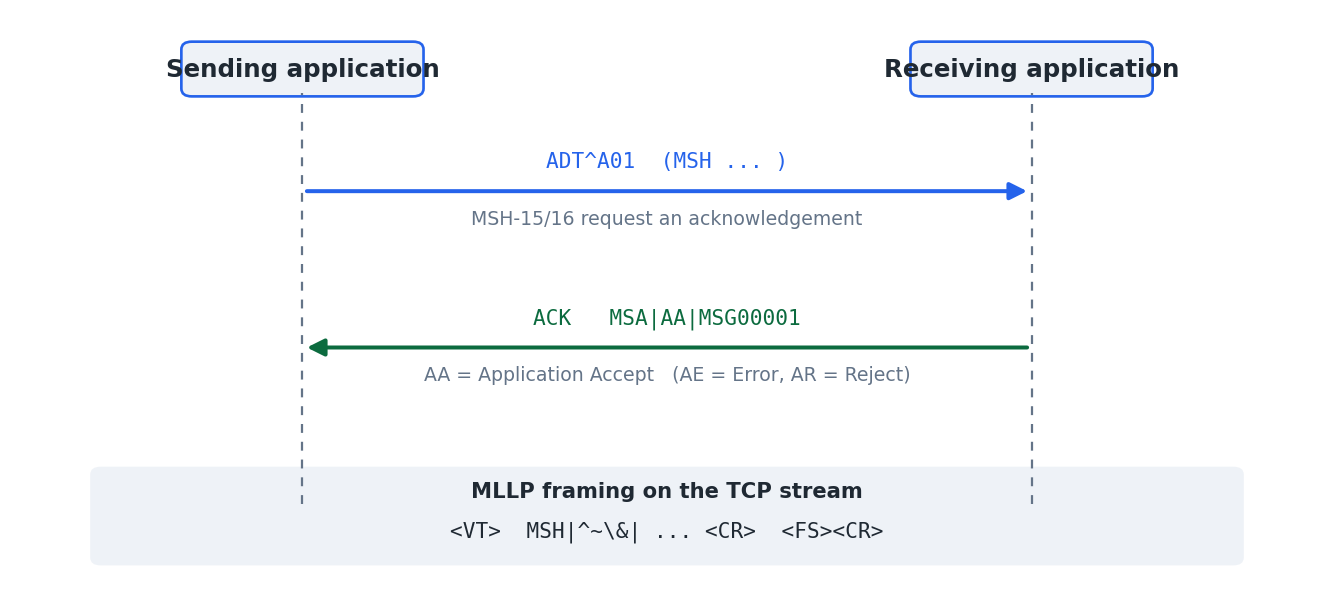
How v2 Messages Are Exchanged — Acknowledgments and MLLP
- 5 min
- 7 steps
- 2 questions
- Lesson 3 of 51
In this lesson
- One send creates several claims
- Correlate every response
- Read AA, AE, and AR as outcomes—not moods
- Original and enhanced acknowledgment modes
- MLLP frames the byte stream
- The unavoidable ambiguous timeout
- Observe the whole conversation
Picking up where you left off.
One send creates several claims
An interface needs to distinguish at least three outcomes:
- a connection accepted bytes;
- the receiver framed and parsed a message;
- the receiving application accepted or rejected the requested work.
These are not interchangeable. TCP can deliver bytes that do not form a valid HL7 message. MLLP can frame a valid message that fails a profile. An application can accept a structurally valid message but later fail to update the intended workflow. HL7 v2 acknowledgments exist because transport delivery alone does not prove application processing 1.
Correlate every response
The initiating message carries a control identifier in MSH-10:
MSH|^~\&|ADT1|HOSP|LAB|HOSP|202608091205-0500||ADT^A01^ADT_A01|MSG00001|P|2.5
The acknowledgment is a new message with its own MSH-10. Its MSA-2 echoes the initiating control ID:
MSH|^~\&|LAB|HOSP|ADT1|HOSP|202608091205-0500||ACK^A01^ACK|ACK90001|P|2.5
MSA|AA|MSG00001
This distinction matters in logs. ACK90001 identifies the acknowledgment message; MSG00001 identifies the message being acknowledged. Correlation should also retain source, destination, connection, timestamps, and route because different senders can accidentally reuse a control ID.
Read AA, AE, and AR as outcomes—not moods
The first field of MSA carries the acknowledgment code:
AA— Application Accept: application processing succeeded under the receiver’s rules.AE— Application Error: the message was accepted far enough to process, but an application error occurred.AR— Application Reject: the message could not be processed as submitted, commonly because of structural, version, or control problems.
The precise behavior belongs in the interface contract. Do not build retry logic around a vague rule such as “retry everything that is not AA.” Some errors are transient; others require correction or human review. Blind retry of an invalid patient identifier only produces a larger error queue.
When available, the ERR segment supplies structured error location, code, severity, and diagnostics. Modern v2 guidance favors ERR over relying on free-text MSA error fields 1. A useful receiver reports the narrowest safe location, such as a field or component, without exposing more patient data than support staff need.
Original and enhanced acknowledgment modes
MSH-15 and MSH-16 request accept- and application-level acknowledgments. Values such as AL (always), NE (never), ER (on error), and SU (on success) control when the corresponding response is expected. In original mode, one application acknowledgment usually represents the interaction. Enhanced mode separates acceptance of the message from later application processing 1.
Write down which mode the interface actually implements. A sender waiting for two responses while the receiver sends one will manufacture timeouts. A receiver returning an immediate positive accept acknowledgment must not let the sender misinterpret that as proof of final application commit.
MLLP frames the byte stream
TCP is a stream, not a sequence of application messages. The Minimal Lower Layer Protocol wraps each payload with control bytes:
0x0B  <HL7 payload ending in segment CRs>  0x1C 0x0D
  VT                                      FS   CR
The start byte marks the beginning of the block; file separator plus carriage return marks the end. The HL7 MLLP specification documents this long-used transport convention and its reliable-transport extensions 2.
Important implementation details include:
- do not assume one socket read equals one message;
- handle a message split across reads and multiple messages in one read;
- enforce maximum frame size and idle timeouts;
- reject or quarantine malformed framing without losing the next good frame;
- agree on character encoding and preserve segment carriage returns;
- use protected network transport where required—MLLP framing itself is not encryption.
The unavoidable ambiguous timeout
Consider this sequence:
- The sender transmits
MSG00001. - The receiver commits the admission.
- The receiver sends
AA. - The connection drops before the sender receives the ACK.
- The sender times out.
The sender cannot tell whether step 2 occurred. If it retries, the receiver may see the same business event twice. Therefore reliable delivery requires idempotent or duplicate-aware processing, not only retries. A receiver might use the control ID plus sending application and facility within a defined retention window, but business identifiers and event rules may also be needed. Control IDs are not automatically globally unique.
A safe retry state machine distinguishes:
- connection failure before a complete frame was sent;
- complete send with no ACK;
- explicit transient error;
- explicit permanent rejection;
- positive acknowledgment with downstream reconciliation still pending.
Backoff, attempt limits, dead-letter handling, and human ownership should be documented. “Keep retrying forever” hides a clinical workflow problem and can overwhelm a recovered destination.
Observe the whole conversation
For each exchange, capture secure, minimum-necessary operational evidence:
- message control ID and acknowledgment correlation;
- event type, version, source, destination, and route;
- send, receive, parse, application, and ACK timestamps;
- outcome code and structured error location;
- retry count, queue age, transformation version, and final disposition.
Measure both technical delivery and workflow reconciliation. A queue can be empty while messages were routed to the wrong destination; all ACKs can be positive while expected encounters are missing.
Practice: design the failure table
For an ADT feed, create rows for connection refused, partial frame, invalid MSH, unsupported event, unknown code, database timeout, ACK lost after commit, and duplicate retry. For each row specify: expected ACK or connection behavior, retryability, duplicate control, alert threshold, responsible team, and reconciliation evidence. The exercise turns “reliable interface” into testable behavior.
Practice
MSA-2 echoes the initiating message control ID so the sender can match the response to the correct message.
Practice
The sender cannot know whether processing failed or only the response was lost; safe duplicate detection is essential.
Lesson complete
Nice work.
Sources for this lesson
- 1HL7 Version 2.9 — Chapter 2: Control. HL7 International (HL7 Europe public mirror). 2019. verifiedDefines v2 message construction, delimiters, message control, original and enhanced acknowledgment modes, MSH, MSA, ERR, and processing rules. Cited at: acknowledgment processing rules; MSA and ERR; original and enhanced acknowledgment modes.
- 2HL7 Transport Specifications — MLLP (Minimal Lower Layer Protocol). HL7 International. verifiedThe de facto TCP framing wrapper for HL7 v2 messages. Release 2 adds commit acknowledgements for reliable transport. Cited at: framing and reliable transport.
Further reading
- HL7 Standards — Section 1d: Version 2 (V2). HL7 International. verifiedThe HL7 Version 2 messaging standard, first released October 1987 and the most widely implemented healthcare messaging standard worldwide.
- Tim Benson, Grahame Grieve. Principles of Health Interoperability: FHIR, HL7 and SNOMED CT. 4th ed. Springer. 2021. verified