Anatomy of an HL7 v2 Message
- 5 min
- 7 steps
- 2 questions
- Lesson 2 of 51
In this lesson
- A message is an ordered tree
- MSH is deliberately special
- Locate data precisely
- Message type, event, and structure are different
- Segment grammar matters
- Empty, null, and omitted are distinct
- A safe parsing sequence
Picking up where you left off.
A message is an ordered tree
HL7 v2 looks like plain text, but its structure is hierarchical:
message
└── segment
    └── field (may repeat)
        └── component
            └── subcomponent
Segments are normally terminated by carriage return. Within each segment, delimiters separate the lower levels. The standard’s Control chapter defines these generic construction rules for all v2 messages 1.
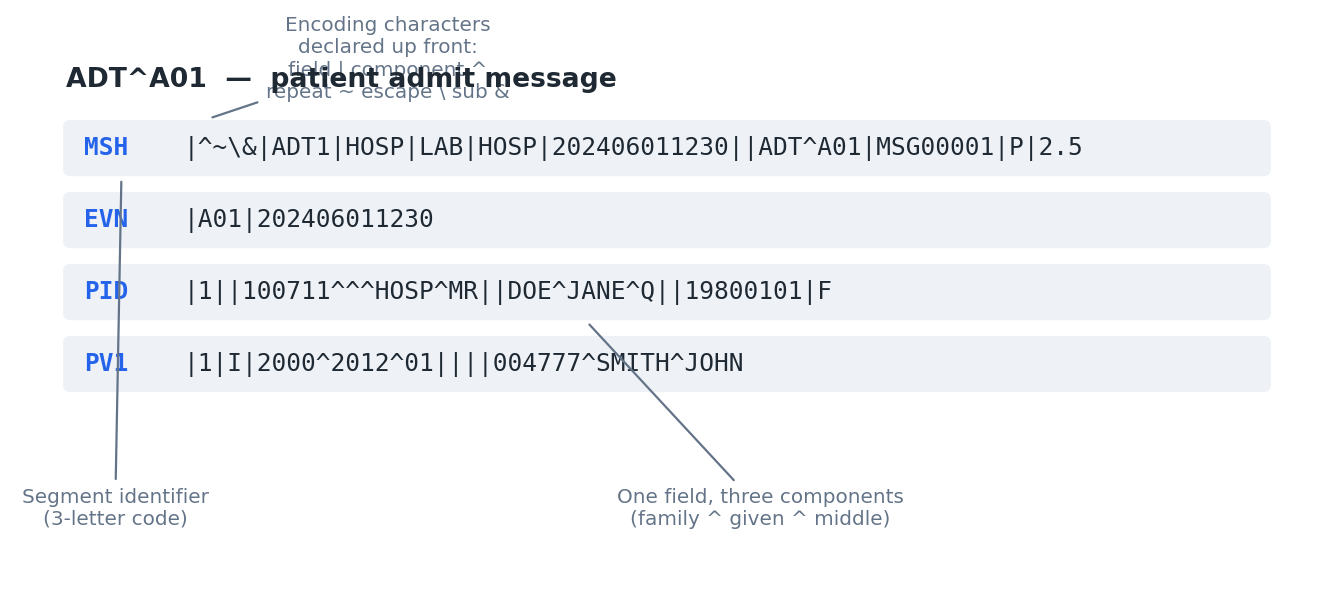
Here is a compact admission message:
MSH|^~\&|ADT1|HOSP|LAB|HOSP|202406011230-0500||ADT^A01^ADT_A01|MSG00001|P|2.5
EVN|A01|202406011230-0500
PID|1||100711^^^HOSP^MR||DOE^JANE^Q||19800101|F
PV1|1|I|2000^2012^01||||004777^SMITH^JOHN
Read it top to bottom: message header (MSH), event (EVN), patient identity (PID), and visit (PV1). The order and repetition of segments are defined by the message structure—not chosen arbitrarily 2.
MSH is deliberately special
Most segments begin with a three-character name followed by the field separator. MSH must also declare the separators needed to parse the rest of the message:
MSH|^~\&|...
   │││││
   ││││└─ subcomponent &
   │││└── escape \
   ││└─── repetition ~
   │└──── component ^
   └───── field |
The field separator is MSH-1; the next four characters are MSH-2. Do not split the full MSH line using assumed defaults before reading these positions. A robust parser discovers the delimiters from the message itself and then applies them consistently.
Locate data precisely
Interface teams commonly identify an element as segment-field.component.subcomponent, optionally naming a repetition. Examples:
MSH-9.1= message code, hereADT;MSH-9.2= trigger event, hereA01;MSH-9.3= message structure, hereADT_A01;PID-3[1].1= first repetition’s identifier value;PID-3[1].4= its assigning authority;PV1-3.1= point of care within the patient location.
This notation is more useful than saying “the patient ID field.” PID-3 can repeat, and each CX repetition contains its own assigning authority and identifier type. A value without its structural context is often ambiguous.
The data-type chapter defines the components that make a composite meaningful 3. For example, DOE^JANE^Q is not three unrelated strings; it is an XPN name whose positions carry family, given, and second-name roles.
Message type, event, and structure are different
MSH-9 may contain three components:
ADT^A01^ADT_A01
ADTnames the broad message code;A01names the real-world trigger event;ADT_A01names the abstract segment structure.
Several events can share one structure. Routing only on ADT throws away important workflow meaning; routing on the full declared contract is safer. Likewise, a receiver should not infer event meaning only from which optional segments happened to appear.
Segment grammar matters
A message definition behaves like a grammar: some segments are required, some optional, and some repeat in groups. An order message may repeat an ORC/OBR group; a result may repeat observations beneath an order. Flattening the message into an unordered dictionary loses these relationships.
Three visual cues are not enough by themselves:
- a segment appearing once does not prove its maximum cardinality is one;
- an absent optional segment is not the same as a prohibited segment;
- a parseable segment in the wrong group can still be nonconformant.
Validate the actual message against the agreed version and profile, not merely against a generic list of segment names.
Empty, null, and omitted are distinct
Two separators with nothing between them indicate an unpopulated field. In many v2 contexts, a pair of double quotes ("") is used as a null value instruction. Omission, empty content, and explicit null can drive different update behavior under an implementation guide. Never normalize them all to the same database value without a documented rule.
The same caution applies to trailing fields and components. Senders often omit unused trailing delimiters. A positional parser must preserve the intended field numbers even when the textual line looks short.
A safe parsing sequence
- Preserve the original bytes and message boundaries.
- Confirm the first segment and discover MSH delimiters.
- Split segments using the segment terminator.
- Parse fields, repetitions, components, and subcomponents without discarding empty positions.
- Read version and message type from MSH.
- Select the agreed message profile.
- Validate structure, usage, cardinality, length, data types, and value sets.
- Map into application data only after validation and identity checks.
Logging should identify the message and error location without casually duplicating protected health information. Preserve a secure audit trail that connects the inbound control ID, acknowledgment, route, transformation version, and downstream outcome.
Worked reading exercise
For the sample message, answer:
- What event occurred, and which structure was declared?
- Which organization assigned identifier
100711? - Is
2000^2012^01one field or three fields? - Which time values include an explicit UTC offset?
- Which assumptions would still require an interface profile?
Then deliberately mutate one element: remove the assigning authority, place A03 in the event component without changing the workflow, or add an unexpected PID repetition. Predict whether the failure should be caught by parsing, profile validation, semantic validation, or application reconciliation. That separation is the foundation of useful interface troubleshooting.
Practice
MSH is special; the character immediately after its segment name declares the field separator.
Practice
An empty field is not populated; it must not be silently converted to zero, false, or an empty-string instruction.
Lesson complete
Nice work.
Sources for this lesson
- 1HL7 Version 2.9 — Chapter 2: Control. HL7 International (HL7 Europe public mirror). 2019. verifiedDefines v2 message construction, delimiters, message control, original and enhanced acknowledgment modes, MSH, MSA, ERR, and processing rules. Cited at: message construction and control.
- 2HL7 Standards — Section 1d: Version 2 (V2). HL7 International. verifiedThe HL7 Version 2 messaging standard, first released October 1987 and the most widely implemented healthcare messaging standard worldwide. Cited at: message definitions.
- 3HL7 Version 2.9 — Chapter 2A: Data Types. HL7 International (HL7 Europe public mirror). 2019. verifiedDefines primitive and composite v2 data types, including CWE, CX, XCN, XPN, identifiers, names, timestamps, coded values, and their components. Cited at: composite data types.
Further reading
- Tim Benson, Grahame Grieve. Principles of Health Interoperability: FHIR, HL7 and SNOMED CT. 4th ed. Springer. 2021. verified