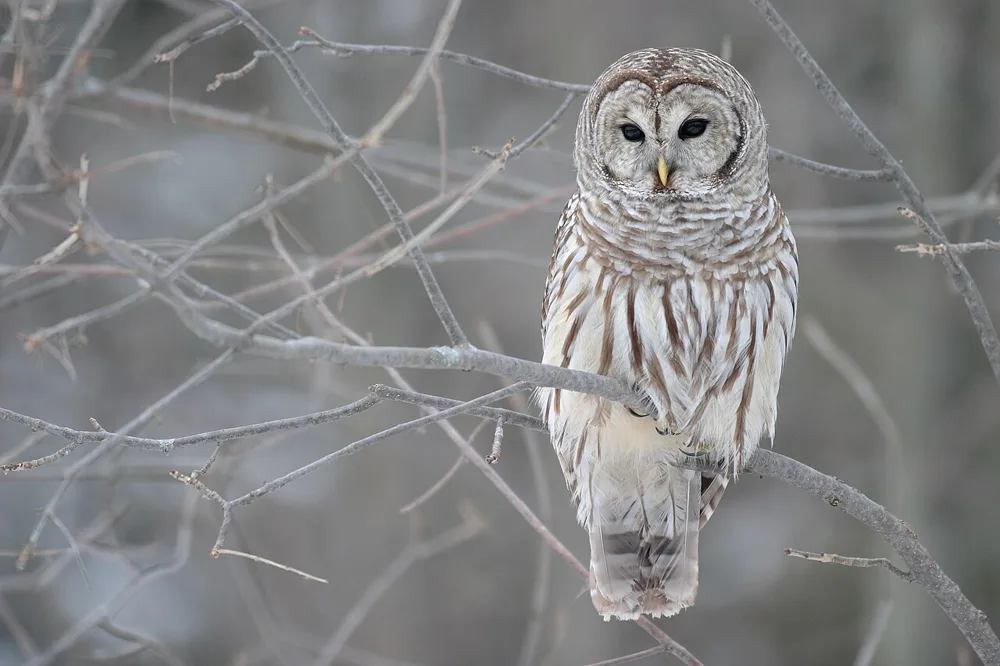
How Can Owls Turn Their Heads So Far?
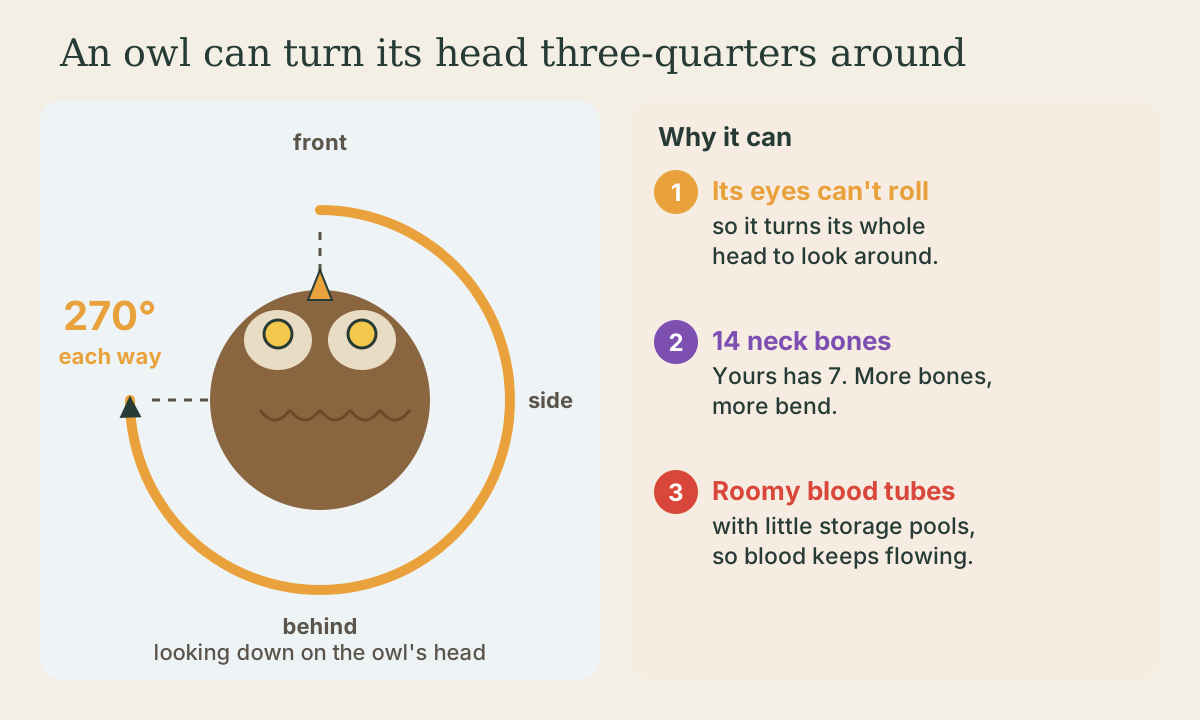
An owl can turn its head up to 270 degrees, three-quarters of the way around, in either direction. It needs to, because its huge eyes are fixed in place and can't roll. Its neck has 14 bones, twice as many as yours, and the blood tubes in its neck have extra room and little storage pools, so blood keeps flowing to its brain and eyes while it twists.
- 4 min
- 5 steps
- 3 questions
- Lesson 15 of 157
In this lesson
- The short answer
- Eyes that can’t move
- A neck full of bones
- Keeping the blood flowing
- So
Picking up where you left off.
The short answer
An owl can turn its head as far as 270 degrees, which is three-quarters of the way around, to the left or to the right. It has to, because an owl’s big eyes are fixed in place and can’t roll around the way yours can. Its body is built for all that turning: its neck has 14 bones, twice as many as yours, and the blood tubes in its neck have extra room and little storage pools, so blood keeps reaching its brain and eyes the whole time 1.
Eyes that can’t move
Try this: keep your head still and look to the side. Your eyes can roll around in their sockets, so you can look sideways without turning your head.
An owl can’t do that. Its eyes are huge for its size, so they can gather lots of light to see at night, and they’re shaped more like tubes than balls. They’re held tight in the skull and can’t roll 1. So whenever an owl wants to look at something, a mouse rustling in the grass, a sound behind it, it turns its whole head to point its eyes there.

Quick check
You can look sideways just by moving your eyes. An owl has to move its head.
A neck full of bones
Your neck has 7 bones, stacked like a little tower. An owl’s neck has 14 1. Each place where two bones meet can bend and twist a little, and with twice as many places to bend, an owl’s neck can turn much farther than yours. Under all those fluffy feathers, an owl’s neck is longer and bendier than it looks.
Quick check
More neck bones means more places to bend.
Keeping the blood flowing
Turning that far could cause a problem. Blood travels up the neck in tubes to bring the brain and eyes the food and oxygen they need. If you twist a tube hard, it can get pinched, the way a garden hose stops spraying when you kink it.
An owl’s neck solves that in three ways 1:
- The holes in the neck bones that the blood tubes run through are about 10 times wider than the tubes, so the tubes have room to move instead of getting squeezed.
- Just under the owl’s jaw, the blood tubes widen into little storage pools that hold extra blood for the brain and eyes while the owl is turned.
- The tubes are connected to each other in extra places, so if one gets squeezed, blood takes another path.
Scientists at Johns Hopkins University figured this out in 2013 by studying owls that had died of natural causes 1.
Playback is optional. If the player is unavailable, open the video at its source.
Quick check
The tubes don’t get pinched, and the pools keep the brain and eyes supplied.
So
An owl turns its head up to three-quarters of the way around because its big eyes can’t move, so it moves its head instead. Fourteen neck bones give it lots of places to bend, and roomy blood tubes with storage pools keep blood flowing to its brain and eyes the whole time it’s turned.
Lesson complete
Nice work.
Sources for this lesson
- 1Owl Mystery Unraveled: Johns Hopkins Scientists Discover How Bird Can Rotate Its Head. Johns Hopkins Medicine (via ScienceDaily). 2013. verifiedOwls can turn their heads as much as 270 degrees in either direction; their eyes are fixed in their sockets, so they turn the head to look; they have 14 neck vertebrae to a human's 7; the holes in the neck bones the vertebral artery runs through are about 10 times wider than the artery, giving it slack and cushioning; blood vessels under the jaw widen into reservoirs that pool blood for the brain and eyes; extra connections between arteries keep blood flowing if one route is squeezed. Published in Science by de Kok-Mercado and Gailloud.