How Does a Touchscreen Know Where You Touch?
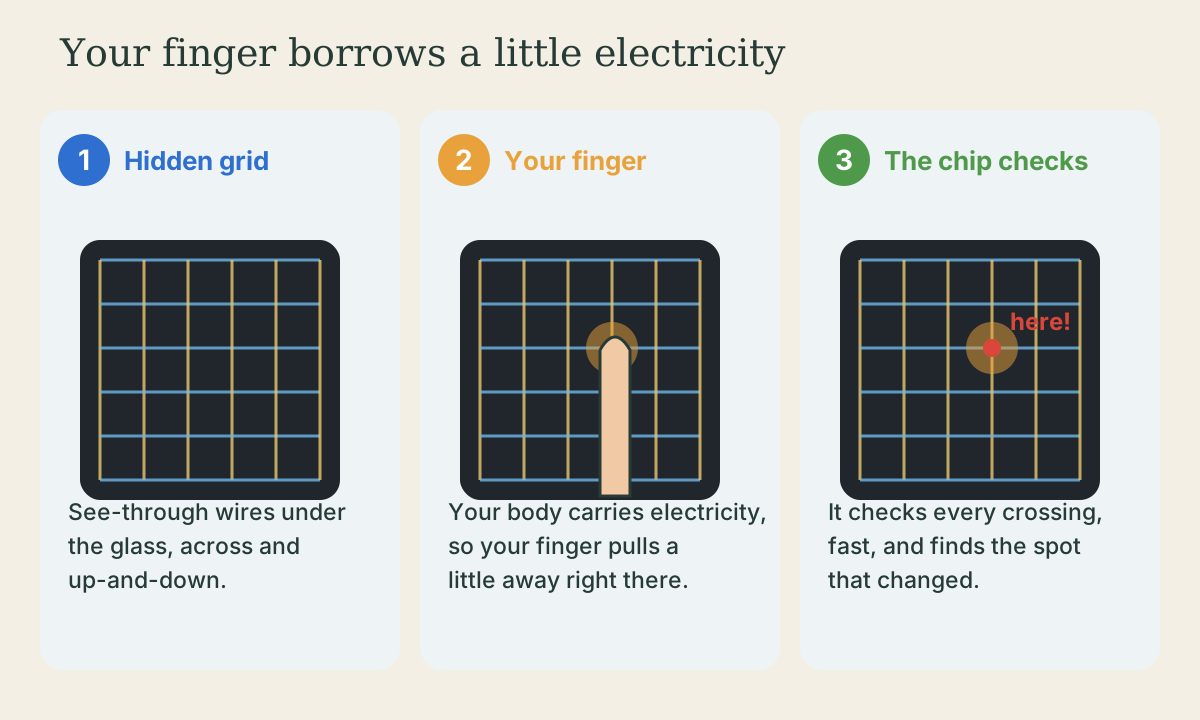
Under the glass of a phone or tablet is a grid of wires so thin you can see right through them, some running across and some running up and down, with a tiny bit of electricity buzzing in them. Your body is good at carrying electricity, so when your finger touches the glass, it pulls a little of that electricity away at the spot where you touch. A tiny computer chip checks every place where the wires cross, over and over, super fast. When it finds the spot where the electricity changed, it knows exactly where your finger is.
- 3 min
- 5 steps
- 2 questions
- Lesson 150 of 157
In this lesson
- The short answer
- A hidden grid
- Your finger is part of it
- The chip checks
- So
Picking up where you left off.
The short answer
Under the glass of a phone or tablet is a grid of wires so thin you can see right through them, with a tiny bit of electricity buzzing in them 1. Your body is good at carrying electricity, so when your finger touches the glass, it pulls a little of that electricity away right where you touch 1. A tiny computer chip checks every spot where the wires cross, super fast, and finds the one where the electricity changed. That’s where your finger is.
A hidden grid
If you could peel the glass off a touchscreen, you’d find a layer of wires made of a special see-through material. Some run across the screen in rows, and some run up and down in columns, like the lines on graph paper 1. Every place where a row crosses a column is a little spot the screen can check.
A tiny, safe amount of electricity is always buzzing through those wires. It’s much too small for you to feel.
Quick check
Some wires run across and some up and down, making lots of crossing points.
Your finger is part of it
People are good at carrying electricity 1. When your fingertip rests on the glass, right over a few of those crossing points, it pulls a little of the electricity away into your body, and the amount at those crossings changes. Your hand holding the phone completes the loop, so the electricity has somewhere to go 1. The tiny amount is well within what your body handles all the time naturally.
That’s also why a plastic pen or a thick glove doesn’t work on most phones: plastic and cloth don’t carry electricity, so they can’t pull any away, and the screen doesn’t notice them.
Quick check
Your finger pulls away a little electricity; plastic can’t, so the screen doesn’t notice it.
The chip checks
Behind the grid is a tiny computer chip that checks every crossing point, over and over, many times every second 1. When it finds the spots where the electricity changed, it figures out exactly where your finger is. If two fingers touch, it finds two spots, which is how you can pinch to zoom. Because the chip is so fast, the picture on the screen can follow your finger smoothly as you swipe.
Playback is optional. If the player is unavailable, open the video at its source.
So
A touchscreen has a see-through grid of wires under the glass with a little electricity in it. Your finger carries electricity, so it pulls some away at the spot you touch, and a fast chip checks every crossing, finds the spot that changed, and knows where you touched.
Lesson complete
Nice work.
Sources for this lesson
- 1How do touch-sensitive screens work?. MIT School of Engineering, Ask an Engineer. verifiedCapacitive touchscreens are blanketed with a grid of electrodes carrying a small alternating current; a finger forms a capacitive contact and, because people are good conductors, draws a little current and completes the circuit through the body; a fast microcontroller behind the grid finds the location. The currents are within natural levels for the body.