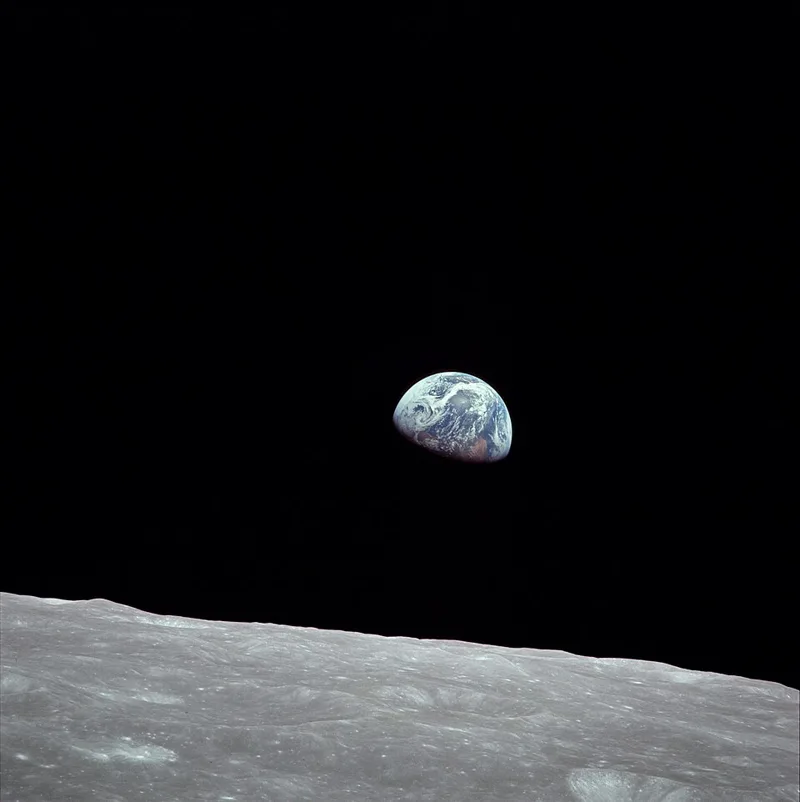
If the Sun Is So Bright, Why Is Space Dark?
Light is invisible while it's zooming along. You only see light when it comes into your eyes. On Earth, the air is full of tiny bits that bounce sunlight in every direction, blue light most of all, so light comes at you from the whole sky and the sky glows blue. In space there's almost no air, so nothing bounces the sunlight toward you. It streams right past, and space looks black, even right next to the Sun. Only things the light hits, like the Moon, a planet, or a spacecraft, shine. And the night sky isn't full of starlight because the universe hasn't been around forever, so light from the farthest stars hasn't reached us yet.
- 5 min
- 8 steps
- 2 questions
- Lesson 127 of 157
In this lesson
- The short answer
- You only see light that reaches your eyes
- Why our sky glows
- Up in space
- On the Moon
- But what about all the stars?
- Try it
- So
Picking up where you left off.
The short answer
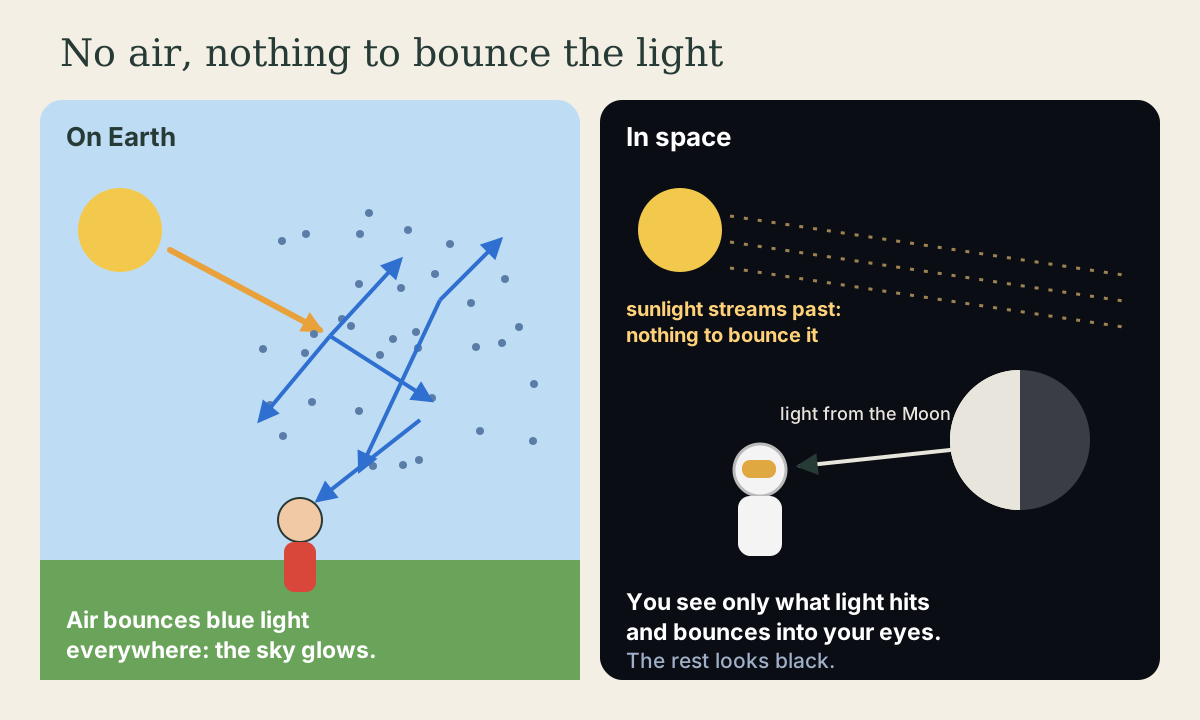
Light is invisible while it travels. You only see light when it comes into your eyes. On Earth, the air bounces sunlight in every direction, so light comes at you from the whole sky and the sky glows. In space there’s no air, so nothing bounces the sunlight toward you. It streams right past, and space looks black. Only things the sunlight hits, like the Moon, shine 1.
You only see light that reaches your eyes
Here’s something that seems strange at first: you can’t see a beam of light from the side.
Think of a flashlight in a dark room. You see the bright spot where the beam lands on the wall, because light bounces off the wall and into your eyes. But the beam itself, crossing the room, is almost invisible, unless the air is dusty or foggy. Then the dust or fog bounces some light toward you, and you can see the beam.
Sunlight works the same way. You see the Sun because its light shines straight into your eyes. You see the Moon because sunlight hits it and bounces off to you. Light that’s just passing by, not coming toward you, you can’t see.
Why our sky glows
Earth is wrapped in a blanket of air. Air is made of tiny bits, much too small to see. When sunlight hits them, they bounce it every which way. That’s called scattering 1.
Sunlight is a mix of all the colors. The air scatters blue light the most, because blue light travels in smaller, shorter waves 2. So everywhere you look in the daytime sky, scattered blue light is coming at you, and the whole sky glows blue 2 1.
Quick check
On the Moon, which has no air, the sky is black even in the middle of the day.
Up in space
In space, there’s almost no air. Nothing scatters the sunlight. It zooms straight past without coming to your eyes, so space looks black, even close to the Sun 1.
The Sun still shines very brightly on anything it hits. A spacecraft, a planet, or the Moon in sunlight gleams, while the space around it is black.

On the Moon
The Moon has no air at all. So on the Moon, the sky is black even in the middle of the day, with the Sun blazing overhead 1.
If you stood on the Moon in a deep shadow, where the Sun’s glare and the bright ground couldn’t shine in your eyes, you could see the stars in the daytime 1.
So why don’t the photos astronauts took on the Moon show stars? The sunlit ground was so bright that the cameras had to be set for bright things. The faint stars were too dim to show up in the pictures 1.
Mars has a little bit of air, about 100 times thinner than ours. That’s enough to make its sky a deep grayish blue, or pinkish when winds stir up its dust 1.
Quick check
An astronaut standing in a deep shadow, out of the glare, would be able to see the stars.
But what about all the stars?
At night, our side of Earth faces away from the Sun, and you can see stars. But between them, the sky is dark. Why isn’t it full of starlight?
Scientists puzzled over this for a long time. If space went on forever with stars spread all through it, then in every direction you looked, you’d eventually see a star. The whole night sky would blaze as bright as the surface of a star 3.
Here’s why it doesn’t 3:
- The universe hasn’t been around forever. Light takes time to travel, and light from stars very, very far away hasn’t had time to get here yet.
- Space is stretching. Light from the farthest stars gets stretched on its long trip, into kinds of light our eyes can’t see.
Playback is optional. If the player is unavailable, open the video at its source.
Try it
In a dark room, turn on a flashlight and point it at a wall. Look at the space between the flashlight and the wall: you can hardly see the beam. Now ask a grown-up to gently mist a little water from a spray bottle into the beam. Suddenly you can see it! The water droplets bounce light into your eyes, like the air does with sunlight. Space doesn’t have anything to do that.
So
Space is dark because light only shows up when it bounces into your eyes. On Earth, the air scatters sunlight all over the sky, so the sky glows. In space, there’s no air, so sunlight streams past unseen, and only the things it lights up, like the Moon, shine. And the night sky stays dark between the stars because light from the farthest stars hasn’t reached us yet.
Lesson complete
Nice work.
Sources for this lesson
- 1Geoff Chester. How is it that in space, despite the Sun's presence, the surroundings look black?. Astronomy magazine (Ask Astro). 2015. verifiedIn two words: no atmosphere. Atmospheres scatter light; Earth's scatters blue preferentially, so the day sky is blue; Mars' air, about 100 times thinner, still makes a deep grayish blue sky, salmon pink when dust is up. The Moon has no air and so a black sky; from a deep enough shadow an astronaut could see stars. Apollo photos show no stars because the film's limited range forced exposures for the sunlit highlights. Answer by the U.S. Naval Observatory's Geoff Chester, February 2015 issue.
- 2Why Is the Sky Blue?. NASA Space Place. verifiedScattering of sunlight by air; why sunsets turn red and orange.
- 3R. Nave. Olbers' Paradox: Why Is the Sky Dark at Night?. HyperPhysics, Georgia State University. verifiedIf the universe were infinite and uniformly filled with stars, every line of sight would end on a star and the sky would be as bright as a star's surface. It isn't, because the universe has a finite age, so light from very distant stars hasn't reached us, and because expansion redshifts light from distant stars out of the visible range.