Arrays and Mass Spectrometry
Massively parallel hybridization and mass-based detection: expression, SNP, and chromosomal microarrays (array-CGH and SNP arrays for copy number and loss of heterozygosity), bead arrays, MALDI-TOF genotyping by primer extension mass, and MALDI-TOF identification of microbes by protein fingerprint.
- 4 min
- 3 steps
- 4 questions
- Lesson 34 of 60
In this lesson
- Microarrays
- Mass spectrometry
- What to take from this
Picking up where you left off.
Microarrays
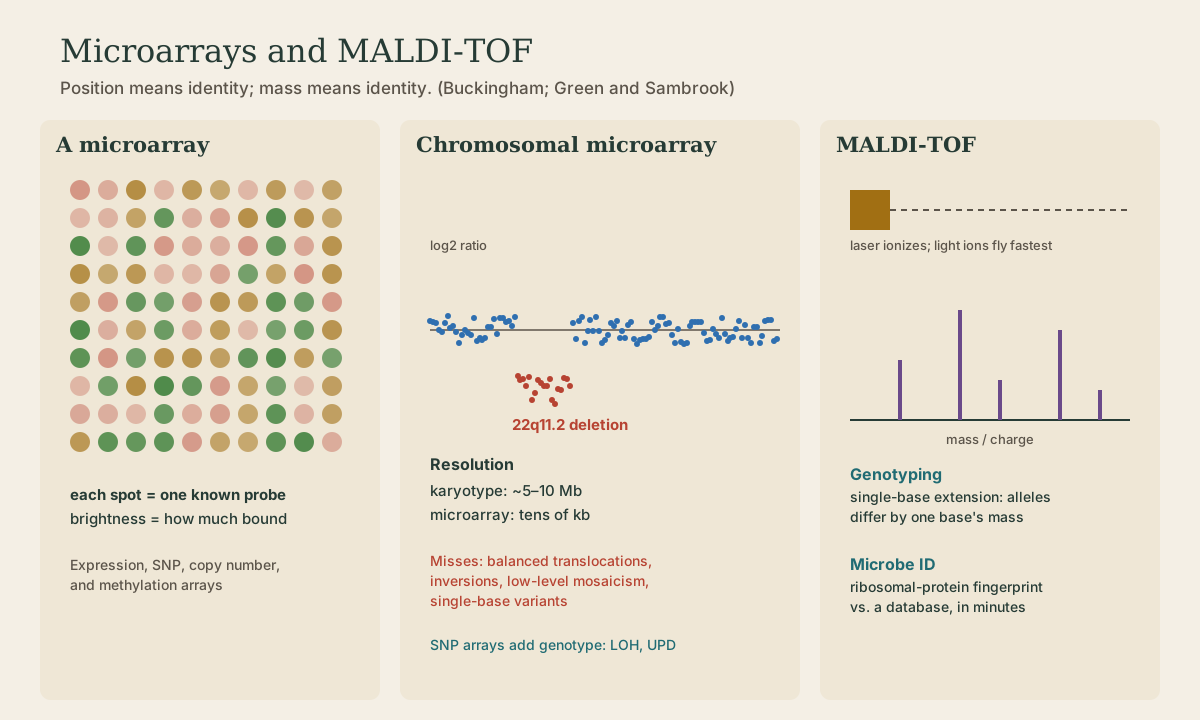
A microarray is massively parallel hybridization: thousands to millions of known probes, each at its own address on a chip 1. A labeled sample is hybridized to the whole array, washed, and scanned; the intensity at each address reports how much of that probe’s target bound 2. Position means identity.
| Array | Probes detect | Uses |
|---|---|---|
| Expression | transcripts (labeled cDNA/cRNA) | expression profiling 3; largely replaced by RNA-seq |
| SNP / genotyping | single-base alleles, by mismatch discrimination or primer extension | genome-wide SNPs, pharmacogenomic panels 1 |
| Chromosomal microarray (CMA) | copy number across the genome | microdeletions and duplications |
| Methylation | bisulfite-converted CpG sites | tumor classification |
Chromosomal microarray is the first-tier test for unexplained developmental delay, intellectual disability, autism, and multiple congenital anomalies, because it finds submicroscopic deletions and duplications - tens of kilobases rather than the 5-10 megabases a karyotype resolves 1:
- Array-CGH: patient and reference DNA labeled in two colors and co-hybridized; the ratio at each probe shows gains and losses.
- SNP arrays: single-sample intensity plus genotype, which reveals loss of heterozygosity, uniparental disomy, and long runs of homozygosity (suggesting consanguinity or a recessive region) - and in tumors, copy-neutral LOH.
- Blind spots: balanced translocations and inversions (no copy change), low-level mosaicism, and single-base variants.
Examples it detects: 22q11.2 deletion (DiGeorge), 7q11.23 deletion (Williams), 15q11-q13 deletions.
Bead arrays put probes on coded microbeads instead of a flat chip; flow-based readers or high-density bead chips read them. Multiplexed bead assays power some pathogen panels, HLA typing, and large SNP chips.
Quick check
The signal intensity at each address reports how much complementary target bound.
Quick check
It can’t see balanced rearrangements, which change no copy number.
Quick check
Long runs of homozygosity also hint at consanguinity, raising suspicion for recessive disorders.
Mass spectrometry
A MALDI-TOF (matrix-assisted laser desorption/ionization time-of-flight) instrument embeds the sample in a matrix, ionizes it with a laser, and measures how long ions take to fly down a tube: lighter ions arrive sooner, giving a mass spectrum 1.
Genotyping by mass: after PCR, a primer ending just before the variant is extended by a single base; the two alleles give products differing by one nucleotide’s mass, which MALDI-TOF separates. Dozens of SNPs can be multiplexed per well, for pharmacogenomics, somatic hotspots, and sample identity panels 1.
Microbe identification: a smear of a colony gives a spectrum dominated by abundant ribosomal proteins - a fingerprint matched against a database to identify the organism in minutes. MALDI-TOF has replaced many biochemical identification panels in clinical microbiology; sequencing (16S, ITS) handles what the database can’t (see Microbial Genetics).
Quick check
Minutes per isolate from a colony; it has replaced many biochemical identification panels.
What to take from this
Microarrays read thousands of known probes at fixed addresses. Chromosomal microarray finds microdeletions and duplications far below karyotype resolution - first-tier for developmental delay - and SNP arrays add genotypes for LOH and UPD, but balanced rearrangements stay invisible. MALDI-TOF measures mass: single-base extension products for multiplex genotyping, and protein fingerprints for identifying microbes from a colony in minutes.
Lesson complete
Nice work.
Sources for this lesson
- 1Lela Buckingham. Molecular Diagnostics: Fundamentals, Methods, and Clinical Applications. 3rd ed. F.A. Davis Company. 2019. verifiedThe standard clinical molecular-diagnostics textbook for MLS/MB programs; author holds MB DLM(ASCP). Covers nucleic-acid chemistry, techniques, lab operations, and applications across infectious disease, oncology, genetics, and identity. Primary topic reference for the ASCP MB program.
- 2Michael R. Green, Joseph Sambrook. Molecular Cloning: A Laboratory Manual. 4th ed. Cold Spring Harbor Laboratory Press. 2012. verifiedThe classic three-volume molecular-biology methods manual — authoritative for nucleic-acid isolation, electrophoresis, restriction digestion, labeling, and hybridization techniques. Standard-tier topic reference for the techniques courses.
- 3Bruce Alberts, Rebecca Heald, Alexander Johnson, David Morgan, Martin Raff, Keith Roberts, Peter Walter. Molecular Biology of the Cell. 7th ed. W. W. Norton & Company. 2022. verifiedThe canonical cell/molecular biology textbook; used for nucleic-acid chemistry and the central dogma.