DNA and RNA Structure
Nucleotides, the 2' carbon that separates DNA from RNA, the phosphodiester backbone and its 5'-to-3' direction, and the three chemical facts every bench method leans on: a negative backbone, alkali-labile RNA, and absorbance at 260 nm.
- 5 min
- 6 steps
- 5 questions
- Lesson 1 of 60
In this lesson
- Overview
- The nucleotide
- The backbone
- Three properties the lab depends on
- DNA vs. RNA at a glance
- What to take from this
Picking up where you left off.
Overview
Every molecular test - extraction, PCR, electrophoresis, sequencing - works by exploiting the chemistry of two polymers, DNA and RNA. Both are long, unbranched chains of nucleotides, and the order of the nucleotides carries the genetic information 1.
The nucleotide
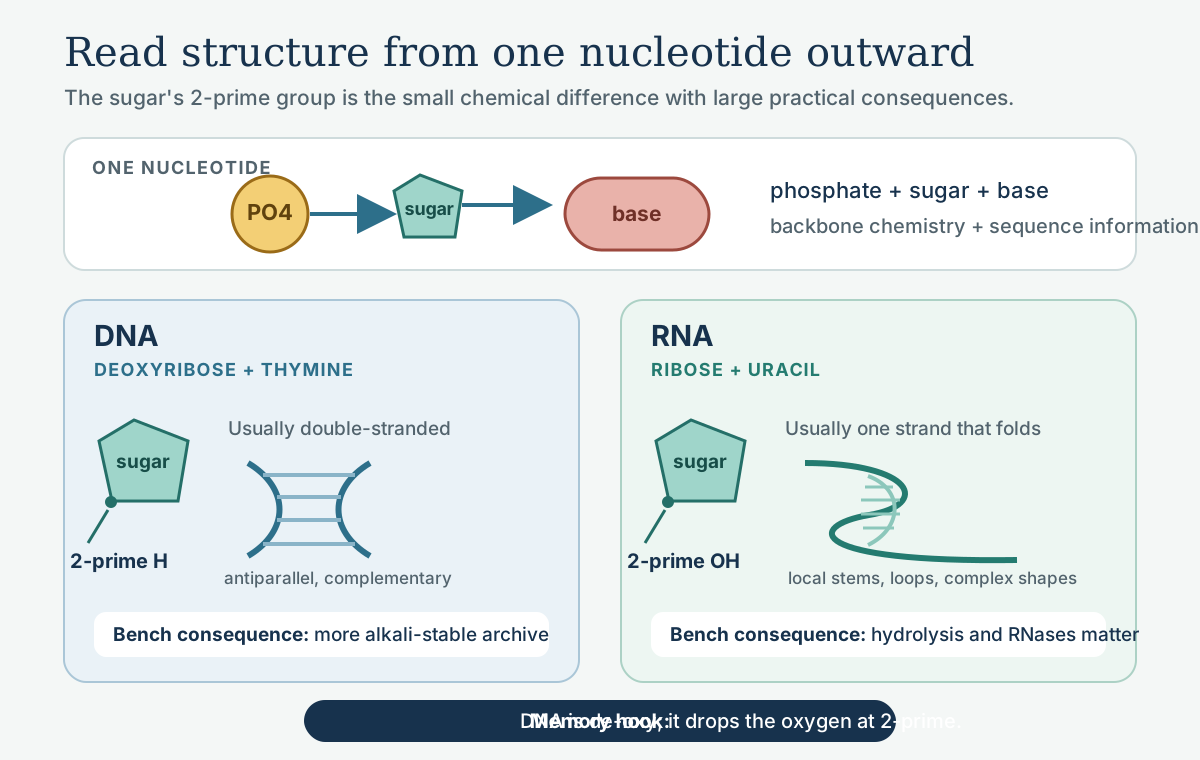
A nucleotide has three parts: a five-carbon sugar, one to three phosphates, and a nitrogenous base 2. Sugar plus base alone is a nucleoside; add a phosphate and it’s a nucleotide.
The sugar. Its carbons are numbered 1’ to 5’ (“one prime”), the primes separating them from the base’s atoms. The base hangs off 1’, the phosphate off 5’, and the next nucleotide links at 3’.
| RNA | DNA | |
|---|---|---|
| Sugar | ribose | 2’-deoxyribose |
| 2’ carbon carries | -OH | -H |
Deoxy- means exactly that missing oxygen at 2’ 2.
The phosphate. Free nucleotides carry one, two, or three phosphates. The triphosphates (dATP, dGTP, dCTP, dTTP for DNA) are what polymerases consume: breaking off two phosphates pays for adding the nucleotide to a chain 1. These are the “dNTPs” in every PCR master mix.
The bases.
| Family | Structure | Bases | In |
|---|---|---|---|
| Purines | two fused rings | adenine (A), guanine (G) | DNA and RNA |
| Pyrimidines | one ring | cytosine (C) | DNA and RNA |
| thymine (T) | DNA only | ||
| uracil (U) | RNA only |
Thymine is uracil with a methyl group added 1. The standard hooks: “Pure As Gold” (purines are A and G) and “CUT the Py” (pyrimidines are C, U, T).
Quick check
Add at least one phosphate to a nucleoside and it becomes a nucleotide.
Quick check
Purines have a fused double ring (A, G); pyrimidines have one ring (C, T, U).
The backbone
Phosphodiester bonds join the 5’ phosphate of one nucleotide to the 3’ hydroxyl of the next, making a sugar-phosphate backbone with the bases sticking out to the side 2.
Because every link runs 3’ to 5’, a strand has a direction: a free 5’ phosphate at one end, a free 3’-OH at the other. Sequences are always written 5’ to 3’, and polymerases only add to the 3’ end, so all synthesis runs 5’→3’ 1. That one rule explains primer design, the lagging strand in replication, and why a primer with a mismatched 3’ end fails to extend.
Double-stranded DNA pairs two strands running in opposite directions (antiparallel):
5'-ATGC-3'
3'-TACG-5'
RNA is usually single-stranded but folds back on itself into hairpins and other local double-stranded regions.
Quick check
Polymerases attach each incoming nucleotide’s 5’ phosphate to the free 3’-OH of the growing strand.
Three properties the lab depends on
A negative backbone. Each phosphate is negatively charged at buffer pH, so a nucleic acid has a uniform negative charge proportional to its length. In a gel every fragment runs toward the positive electrode (anode), and the gel matrix sorts them by size 3. The same charge is what lets nucleic acids bind silica in chaotropic salt during extraction.
Fragile RNA. Under alkaline conditions RNA’s 2’-OH attacks the adjacent phosphodiester bond and cuts the chain; DNA, without the 2’-OH, resists this 3. RNA is also attacked by ubiquitous, hardy RNases, so RNA work needs RNase-free reagents, gloves, and cold handling. Alkaline treatment is used deliberately to remove RNA from DNA preparations.
Absorbance at 260 nm. The base rings absorb UV light maximally near 260 nm, so A260 measures how much nucleic acid is present; proteins peak near 280 nm, so the A260/A280 ratio flags protein contamination 3. Spectrophotometry and its purity ratios come back in the nucleic acid prep course.
Quick check
Alkaline hydrolysis needs the 2’-hydroxyl; deoxyribose doesn’t have one. Labs use this on purpose to strip RNA from DNA preps.
Quick check
Charge per unit length is constant, so the gel’s sieving separates fragments by size.
DNA vs. RNA at a glance
| Property | DNA | RNA |
|---|---|---|
| Sugar | 2’-deoxyribose | ribose (2’-OH) |
| Bases | A, G, C, T | A, G, C, U |
| Usual form | double strand | single strand, folded |
| Stability | stable; alkali-resistant | fragile; alkali-labile, RNase-sensitive |
| Job | long-term storage | expression and regulation |
What to take from this
A nucleotide is a sugar, phosphate, and base. DNA differs from RNA at the sugar’s 2’ carbon (H vs OH) and in using thymine instead of uracil. The backbone runs 5’→3’, strands pair antiparallel, and synthesis always adds to the 3’ end. The negative backbone drives electrophoresis, the 2’-OH makes RNA fragile, and base rings absorbing at 260 nm let you measure nucleic acid.
Lesson complete
Nice work.
Sources for this lesson
- 1Bruce Alberts, Rebecca Heald, Alexander Johnson, David Morgan, Martin Raff, Keith Roberts, Peter Walter. Molecular Biology of the Cell. 7th ed. W. W. Norton & Company. 2022. verifiedThe canonical cell/molecular biology textbook; used for nucleic-acid chemistry and the central dogma.
- 2David L. Nelson, Michael M. Cox, Aaron A. Hoskins. Lehninger Principles of Biochemistry. 8th ed. W. H. Freeman (Macmillan Learning). 2021. verifiedStandard biochemistry reference for nucleotide chemistry, nucleic-acid structure, and enzymology.
- 3Lela Buckingham. Molecular Diagnostics: Fundamentals, Methods, and Clinical Applications. 3rd ed. F.A. Davis Company. 2019. verifiedThe standard clinical molecular-diagnostics textbook for MLS/MB programs; author holds MB DLM(ASCP). Covers nucleic-acid chemistry, techniques, lab operations, and applications across infectious disease, oncology, genetics, and identity. Primary topic reference for the ASCP MB program.