PCR Principles and the Thermal Cycle
What goes in a PCR tube and why, the three temperatures of a cycle, why two inward-facing primers define the product, the arithmetic of doubling (2^30 is a billion), and the exponential, linear, and plateau phases that explain why endpoint PCR can't quantify.
- 4 min
- 6 steps
- 4 questions
- Lesson 24 of 60
In this lesson
- The goal
- What goes in the tube
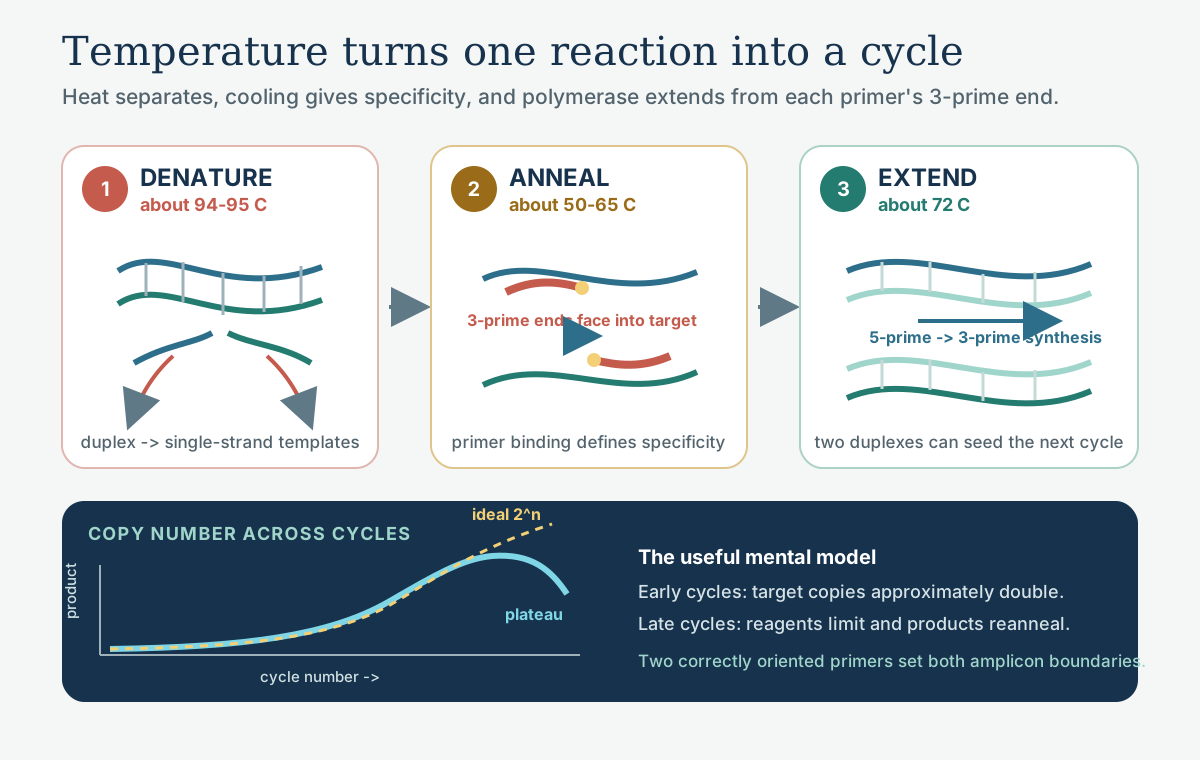
- One cycle, three temperatures
- Two primers, one product
- Doubling and its limits
- What to take from this
Picking up where you left off.
The goal
PCR copies one defined stretch of DNA - the amplicon - millions to billions of times, so a few starting molecules become enough to detect, size, or sequence 1. It is DNA replication stripped to the polymerase’s requirements (see the Foundations lesson on replication).
What goes in the tube
| Component | Job 1 2 |
|---|---|
| Template | the sample DNA; it needn’t be pure, because the primers supply the specificity |
| Two primers (about 18-25 nt) | bind opposite strands flanking the target, each giving a 3’-OH to extend |
| dNTPs | dATP, dCTP, dGTP, dTTP building blocks |
| Thermostable polymerase | Taq or a high-fidelity or hot-start version |
| Buffer with Mg²⁺ | polymerase cofactor; also stabilizes primer binding, so its concentration tunes specificity |
| Water | nuclease-free, to volume |
Master mixes premix everything except primers and template. Every reaction set includes positive, negative, and no-template controls (see Assay Design).
Quick check
The two primers bind opposite strands, pointing toward each other, and define both ends of the amplicon.
One cycle, three temperatures
| Step | Typical | What happens |
|---|---|---|
| Denature | 94-98 °C, 10-30 s | strands separate (the first cycle often has a longer initial denaturation, which also activates hot-start enzymes) |
| Anneal | about 50-65 °C, 15-30 s | primers bind their sites; set a few degrees below the primers’ Tm |
| Extend | 72 °C | Taq copies about 1,000 bases per minute, so 30 s covers most diagnostic amplicons |
A run is typically 25-40 cycles, often finished with a final extension.
Quick check
95 °C denatures, the annealing temperature lets primers bind, and 72 °C is Taq’s extension optimum.
Two primers, one product
The primers bind opposite strands with their 3’ ends pointing toward each other 1. In early cycles, products copied from genomic template run past the far primer site; but from the third cycle on, strands appear that begin at one primer and end at the other. These defined-length products are themselves templates and soon dominate: the amplicon is exactly primer to primer.
Doubling and its limits
Each perfect cycle doubles the target:
- 2^10 ≈ 1,000; 2^20 ≈ 1 million; 2^30 ≈ 1 billion.
- 100 starting copies after 30 cycles: about 10^11.
Real reactions run at somewhat under 100% efficiency, and they go through three phases 1:
- Exponential: reagents in excess, near-perfect doubling; product is proportional to starting amount.
- Linear: primers, dNTPs, or enzyme start to run short; gains slow.
- Plateau: little more product, and products re-anneal to each other instead of to primers.
Because reactions with 10 or 10,000 starting copies can both reach plateau, the endpoint yield says little about starting amount - which is why quantitative PCR measures during the exponential phase (see Real-Time PCR). Plateau is also when contamination becomes dangerous: a tube now holds enough amplicon to contaminate a whole lab with a drop.
Quick check
2^10 ≈ 1,000, so 2^20 ≈ 1 million; times 100 is about 10^8.
Quick check
Real-time PCR measures during the exponential phase instead.
What to take from this
PCR needs template, two primers, dNTPs, a thermostable polymerase, and Mg²⁺ buffer. Each cycle denatures (about 95 °C), anneals (about 55-65 °C), and extends (72 °C), and two inward-pointing primers make a product that runs exactly primer to primer. Doubling means 2^30 ≈ a billion copies, but reactions plateau, so only exponential-phase measurement quantifies.
Lesson complete
Nice work.
Sources for this lesson
- 1Lela Buckingham. Molecular Diagnostics: Fundamentals, Methods, and Clinical Applications. 3rd ed. F.A. Davis Company. 2019. verifiedThe standard clinical molecular-diagnostics textbook for MLS/MB programs; author holds MB DLM(ASCP). Covers nucleic-acid chemistry, techniques, lab operations, and applications across infectious disease, oncology, genetics, and identity. Primary topic reference for the ASCP MB program.
- 2Michael R. Green, Joseph Sambrook. Molecular Cloning: A Laboratory Manual. 4th ed. Cold Spring Harbor Laboratory Press. 2012. verifiedThe classic three-volume molecular-biology methods manual — authoritative for nucleic-acid isolation, electrophoresis, restriction digestion, labeling, and hybridization techniques. Standard-tier topic reference for the techniques courses.
- 3Bruce Alberts, Rebecca Heald, Alexander Johnson, David Morgan, Martin Raff, Keith Roberts, Peter Walter. Molecular Biology of the Cell. 7th ed. W. W. Norton & Company. 2022. verifiedThe canonical cell/molecular biology textbook; used for nucleic-acid chemistry and the central dogma.