Capillary Electrophoresis
Electrophoresis in a hair-thin capillary: polymer instead of gel, electrokinetic injection, laser detection as fragments pass a window, the electropherogram, multi-dye multiplexing with an internal size standard, and the two clinical readouts - Sanger sequencing and fragment analysis for STRs, repeat expansions, MSI, and clonality.
- 4 min
- 5 steps
- 3 questions
- Lesson 21 of 60
In this lesson
- From slab to capillary
- The electropherogram
- Dyes and the size standard
- Two clinical readouts
- What to take from this
Picking up where you left off.
From slab to capillary
Capillary electrophoresis (CE) separates DNA by size like a gel, but inside a fused-silica capillary about 50 µm across, filled with a liquid sieving polymer instead of a cast gel 1. Because the narrow capillary sheds heat well, it can run at high voltage: fast, sharp separations with single-base resolution. Instruments run 8 to 96 capillaries at once and refill the polymer automatically.
Samples (dye-labeled DNA in formamide, denatured) are loaded by electrokinetic injection: a brief voltage pulls DNA into the capillary tip. Salt competes with DNA for injection, so salty or unpurified samples load poorly.
The electropherogram
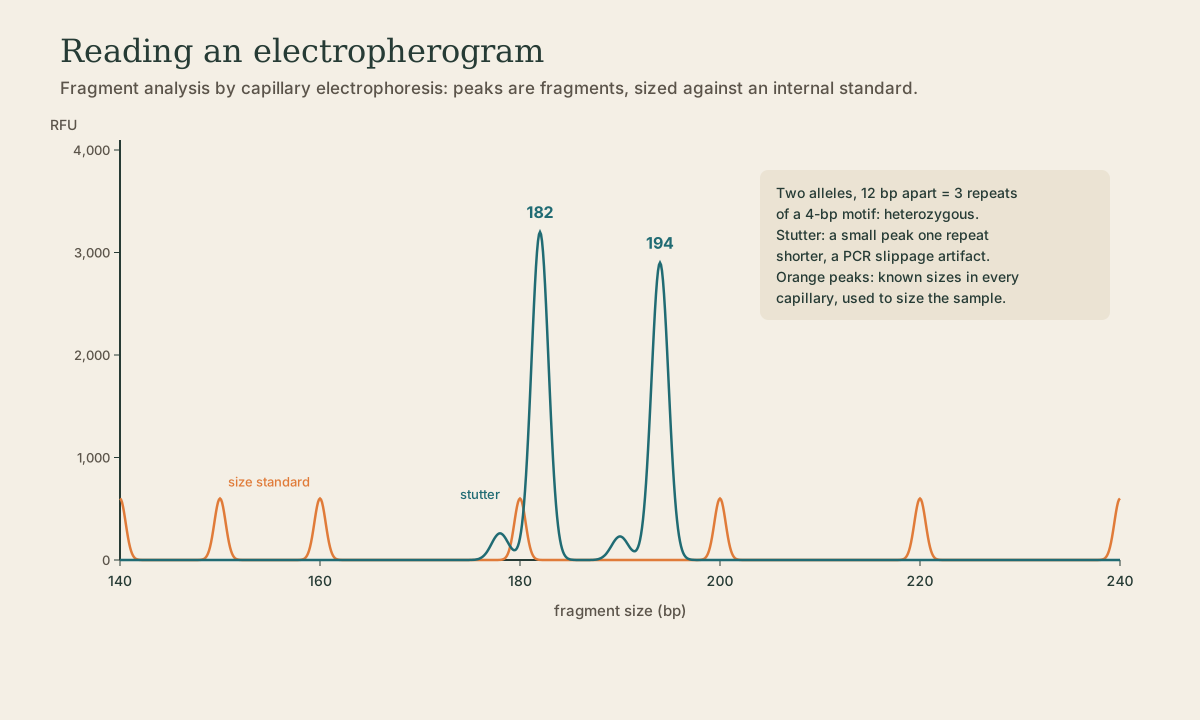
Near the capillary’s end, a laser excites dye-labeled fragments as they pass a window, and a detector records their emission. Small fragments arrive first. The plot of fluorescence (RFU) against time - converted to size - is the electropherogram: each fragment is a peak 1.
Quick check
The x-axis is converted from time to size using the internal standard.
Dyes and the size standard
The detector separates several dye colors at once, so different markers (or different bases, in sequencing) are labeled with different dyes and run together in one capillary.
One color is reserved for an internal size standard - fragments of known size added to every sample. Migration varies between capillaries and runs, so the software sizes each sample peak against the standard in its own capillary 1. Sizes come out to a fraction of a base; reproducibility depends on the same polymer, temperature, and standard.
Pull-up is an artifact where a very strong peak in one color bleeds into another color’s channel at the same position; overloading makes it worse.
Quick check
It’s labeled in its own dye so it doesn’t interfere with sample colors.
Two clinical readouts
Sanger sequencing
The sequencing reaction makes fragments ending at every position, each tagged with one of four dye-labeled terminators, one color per base. CE lines them up by size, one base apart, and the color of each successive peak gives the sequence 2. A heterozygous base shows two overlapping peaks of different colors at one position. (Chemistry in the amplification and sequencing course.)
Fragment analysis
Here the goal is size, not sequence: dye-labeled PCR products are sized against the standard 1.
| Application | What’s sized |
|---|---|
| STR profiling | repeat-length alleles at many loci at once; identity testing, sample mix-ups, and bone-marrow engraftment (chimerism) |
| Repeat expansions | FMR1 CGG (fragile X), HTT CAG (Huntington): product size gives repeat number; repeat-primed PCR flags expansions too large to amplify across |
| Microsatellite instability (MSI) | tumor versus normal at mononucleotide markers; new allele sizes in the tumor mean MSI |
| Clonality | immunoglobulin or T-cell receptor rearrangements: one dominant peak suggests a clonal (malignant) population, a bell-shaped spread a polyclonal one |
Fragment-analysis artifacts to know: stutter (a peak one repeat shorter, from polymerase slippage, usually well under the parent peak), +A (Taq’s extra adenine adding a base), and pull-up between colors.
Quick check
Stutter is expected and usually under about 15% of the parent peak; labs set thresholds for it.
What to take from this
CE separates labeled DNA by size in a polymer-filled capillary at single-base resolution, detecting fragments with a laser as they pass. The electropherogram plots RFU against size, calibrated by an internal size standard in its own dye in every capillary. Sanger sequencing reads four colors one base apart; fragment analysis sizes products for STRs, repeat expansions, MSI, and clonality. Recognize stutter, +A, and pull-up.
Lesson complete
Nice work.
Sources for this lesson
- 1Lela Buckingham. Molecular Diagnostics: Fundamentals, Methods, and Clinical Applications. 3rd ed. F.A. Davis Company. 2019. verifiedThe standard clinical molecular-diagnostics textbook for MLS/MB programs; author holds MB DLM(ASCP). Covers nucleic-acid chemistry, techniques, lab operations, and applications across infectious disease, oncology, genetics, and identity. Primary topic reference for the ASCP MB program.
- 2Bruce Alberts, Rebecca Heald, Alexander Johnson, David Morgan, Martin Raff, Keith Roberts, Peter Walter. Molecular Biology of the Cell. 7th ed. W. W. Norton & Company. 2022. verifiedThe canonical cell/molecular biology textbook; used for nucleic-acid chemistry and the central dogma.
Further reading
- Michael R. Green, Joseph Sambrook. Molecular Cloning: A Laboratory Manual. 4th ed. Cold Spring Harbor Laboratory Press. 2012. verifiedThe classic three-volume molecular-biology methods manual — authoritative for nucleic-acid isolation, electrophoresis, restriction digestion, labeling, and hybridization techniques. Standard-tier topic reference for the techniques courses.