Principles of Nucleic Acid Extraction
Every extraction does three things - lyse, separate, recover. What detergent, proteinase K, and chaotropic salts each do; organic, salting-out, and silica chemistries compared; why RNA work is a fight against RNases; and why a bad extract can't be rescued downstream.
- 5 min
- 6 steps
- 4 questions
- Lesson 14 of 60
In this lesson
- Three steps, every time
- Lysis reagents
- Three chemistries
- DNA versus RNA
- Input sets the ceiling
- What to take from this
Picking up where you left off.
Three steps, every time
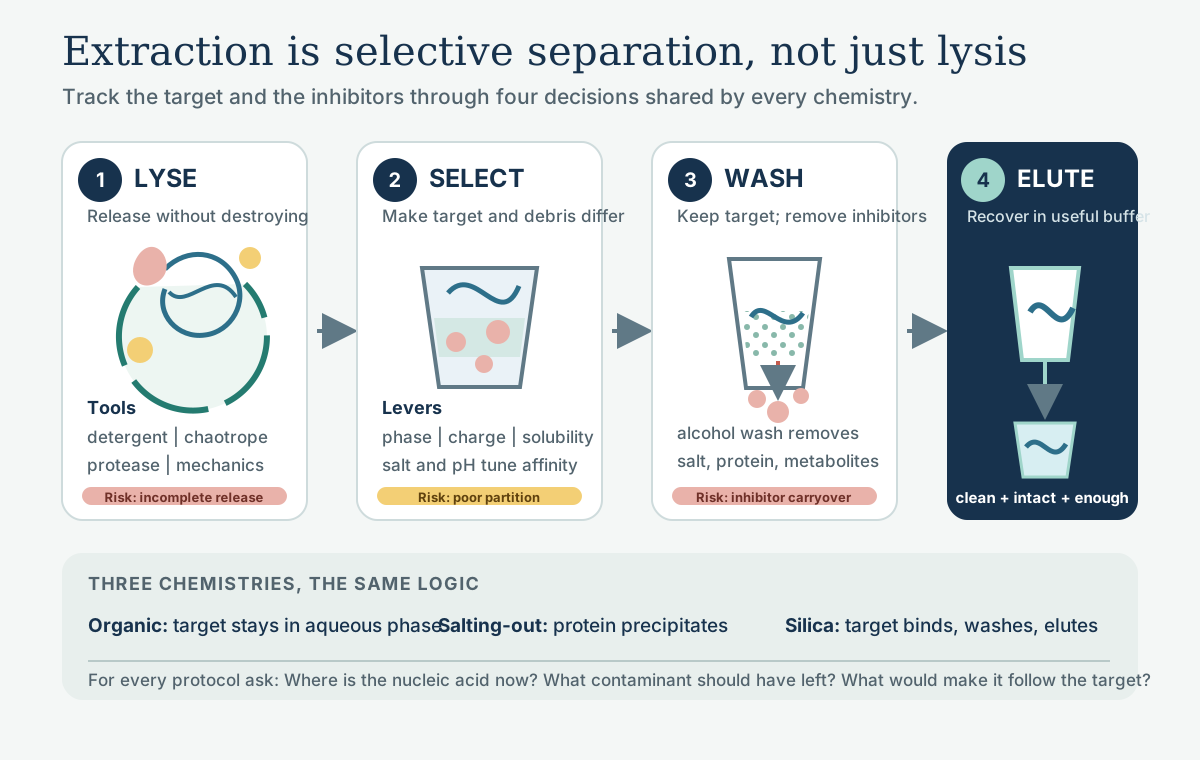
However different two methods look, every extraction does the same three things 1:
- Lyse: break open cells (and walls, for bacteria, fungi, and plants) and strip proteins off the nucleic acid.
- Separate: get proteins, lipids, polysaccharides, heme, and salts away from the nucleic acid.
- Recover: collect the purified nucleic acid in a defined volume of water or buffer.
Lysis reagents
| Reagent | Job |
|---|---|
| Detergent (SDS, Triton, Tween) | dissolves lipid membranes, begins denaturing protein 2 |
| Proteinase K | digests proteins: inactivates nucleases and strips histones off DNA 3 |
| Chaotropic salt (guanidinium thiocyanate or HCl) | denatures proteins and nucleases, lyses cells, and sets up silica binding 1 |
| Lysozyme, lysostaphin | enzymatic breakdown of bacterial cell walls |
| Bead-beating, sonication | mechanical lysis for tough organisms (mycobacteria, fungi) and tissue |
| EDTA | chelates Mg²⁺ so DNases can’t work |
The goal is complete release without shearing the DNA into uselessly short pieces. Guanidinium is also why lysis buffers are dangerous: mixed with bleach it releases toxic gas, so keep guanidinium waste away from bleach (see the lab operations lesson on contamination).
Quick check
Detergent opens membranes; proteinase K clears protein and inactivates nucleases.
Three chemistries
Organic (phenol-chloroform). Mix lysate with phenol-chloroform and spin. Nucleic acid stays in the upper aqueous phase; denatured protein collects at the interphase; lipids go to the lower organic phase. Draw off the aqueous layer, clean up with chloroform, and recover by alcohol precipitation (salt plus ethanol or isopropanol, spin, wash, redissolve) 3. High quality, but toxic, corrosive, and slow.
Salting-out. After detergent and proteinase K lysis, a saturated salt precipitates proteins, a spin pellets them, and the DNA in the supernatant is alcohol-precipitated 1. Cheap and solvent-free, slightly less pure.
Solid phase (silica). The basis of nearly every kit and automated platform. In high chaotropic salt, nucleic acid binds silica - a column membrane or magnetic beads - while contaminants don’t 1:
- Bind lysate in chaotropic buffer to the silica.
- Wash with ethanol-containing buffers to remove protein and salt; the nucleic acid stays bound.
- Dry briefly so no ethanol carries over (ethanol inhibits PCR).
- Elute in low-salt buffer or water 1.
| Organic | Salting-out | Silica | |
|---|---|---|---|
| Purity | highest | good | good |
| Speed | slow | moderate | fast |
| Hazards | phenol, chloroform | low | guanidinium |
| Automation | poor | poor | excellent |
| Main carryover risk | phenol (A270) | salt | guanidinium (A230), ethanol |
Quick check
Charged, water-soluble nucleic acid stays in the aqueous layer; protein collects at the interphase and lipids go to the organic phase.
Quick check
Bind in chaotrope, wash with ethanol-containing buffers, elute in low-salt buffer or water.
DNA versus RNA
RNA needs more care: the 2’-OH makes it chemically fragile, and RNases are everywhere - on skin, dust, and reagents - and survive autoclaving 2 3. RNA work means RNase-free tubes and tips, gloves changed often, quick work on ice, and lysis straight into a chaotropic or RNA-stabilizing buffer.
| Target | Remove | With |
|---|---|---|
| DNA | co-extracted RNA | RNase A |
| RNA | co-extracted genomic DNA | DNase I 1 |
Many RNA kits do the DNase step on the column. Specimens for RNA testing are often collected in stabilizing tubes (PAXgene for blood) or frozen quickly.
Quick check
DNA preps get RNase; RNA preps get DNase.
Input sets the ceiling
What comes out of extraction caps every assay after it 1:
- Carryover inhibits: phenol, guanidinium, ethanol, heme, and heparin inhibit polymerases and give falsely low or negative results.
- Damage is permanent: sheared or degraded nucleic acid can’t be repaired later 3.
- Wrong nucleic acid: genomic DNA in an RNA prep inflates RT-qPCR signal.
That’s why the next steps are measuring quantity, purity, and integrity, and why most labs move the silica chemistry onto instruments.
What to take from this
Every extraction lyses, separates, and recovers. Detergent opens membranes, proteinase K clears proteins and nucleases, and chaotropic salt denatures and drives silica binding. Organic extraction keeps nucleic acid in the upper aqueous phase; salting-out precipitates protein; silica binds in chaotrope, washes in ethanol, and elutes in low salt. RNA needs RNase-free technique and a DNase step. A poor extract can’t be rescued downstream.
Lesson complete
Nice work.
Sources for this lesson
- 1Lela Buckingham. Molecular Diagnostics: Fundamentals, Methods, and Clinical Applications. 3rd ed. F.A. Davis Company. 2019. verifiedThe standard clinical molecular-diagnostics textbook for MLS/MB programs; author holds MB DLM(ASCP). Covers nucleic-acid chemistry, techniques, lab operations, and applications across infectious disease, oncology, genetics, and identity. Primary topic reference for the ASCP MB program.
- 2Bruce Alberts, Rebecca Heald, Alexander Johnson, David Morgan, Martin Raff, Keith Roberts, Peter Walter. Molecular Biology of the Cell. 7th ed. W. W. Norton & Company. 2022. verifiedThe canonical cell/molecular biology textbook; used for nucleic-acid chemistry and the central dogma.
- 3Michael R. Green, Joseph Sambrook. Molecular Cloning: A Laboratory Manual. 4th ed. Cold Spring Harbor Laboratory Press. 2012. verifiedThe classic three-volume molecular-biology methods manual — authoritative for nucleic-acid isolation, electrophoresis, restriction digestion, labeling, and hybridization techniques. Standard-tier topic reference for the techniques courses.