Chromosome and Extrachromosomal Structure
The human nuclear genome, chromosome landmarks and band addresses like 7q31.2, karyotype shorthand, the circular maternally inherited mitochondrial genome, plasmids, phage, and viral genomes - and why copies per cell sets how sensitive a test can be.
- 6 min
- 6 steps
- 5 questions
- Lesson 8 of 60
In this lesson
- The nuclear genome
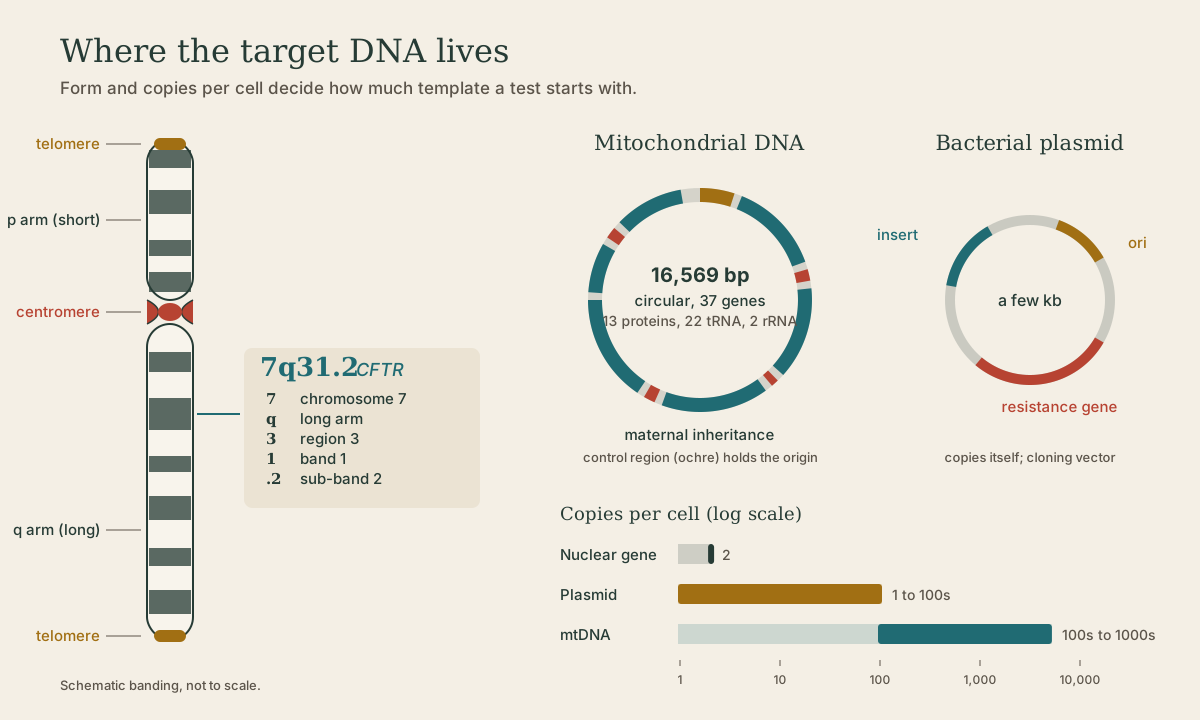
- Chromosome landmarks and band addresses
- The mitochondrial genome
- Plasmids, phage, and viruses
- Copy number and sensitivity
- What to take from this
Picking up where you left off.
The nuclear genome
Human somatic cells are diploid: 46 chromosomes, 22 pairs of autosomes plus the sex chromosomes (XX or XY), one set from each parent 1. The haploid set (23 chromosomes, as in an egg or sperm) is about 3.2 billion base pairs, so a somatic cell holds about 6.4 billion 1, folded into nucleosomes and chromatin (see DNA-Associated Proteins).
The number that matters most for testing: a typical nuclear gene is present at two copies per cell. A haploid human genome weighs about 3.3 picograms, so 10 ng of genomic DNA holds only about 3,000 copies of a single-copy gene (about 1,500 cells), a useful sanity check when an assay looks too sensitive.
Quick check
Gametes carry 23 (haploid); somatic cells are diploid.
Chromosome landmarks and band addresses
- Centromere: the constriction holding sister chromatids together and attaching to the spindle; it splits the chromosome into two arms.
- p arm (short, petit) and q arm (long) 1.
- Telomeres: TTAGGG repeats capping each end so it isn’t mistaken for a break 1.
A karyotype shows all chromosomes, arranged by size and centromere position. Staining (G-banding) gives each chromosome a reproducible pattern of light and dark bands, and the bands give addresses: chromosome, arm, region, band, sub-band 1.
| Address | Read as | What’s there |
|---|---|---|
| 7q31.2 | chromosome 7, long arm, region 3, band 1, sub-band 2 | CFTR |
| 17q21.31 | chromosome 17, long arm, region 2, band 1, sub-band 31 | BRCA1 |
| Xq27.3 | X, long arm, region 2, band 7, sub-band 3 | FMR1 (fragile X) |
Karyotype shorthand (ISCN) gives count, sex chromosomes, then changes:
| Karyotype | Meaning |
|---|---|
| 46,XX | normal female |
| 47,XY,+21 | male with trisomy 21 |
| 45,X | Turner syndrome |
| 46,XY,t(9;22)(q34;q11.2) | translocation between 9q34 and 22q11.2: the Philadelphia chromosome |
Quick check
p (petit) is the short arm, q the long arm; 21 is region 2, band 1. BRCA1 lives at 17q21.31.
Quick check
Count, sex chromosomes, then abnormalities: +21 is a whole extra chromosome 21 (Down syndrome).
The mitochondrial genome
Each mitochondrion carries its own small, circular genome, a relic of its bacterial ancestry 1:
- 16,569 bp with 37 genes: 13 respiratory-chain proteins, 22 tRNAs, 2 rRNAs. Most mitochondrial proteins are still encoded in the nucleus and imported 1.
- Maternally inherited through the egg 1.
- High copy number: many mitochondria per cell, several genomes each - hundreds to thousands of copies per cell 2.
- Heteroplasmy: a cell can hold a mix of normal and variant mtDNA, and the proportion affects disease severity.
Quick check
mtDNA passes through the egg, so it’s maternally inherited.
Plasmids, phage, and viruses
Plasmids are small circular double-stranded DNAs that replicate independently of the bacterial chromosome, often carrying antibiotic-resistance genes that spread between bacteria 1. Carbapenemase genes like blaKPC travel on plasmids, one reason labs test for resistance genes directly. Plasmids are also the lab’s cloning vectors: insert a sequence, grow the bacteria, harvest many copies 3. Plasmid copy number ranges from one to hundreds per cell.
Bacteriophages infect bacteria and have also been adapted as vectors 1.
Viral genomes come in every combination: DNA or RNA, single- or double-stranded, linear or circular, sometimes segmented 1.
| Genome | Examples |
|---|---|
| dsDNA | HSV, CMV, HPV, adenovirus |
| ssDNA | parvovirus B19 |
| ssRNA, positive sense | SARS-CoV-2, hepatitis C, enteroviruses |
| ssRNA, negative sense | influenza, RSV |
| RNA with reverse transcription | HIV (retrovirus) |
| partly dsDNA, reverse transcribed | hepatitis B |
RNA viruses need a reverse transcription step before PCR; this is why the extraction and amplification must match the target.
Copy number and sensitivity
| Target | Copies per cell | Consequence |
|---|---|---|
| Single-copy nuclear gene | 2 | least template; needs efficient extraction and amplification |
| Mitochondrial DNA | hundreds to thousands | works from tiny or degraded samples |
| Plasmid | one to hundreds | often abundant in bacterial targets |
| rRNA | thousands of ribosomes per cell | why rRNA-targeted assays are very sensitive |
The template a specimen holds sets a floor on what an assay can detect 3. Forensic labs use mtDNA for hair shafts and old bone for exactly this reason, and many infectious-disease assays target multicopy genes or rRNA to boost sensitivity.
Quick check
High copy number beats degradation, though mtDNA can’t distinguish maternal relatives.
What to take from this
Human cells carry 46 chromosomes (3.2 Gb per haploid set), so a nuclear gene starts at two copies per cell. Chromosome addresses read chromosome, arm (p short, q long), region, band, sub-band - CFTR is at 7q31.2 - and karyotypes read count, sex chromosomes, changes. mtDNA is a 16,569 bp maternally inherited circle at hundreds to thousands of copies per cell. Plasmids carry resistance genes and serve as vectors, and viral genomes vary in chemistry. Copy number sets the sensitivity floor.
Lesson complete
Nice work.
Sources for this lesson
- 1Bruce Alberts, Rebecca Heald, Alexander Johnson, David Morgan, Martin Raff, Keith Roberts, Peter Walter. Molecular Biology of the Cell. 7th ed. W. W. Norton & Company. 2022. verifiedThe canonical cell/molecular biology textbook; used for nucleic-acid chemistry and the central dogma.
- 2David L. Nelson, Michael M. Cox, Aaron A. Hoskins. Lehninger Principles of Biochemistry. 8th ed. W. H. Freeman (Macmillan Learning). 2021. verifiedStandard biochemistry reference for nucleotide chemistry, nucleic-acid structure, and enzymology.
- 3Lela Buckingham. Molecular Diagnostics: Fundamentals, Methods, and Clinical Applications. 3rd ed. F.A. Davis Company. 2019. verifiedThe standard clinical molecular-diagnostics textbook for MLS/MB programs; author holds MB DLM(ASCP). Covers nucleic-acid chemistry, techniques, lab operations, and applications across infectious disease, oncology, genetics, and identity. Primary topic reference for the ASCP MB program.
Previous: Translation, the Genetic Code, and Protein Structure