Restriction Enzymes and RFLP
Turning a single-base change into a fragment-size difference: how a variant creates or destroys a restriction site, the PCR-RFLP workflow, reading normal, heterozygous, and variant lanes, the controls that catch incomplete digestion, the historical Southern blot, and where RFLP still earns its place.
- 4 min
- 7 steps
- 3 questions
- Lesson 18 of 60
In this lesson
- Sequence into size
- The PCR-RFLP workflow
- Reading the lanes
- Controls and pitfalls
- Southern-blot RFLP
- Strengths and limits
- What to take from this
Picking up where you left off.
Sequence into size
A restriction enzyme cuts only at its recognition site (see the Foundations lesson on nucleases). A single-base change inside a site destroys it; a change that completes a site creates one. Either way the fragment sizes change, and a gel can see sizes 1.
The PCR-RFLP workflow
- Amplify a short region around the variant (100-500 bp).
- Digest an aliquot with the chosen enzyme, in its buffer, at its temperature, for a set time.
- Separate on agarose or polyacrylamide next to a ladder and an undigested sample.
- Read the bands against the expected sizes worked out from the reference sequence 1.
Reading the lanes
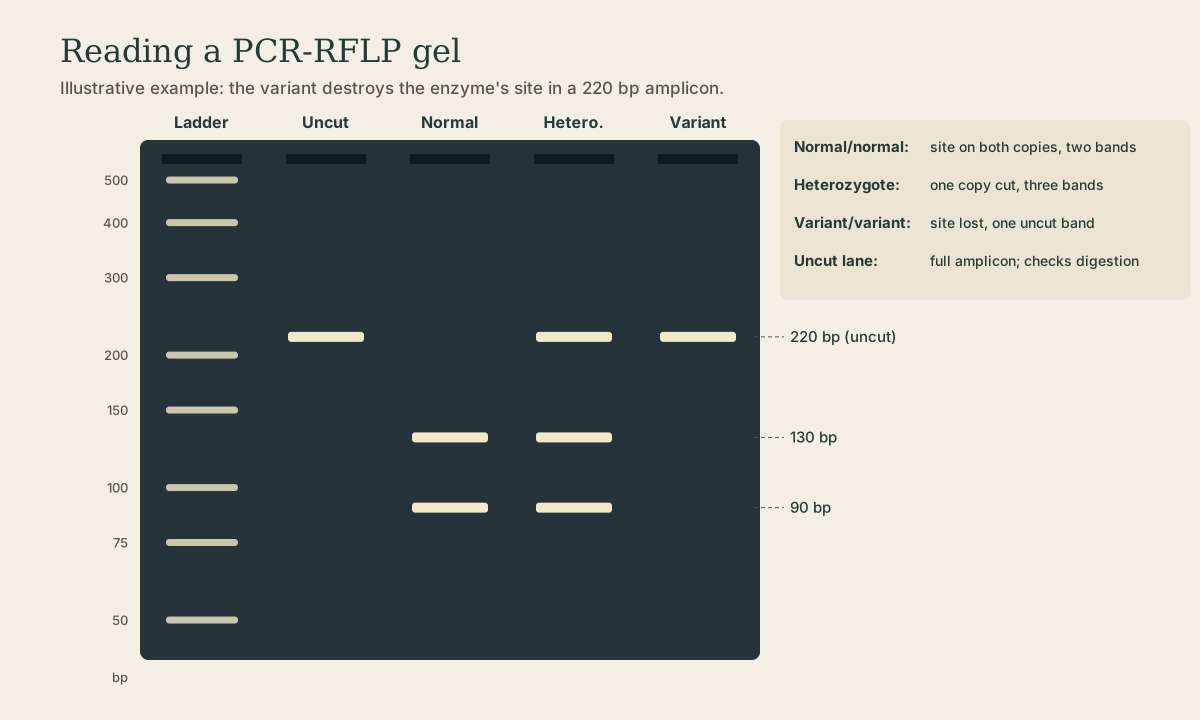
Example: a 300 bp amplicon with one site 100 bp from an end, destroyed by the variant.
| Genotype | Bands |
|---|---|
| Homozygous normal (site on both copies) | 200 + 100 |
| Heterozygous | 300 + 200 + 100 |
| Homozygous variant (site lost on both) | 300 |
If a variant creates a site, the pattern flips: normal stays uncut and the variant cuts. A heterozygote always shows every band from both homozygous patterns 1. Real examples of each kind:
- Site destroyed: the sickle cell change in HBB abolishes an MstII site (historical Southern-blot test; later PCR-RFLP with DdeI).
- Site destroyed: Factor V Leiden, F5 c.1601G>A, abolishes an MnlI site in the common PCR-RFLP assay.
- Site created: HFE C282Y (c.845G>A) creates an RsaI site.
Quick check
One allele is cut (200 + 100), the other isn’t (300).
Controls and pitfalls
- Undigested lane: shows the full amplicon size.
- Known genotype controls: at least one that must cut completely. Incomplete digestion leaves some uncut product in a normal sample and looks just like a heterozygote - the most common RFLP error.
- Ladder: sizes every band.
- Small fragments: below about 50 bp they can run off or stain faintly; polyacrylamide resolves small differences better than agarose.
- Unexpected bands: a second, unrelated variant in the site (or a polymorphism creating a new one) can give a pattern you didn’t plan for.
Quick check
Include a control that must cut completely, and check the enzyme, buffer, and incubation.
Southern-blot RFLP
Before PCR, RFLP was done on genomic DNA with Southern blotting: digest micrograms of DNA, run it, transfer it to a membrane, and hybridize a labeled probe for the locus so only its fragments show 2. It took days, needed micrograms of high-quality DNA, and often used radioactive probes 3. PCR-RFLP does the same job from nanograms in a day 1. Southern blots survive for things PCR handles poorly, such as large FMR1 repeat expansions and their methylation status in fragile X.
Quick check
Amplifying the region first makes the fragments abundant and visible on an ordinary stained gel.
Strengths and limits
| Strengths | Limits |
|---|---|
| cheap: thermocycler, enzyme, gel | one known variant per assay, and only if it touches a site |
| easy to read; no special instruments | slow and manual compared with real-time PCR genotyping |
| good for confirming a result by an independent method | open-tube post-PCR handling risks amplicon contamination |
Most labs now genotype single variants with real-time PCR probes or melt curves, and keep PCR-RFLP for confirmation, teaching, and low-volume tests.
What to take from this
A variant that destroys or creates a restriction site changes fragment sizes: amplify, digest, and run next to a ladder and uncut product. Normal and variant homozygotes give their own patterns and the heterozygote shows both (sickle cell and Factor V Leiden destroy sites; HFE C282Y creates one). Always include a control that must cut completely, because incomplete digestion mimics a heterozygote.
Lesson complete
Nice work.
Sources for this lesson
- 1Lela Buckingham. Molecular Diagnostics: Fundamentals, Methods, and Clinical Applications. 3rd ed. F.A. Davis Company. 2019. verifiedThe standard clinical molecular-diagnostics textbook for MLS/MB programs; author holds MB DLM(ASCP). Covers nucleic-acid chemistry, techniques, lab operations, and applications across infectious disease, oncology, genetics, and identity. Primary topic reference for the ASCP MB program.
- 2Bruce Alberts, Rebecca Heald, Alexander Johnson, David Morgan, Martin Raff, Keith Roberts, Peter Walter. Molecular Biology of the Cell. 7th ed. W. W. Norton & Company. 2022. verifiedThe canonical cell/molecular biology textbook; used for nucleic-acid chemistry and the central dogma.
- 3Michael R. Green, Joseph Sambrook. Molecular Cloning: A Laboratory Manual. 4th ed. Cold Spring Harbor Laboratory Press. 2012. verifiedThe classic three-volume molecular-biology methods manual — authoritative for nucleic-acid isolation, electrophoresis, restriction digestion, labeling, and hybridization techniques. Standard-tier topic reference for the techniques courses.