Nucleic Acid Labeling
Making a probe visible: isotopic versus fluorescent, hapten, and enzyme labels; direct versus indirect detection; and the ways labels get onto nucleic acid - end labeling, nick translation, random priming, PCR, and in vitro transcription - with where each shows up in today's lab.
- 5 min
- 6 steps
- 4 questions
- Lesson 17 of 60
In this lesson
- Label and method
- Labels
- Direct versus indirect
- Getting the label on
- Uses in the lab
- What to take from this
Picking up where you left off.
Label and method
DNA is chemically the same from one fragment to the next, so to see a specific sequence you attach a reporter to a probe that will find it. Keep two choices separate 1:
- the label - what makes the probe detectable;
- the labeling method - how the label gets attached.
Labels
| Family | Examples | How it’s read |
|---|---|---|
| Isotopic | ³²P, ³³P, ³⁵S, ³H | autoradiography; very sensitive but short half-lives and disposal burden - mostly historical in clinical work 2 |
| Fluorophores | FAM, HEX/VIC, Cy3, Cy5, Texas Red | excite with one wavelength, read emission at another; several colors at once allow multiplexing |
| Haptens | biotin, digoxigenin (DIG) | detected by a partner: streptavidin binds biotin; an anti-DIG antibody binds DIG; the partner carries the signal 1 |
| Enzymes | alkaline phosphatase, horseradish peroxidase | turn substrate into a colored (colorimetric) or light-emitting (chemiluminescent) product |
Biotin has a catch: tissues like liver and kidney contain endogenous biotin, which can cause background in tissue-based detection; DIG avoids this because it’s a plant compound absent from human cells.
Quick check
Biotin is a hapten: not a signal itself, but bound extremely tightly by streptavidin, which carries the signal.
Direct versus indirect
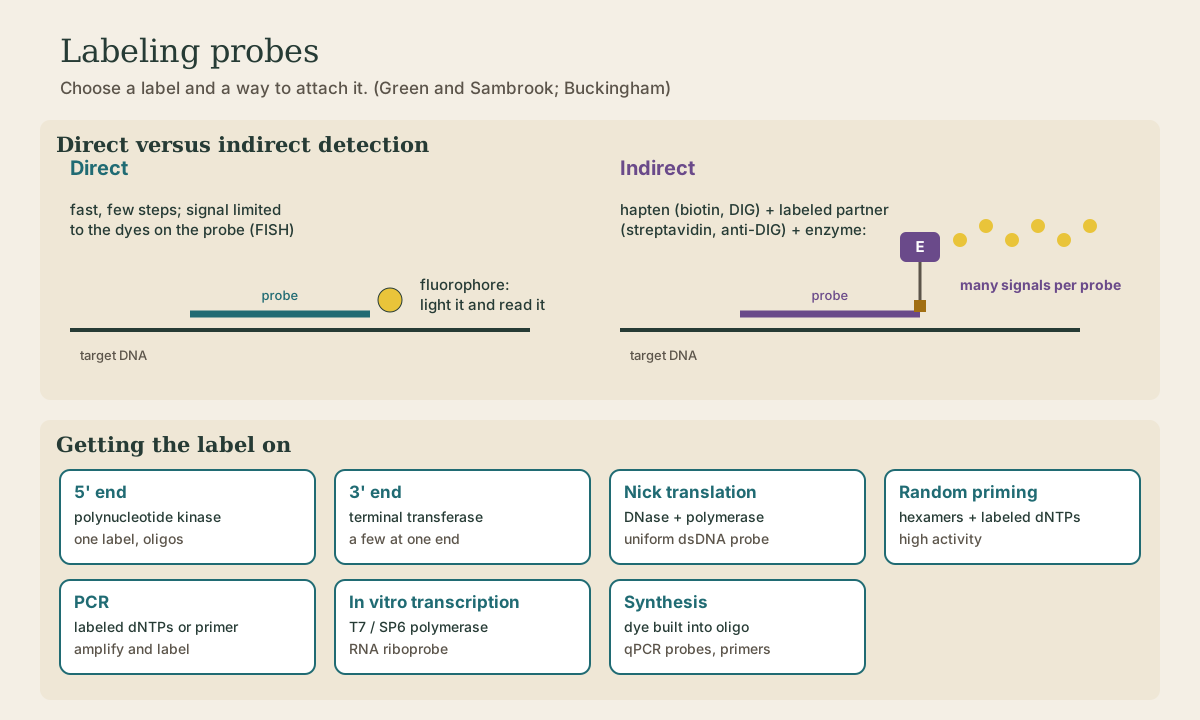
- Direct: the signal is on the probe - a fluorophore-labeled FISH probe is simply illuminated. Fast, few steps, signal limited to the attached dyes.
- Indirect: the probe carries a hapten; after hybridization, a labeled partner (streptavidin-enzyme or anti-DIG antibody) binds, and an enzyme turns over substrate. More steps, but each binding event becomes many signal molecules.
Quick check
One bound enzyme turns over many substrate molecules.
Getting the label on
Most methods use the polymerases, kinases, and ligases from the foundations course 2:
| Method | How | Result |
|---|---|---|
| 5’ end labeling | polynucleotide kinase transfers a labeled phosphate to the 5’ end | one label per molecule; for oligos |
| 3’ end labeling | terminal transferase adds labeled nucleotides to the 3’ end | a few labels at one end |
| Nick translation | DNase nicks dsDNA; a polymerase with 5’→3’ exonuclease replaces nucleotides from each nick with labeled ones | uniformly labeled dsDNA probe 2 |
| Random priming | denature template, anneal random hexamers, extend with labeled dNTPs | uniformly labeled, high-activity probe from little template |
| PCR incorporation | labeled dNTPs or a labeled primer during PCR | amplifies and labels in one step |
| In vitro transcription | a phage RNA polymerase (T7, SP6) transcribes from its promoter with labeled NTPs | single-stranded RNA probe (riboprobe) of defined orientation |
| Chemical synthesis | dye or hapten built into an oligo on the synthesizer | the norm for qPCR probes and primers |
Quick check
A polymerase extends the random primers, incorporating labeled nucleotides throughout.
Uses in the lab
- Real-time PCR probes: synthetic oligos with a 5’ reporter (FAM, HEX/VIC) and a 3’ quencher (see Probe Chemistries).
- FISH: directly labeled fluorescent probes in two or three colors, such as the dual-color dual-fusion BCR::ABL1 probe set.
- In situ hybridization in pathology: DIG- or biotin-labeled probes with enzyme detection, such as EBV-encoded RNA (EBER) in tissue.
- Microarrays: sample DNA labeled with Cy3/Cy5 and hybridized to the chip.
- NGS hybrid capture: biotinylated probes (“baits”) bind target regions, and streptavidin magnetic beads pull them out - labeling used as a capture handle.
- Sanger sequencing: four dye-labeled terminators, one color per base.
Quick check
The same biotin-streptavidin pair used for detection becomes a capture handle.
What to take from this
A probe needs a label (isotope, fluorophore, hapten, or enzyme) and a way to attach it. Direct detection reads the label on the probe; indirect detection adds a labeled partner - streptavidin for biotin, antibody for DIG - for amplified signal. End labeling, nick translation, random priming, PCR incorporation, in vitro transcription, and chemical synthesis put labels on. Today’s lab uses dye-labeled oligos for qPCR and Sanger, fluorescent FISH probes, DIG and biotin for tissue ISH, and biotin-streptavidin for NGS capture.
Lesson complete
Nice work.
Sources for this lesson
- 1Lela Buckingham. Molecular Diagnostics: Fundamentals, Methods, and Clinical Applications. 3rd ed. F.A. Davis Company. 2019. verifiedThe standard clinical molecular-diagnostics textbook for MLS/MB programs; author holds MB DLM(ASCP). Covers nucleic-acid chemistry, techniques, lab operations, and applications across infectious disease, oncology, genetics, and identity. Primary topic reference for the ASCP MB program.
- 2Michael R. Green, Joseph Sambrook. Molecular Cloning: A Laboratory Manual. 4th ed. Cold Spring Harbor Laboratory Press. 2012. verifiedThe classic three-volume molecular-biology methods manual — authoritative for nucleic-acid isolation, electrophoresis, restriction digestion, labeling, and hybridization techniques. Standard-tier topic reference for the techniques courses.
Further reading
- Bruce Alberts, Rebecca Heald, Alexander Johnson, David Morgan, Martin Raff, Keith Roberts, Peter Walter. Molecular Biology of the Cell. 7th ed. W. W. Norton & Company. 2022. verifiedThe canonical cell/molecular biology textbook; used for nucleic-acid chemistry and the central dogma.