Mutations and Sequence Variation
The kinds of DNA change a molecular lab finds - transitions and transversions, silent, missense, nonsense, frameshift and in-frame changes, splice, copy-number, repeat and structural variants - plus germline versus somatic, polymorphism versus pathogenic, and how to read an HGVS name like KRAS c.35G>A p.(Gly12Asp).
- 6 min
- 8 steps
- 5 questions
- Lesson 4 of 60
In this lesson
- Why variation is the point
- Substitutions
- Insertions, deletions, and the frame
- Beyond the codons
- Germline versus somatic
- Polymorphism versus pathogenic
- Naming variants: HGVS
- What to take from this
Picking up where you left off.
Why variation is the point
A lab sequences or genotypes DNA because copies differ. Any difference from a chosen reference sequence is a variant. A few change how a gene works; most don’t. The lab’s job is to find variants reliably and describe them so precisely that another lab, a clinician, or a database reads the finding the same way 1.
Substitutions
A substitution swaps one base for another. By chemistry 2:
| Class | Change | Examples | Frequency |
|---|---|---|---|
| Transition | purine ↔ purine, pyrimidine ↔ pyrimidine | A↔G, C↔T | more common |
| Transversion | purine ↔ pyrimidine | A↔C, A↔T, G↔C, G↔T | less common |
C→T at CpG sites is the single most common point change in human DNA, because methylated cytosine readily loses an amino group and becomes thymine.
In coding DNA the effect is read through the genetic code 3:
| Effect | What happens | Example |
|---|---|---|
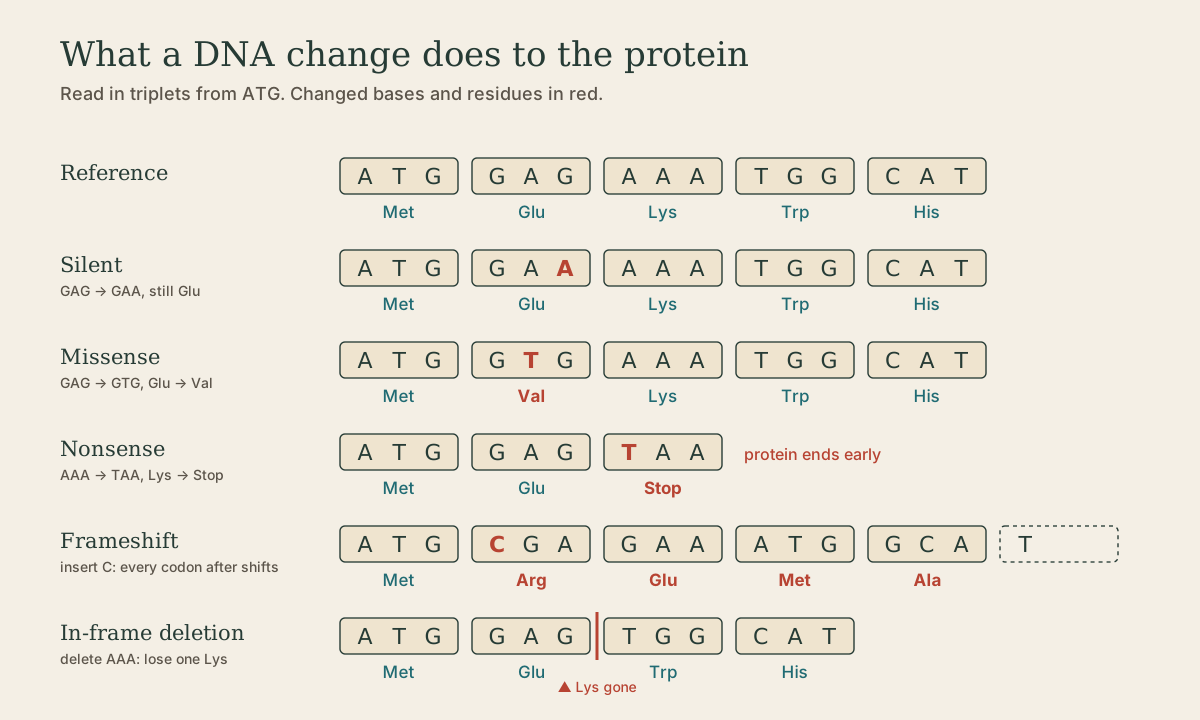
| Silent (synonymous) | codon changes, amino acid doesn’t | GAG→GAA, both Glu |
| Missense | a different amino acid | sickle cell, HBB GAG→GTG, Glu→Val |
| Nonsense | codon becomes a stop (TAA, TAG, TGA) | protein truncated |
Identical chemistry can carry very different weight: a missense change in an enzyme’s active site can be devastating, one on the protein’s surface harmless 1. Silent changes aren’t always harmless either - some disrupt splicing signals.
Quick check
Transitions swap within a family (A↔G, C↔T); transversions cross between purines and pyrimidines.
Quick check
TGA, TAA, and TAG are stop codons; a premature stop truncates the protein.
Insertions, deletions, and the frame
Insertions add bases and deletions remove them (together indels) 3. Translation reads non-overlapping triplets, so the count matters:
- Frameshift: an indel that isn’t a multiple of three reshuffles every downstream codon, usually reaching a premature stop soon after. BRCA1 c.68_69del, a two-base founder deletion, is a classic example.
- In-frame: multiples of three add or remove whole amino acids and leave the rest intact. CFTR p.Phe508del, the most common cystic fibrosis variant, deletes three bases and one phenylalanine. In-frame changes are often milder than frameshifts, but not always - Phe508del misfolds the protein 1.
Quick check
Multiples of three remove whole codons. CFTR p.Phe508del is a 3-base, in-frame deletion.
Beyond the codons
| Type | What it is | Clinical example |
|---|---|---|
| Splice-site | at exon-intron boundaries; exon skipped or intron kept 3 | intronic +1/+2 and -1/-2 changes, like c.123+1G>A |
| Copy-number (CNV) | kilobase-to-megabase gains or losses 1 | ERBB2 (HER2) amplification; PMP22 duplication |
| Repeat expansion | a short motif repeated past its normal range 1 | FMR1 CGG in fragile X; HTT CAG in Huntington |
| Structural | large deletions, duplications, inversions, translocations 1 | t(9;22) BCR::ABL1 fusion in CML |
Variation spans every scale from one base to whole chromosome arms, and each scale needs its own method: sequencing for small changes, sizing or Southern blot for repeats, FISH, microarray, or NGS read depth for CNVs and fusions.
Germline versus somatic
| Germline | Somatic | |
|---|---|---|
| Origin | in the egg or sperm | in one cell after conception |
| Present in | essentially every cell | that cell’s descendants only |
| Heritable | yes | no |
| Typical context | inherited disease, hereditary cancer risk 3 | cancer drivers 1 |
| Specimen | blood or saliva | tumor tissue, often compared with normal |
A tumor-only result can’t tell germline from somatic for certain; a variant near 50% (heterozygous) or 100% allele fraction in a tumor may be germline and calls for confirmation in normal tissue.
Quick check
Germline variants are in essentially every cell, including blood; somatic variants arise in one lineage.
Polymorphism versus pathogenic
Whether a variant exists says nothing about whether it causes disease.
- Allele frequency: how common the allele is in a population. A variant common enough to be normal human diversity is a polymorphism; single-nucleotide polymorphisms (SNPs) account for most benign differences between people 1. A variant too common in healthy people to cause a rare disease is effectively ruled out.
- Pathogenic: evidence that it causes or substantially contributes to disease, combining frequency, predicted effect, segregation with disease in families, and functional data 1. It’s a judgment, formalized in the ACMG/AMP five tiers: pathogenic, likely pathogenic, uncertain significance (VUS), likely benign, benign.
Current practice says variant rather than mutation and states the interpretation separately.
Naming variants: HGVS
The same change can be written many informal ways (“G12D”, “35G>A”, “185delAG”), so the field uses HGVS nomenclature: every variant is named against a stated reference sequence with an explicit coordinate system 1.
| Prefix | Level | Numbering |
|---|---|---|
g. |
genomic | from the start of the genomic reference |
c. |
coding DNA | A of the ATG start codon = c.1; intronic positions as c.123+1 or c.124-2 |
p. |
protein | amino acid residues, Met = 1; parentheses mean predicted |
r. |
RNA | as c., in lowercase bases |
Reading a real one: NM_004985.5(KRAS):c.35G>A p.(Gly12Asp)
NM_004985.5- the RefSeq transcript and its version; the reference must be stated.c.35G>A- coding position 35, G changed to A.p.(Gly12Asp)- predicted protein change: glycine 12 to aspartate (the “G12D” in oncology shorthand). Base 35 is the middle base of codon 12 (bases 34-36).
Other patterns: c.68_69del (deletion of two bases), c.1521_1523del p.(Phe508del) (in-frame), p.(Glu23ValfsTer17) (frameshift starting at residue 23, stop 17 codons later), p.(Arg213Ter) (nonsense; * may replace Ter).
Quick check
c. is coding-DNA numbering; base 35 sits in codon 12 (bases 34-36), so the protein change is at residue 12.
What to take from this
Transitions (A↔G, C↔T) outnumber transversions. In coding DNA, substitutions are silent, missense, or nonsense; indels either shift the frame (usually severe) or remove whole codons in frame. Variation also comes as splice, copy-number, repeat-expansion, and structural changes, each detected differently. Germline variants are in every cell and inherited; somatic ones are confined to a lineage, such as a tumor. Frequency separates polymorphisms from candidates, and pathogenicity is an evidence-based judgment. HGVS names give the reference, the level (g., c., p.), and the change: KRAS c.35G>A p.(Gly12Asp).
Lesson complete
Nice work.
Sources for this lesson
- 1Lela Buckingham. Molecular Diagnostics: Fundamentals, Methods, and Clinical Applications. 3rd ed. F.A. Davis Company. 2019. verifiedThe standard clinical molecular-diagnostics textbook for MLS/MB programs; author holds MB DLM(ASCP). Covers nucleic-acid chemistry, techniques, lab operations, and applications across infectious disease, oncology, genetics, and identity. Primary topic reference for the ASCP MB program.
- 2David L. Nelson, Michael M. Cox, Aaron A. Hoskins. Lehninger Principles of Biochemistry. 8th ed. W. H. Freeman (Macmillan Learning). 2021. verifiedStandard biochemistry reference for nucleotide chemistry, nucleic-acid structure, and enzymology.
- 3Bruce Alberts, Rebecca Heald, Alexander Johnson, David Morgan, Martin Raff, Keith Roberts, Peter Walter. Molecular Biology of the Cell. 7th ed. W. W. Norton & Company. 2022. verifiedThe canonical cell/molecular biology textbook; used for nucleic-acid chemistry and the central dogma.