Sanger Sequencing
Chain termination with dideoxynucleotides, four-color dye terminators in one tube, capillary readout, reading a trace and its quality, spotting heterozygous bases and indels, sensitivity limits (about 15-20% allele fraction), and Sanger's continuing role confirming NGS variants and testing family members.
- 4 min
- 6 steps
- 3 questions
- Lesson 29 of 60
In this lesson
- Chain termination
- Readout
- Reading the trace
- Strengths and limits
- Continuing role
- What to take from this
Picking up where you left off.
Chain termination
Sanger sequencing copies a template with a polymerase from one primer, in the presence of normal dNTPs plus a small amount of dideoxynucleotides (ddNTPs) 1 2. A ddNTP lacks the 3’-OH, so once incorporated, the chain can’t grow. Incorporation is random, so the reaction makes a nested set of fragments ending at every position.
Dye terminators: each of the four ddNTPs carries a different fluorescent dye, so all four reactions happen in one tube and each fragment’s color reports its last base 1. The template is usually a PCR product cleaned of leftover primers and dNTPs (enzymatically or by beads), and the sequencing reaction itself is cycled (cycle sequencing) with one primer only.
Quick check
Random incorporation produces fragments ending at every position.
Readout
Fragments are separated by capillary electrophoresis at single-base resolution; a laser excites each dye as fragments pass, and the order of colors is the sequence 1 (see Capillary Electrophoresis). Reads run about 700-1,000 bases.
Reading the trace
Base-calling software assigns each peak a base and a quality score (Phred; see Bioinformatics). What to look for:
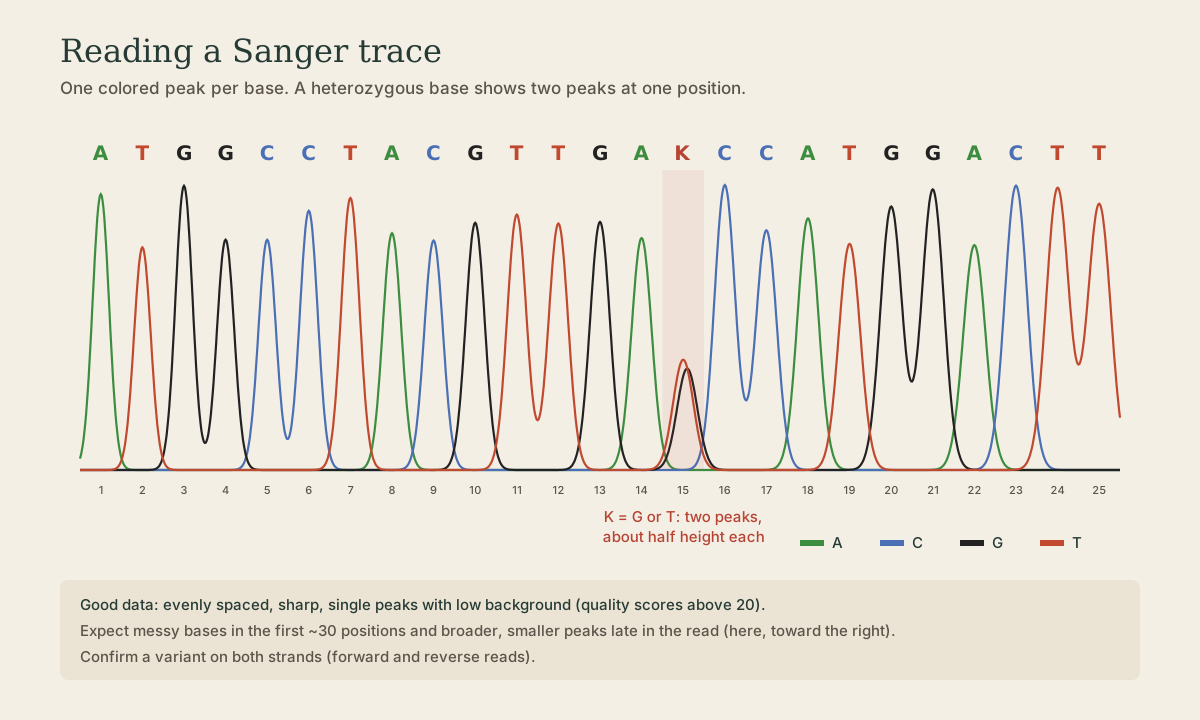
- Good data: evenly spaced, sharp, single peaks with flat background; quality above 20 (99% accuracy) through the region of interest.
- The ends: the first ~30 bases after the primer are messy, and peaks broaden and shrink late in the read. Place primers well outside the region you need.
- Heterozygous substitution: two different-colored peaks, each about half height, at one position, called with IUPAC codes (R = A/G, Y = C/T, K = G/T, M = A/C, S = G/C, W = A/T).
- Heterozygous indel: clean sequence up to a point, then overlapping double peaks for the rest of the read, because the two alleles are now out of register. Reading the reverse strand or using software deconvolution sorts out the indel.
- Dye blobs: broad, featureless peaks from unincorporated dye, usually near 70-80 bases.
- Always compare with a reference sequence, and confirm variants on both strands.
Quick check
Heterozygous indels instead cause the trace to turn into overlapping double peaks from that point on.
Strengths and limits
| Strengths | Limits |
|---|---|
| very accurate base calls; the long-standing “gold standard” | one amplicon at a time: low throughput |
| long reads (about 700-1,000 bp) | detects variants only above about 15-20% allele fraction |
| simple analysis; cheap per reaction | can’t phase variants or count copy number |
| quick turnaround for a few targets | large deletions of a whole exon look normal (one allele drops out silently) |
That last point matters: if one allele’s exon is deleted, Sanger sees only the other allele and reads “normal.” Copy-number methods (MLPA, NGS depth) catch it.
Quick check
Low-level somatic variants need NGS, digital PCR, or other sensitive methods.
Continuing role
- Confirming variants found by NGS, though many labs now validate high-quality NGS calls without it.
- Known familial variant testing of relatives - one amplicon, one answer.
- Filling NGS coverage gaps, and single-gene tests.
- Identifying organisms from 16S or ITS amplicons (see Microbial Genetics).
What to take from this
Sanger copies a template with dye-labeled ddNTPs that stop chains at every position, then reads the colors by capillary electrophoresis. Good traces have sharp, evenly spaced peaks with quality above 20; heterozygous substitutions show two half-height peaks, and heterozygous indels scramble the read from that point on. Sanger is accurate and long-reading but low-throughput, blind below about 15-20% allele fraction, and blind to single-allele exon deletions, so it now mainly confirms and tests known variants.
Lesson complete
Nice work.
Sources for this lesson
- 1Lela Buckingham. Molecular Diagnostics: Fundamentals, Methods, and Clinical Applications. 3rd ed. F.A. Davis Company. 2019. verifiedThe standard clinical molecular-diagnostics textbook for MLS/MB programs; author holds MB DLM(ASCP). Covers nucleic-acid chemistry, techniques, lab operations, and applications across infectious disease, oncology, genetics, and identity. Primary topic reference for the ASCP MB program.
- 2Bruce Alberts, Rebecca Heald, Alexander Johnson, David Morgan, Martin Raff, Keith Roberts, Peter Walter. Molecular Biology of the Cell. 7th ed. W. W. Norton & Company. 2022. verifiedThe canonical cell/molecular biology textbook; used for nucleic-acid chemistry and the central dogma.
Further reading
- Michael R. Green, Joseph Sambrook. Molecular Cloning: A Laboratory Manual. 4th ed. Cold Spring Harbor Laboratory Press. 2012. verifiedThe classic three-volume molecular-biology methods manual — authoritative for nucleic-acid isolation, electrophoresis, restriction digestion, labeling, and hybridization techniques. Standard-tier topic reference for the techniques courses.