Pyrosequencing, RNA-seq, and Long Reads
Three more ways to read sequence: pyrosequencing's light-per-incorporation pyrogram for quantitative hotspot and methylation calls, RNA-seq for expression and fusions, and long-read single-molecule platforms that span repeats, structural variants, and haplotypes.
- 4 min
- 4 steps
- 3 questions
- Lesson 31 of 60
In this lesson
- Pyrosequencing
- RNA-seq
- Long reads
- What to take from this
Picking up where you left off.
Pyrosequencing
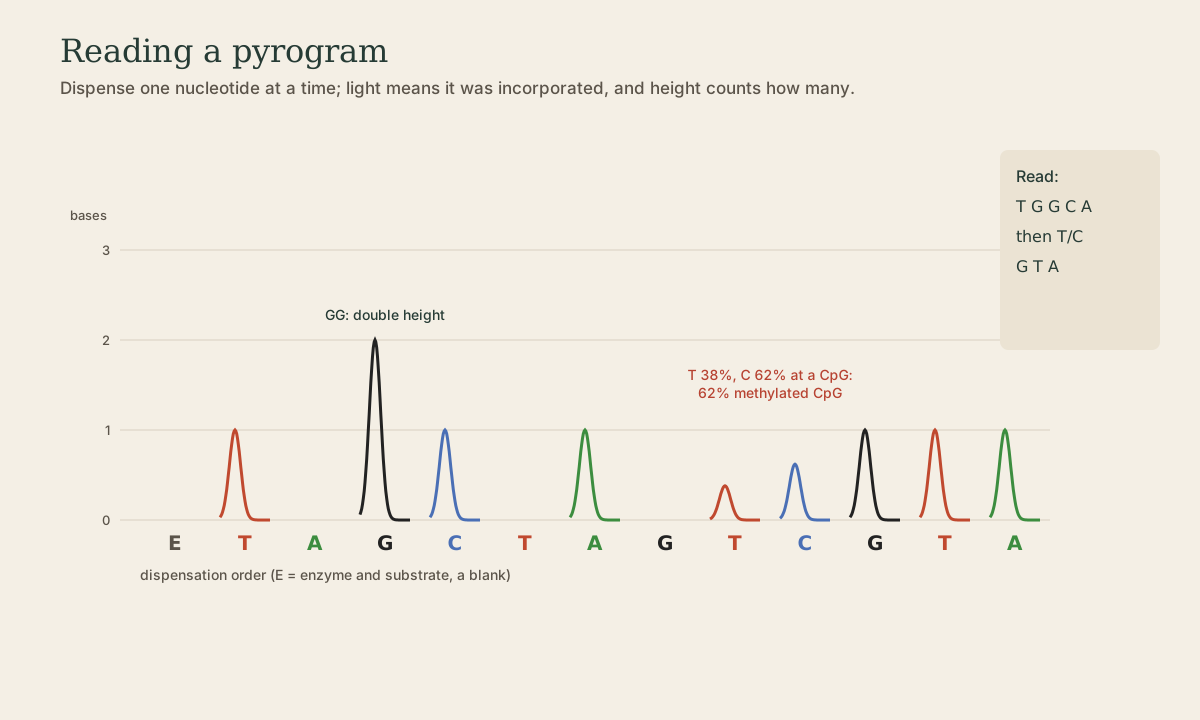
Pyrosequencing is sequencing by synthesis read with light 1. Nucleotides are dispensed one type at a time in a known order. When the polymerase incorporates one, it releases pyrophosphate, which ATP sulfurylase turns into ATP, which luciferase uses to make a flash of light; apyrase then clears leftover nucleotide before the next dispensation 1.
Reading a pyrogram:
- A peak at a dispensation means that base was added; no peak, not added.
- Peak height is proportional to the number of identical bases added - a double-height G means GG 1. Long homopolymers get less accurate.
- At a position with two alleles, the two peaks split the height, giving a quantitative percentage.
That quantitation is pyrosequencing’s niche: percent methylation at each CpG after bisulfite conversion (MGMT in glioblastoma), and mutant percentage at hotspots (KRAS, BRAF), sensitive to roughly 5%. Reads are short (tens of bases), and it’s been displaced in many labs by NGS, but remains a reliable targeted tool.
Quick check
Nucleotides are dispensed one at a time; light means that base was added, and its height counts how many.
Quick check
MGMT methylation and KRAS codon 12/13 assays are classic uses.
RNA-seq
RNA-seq sequences cDNA made from RNA, so it measures what genes are expressed and how much (by counting reads per gene), plus splice variants and fusion transcripts 1.
- Library prep starts with RNA: remove ribosomal RNA (or select poly(A) mRNA), fragment, reverse-transcribe, then build a normal library.
- Clinically, targeted RNA panels detect gene fusions in solid tumors and leukemias (ALK, ROS1, RET, NTRK, BCR::ABL1) more reliably than DNA, because introns, where DNA breakpoints scatter, are spliced out.
- Expression signatures classify some cancers and predict recurrence risk.
RNA quality matters: degraded FFPE RNA is assessed by DV200 before library prep (see Assessing Quality and Quantity).
Long reads
Long-read (third-generation) platforms sequence single molecules without clonal amplification, producing reads of thousands to hundreds of thousands of bases 1:
| Platform type | How it reads |
|---|---|
| Real-time single-molecule (zero-mode waveguide) | watches a single polymerase incorporate fluorescent nucleotides in a tiny well; repeated passes give high-accuracy consensus reads |
| Nanopore | ratchets a DNA or RNA strand through a protein pore and reads changes in ionic current; portable devices exist |
Why it matters:
- Repeat expansions: a read longer than the repeat sizes it exactly (FMR1, C9orf72).
- Structural variants, inversions, and complex rearrangements.
- Phasing: whether two variants are on the same copy (cis) or opposite copies (trans), critical for compound heterozygosity in recessive disease.
- Methylation read directly from the native DNA, without bisulfite.
- Difficult regions: pseudogenes (CYP2D6, SMN1/SMN2) and highly repetitive DNA.
Per-base accuracy and cost have improved enough that long reads are moving into clinical genomes.
Quick check
A read longer than the repeat or rearrangement spans it end to end.
What to take from this
Pyrosequencing dispenses one nucleotide at a time and reads light from released pyrophosphate; peak heights count bases and give quantitative methylation or mutant percentages. RNA-seq sequences cDNA for expression and, clinically, fusion detection. Long-read single-molecule platforms span repeats and structural variants, phase variants, and read methylation directly.
Lesson complete
Nice work.
Sources for this lesson
- 1Lela Buckingham. Molecular Diagnostics: Fundamentals, Methods, and Clinical Applications. 3rd ed. F.A. Davis Company. 2019. verifiedThe standard clinical molecular-diagnostics textbook for MLS/MB programs; author holds MB DLM(ASCP). Covers nucleic-acid chemistry, techniques, lab operations, and applications across infectious disease, oncology, genetics, and identity. Primary topic reference for the ASCP MB program.
Further reading
- Michael R. Green, Joseph Sambrook. Molecular Cloning: A Laboratory Manual. 4th ed. Cold Spring Harbor Laboratory Press. 2012. verifiedThe classic three-volume molecular-biology methods manual — authoritative for nucleic-acid isolation, electrophoresis, restriction digestion, labeling, and hybridization techniques. Standard-tier topic reference for the techniques courses.
- Bruce Alberts, Rebecca Heald, Alexander Johnson, David Morgan, Martin Raff, Keith Roberts, Peter Walter. Molecular Biology of the Cell. 7th ed. W. W. Norton & Company. 2022. verifiedThe canonical cell/molecular biology textbook; used for nucleic-acid chemistry and the central dogma.