Isothermal and Signal Amplification
Amplifying without a thermal cycler: TMA and NASBA's RNA-intermediate cycle at about 41 °C, LAMP's strand-displacing polymerase and loop primers with by-eye readouts, and the other way to boost sensitivity - amplifying signal or probe instead of target, as in hybrid capture, branched DNA, and Invader chemistry.
- 4 min
- 5 steps
- 4 questions
- Lesson 28 of 60
In this lesson
- The idea
- TMA and NASBA
- LAMP
- Amplifying signal instead of target
- What to take from this
Picking up where you left off.
The idea
PCR separates strands with heat. Isothermal methods do it with enzymes, at one constant temperature, so they need only a heat block - or a heated pouch in a handheld device 1. They’re fast and suit point-of-care and high-volume testing.
| Method | Enzymes | Temperature | Target |
|---|---|---|---|
| TMA / NASBA | reverse transcriptase + RNA polymerase | about 41 °C | RNA (mostly) |
| LAMP | strand-displacing DNA polymerase (Bst) | about 60-65 °C | DNA, or RNA with RT |
| SDA, RPA, HDA | nicking enzymes, recombinases, helicases | 37-65 °C | DNA |
Quick check
Strand-displacing polymerases (LAMP) or RNase H activity in an RNA-intermediate cycle (TMA, NASBA).
TMA and NASBA
Transcription-mediated amplification and nucleic acid sequence-based amplification route the target through an RNA intermediate 1:
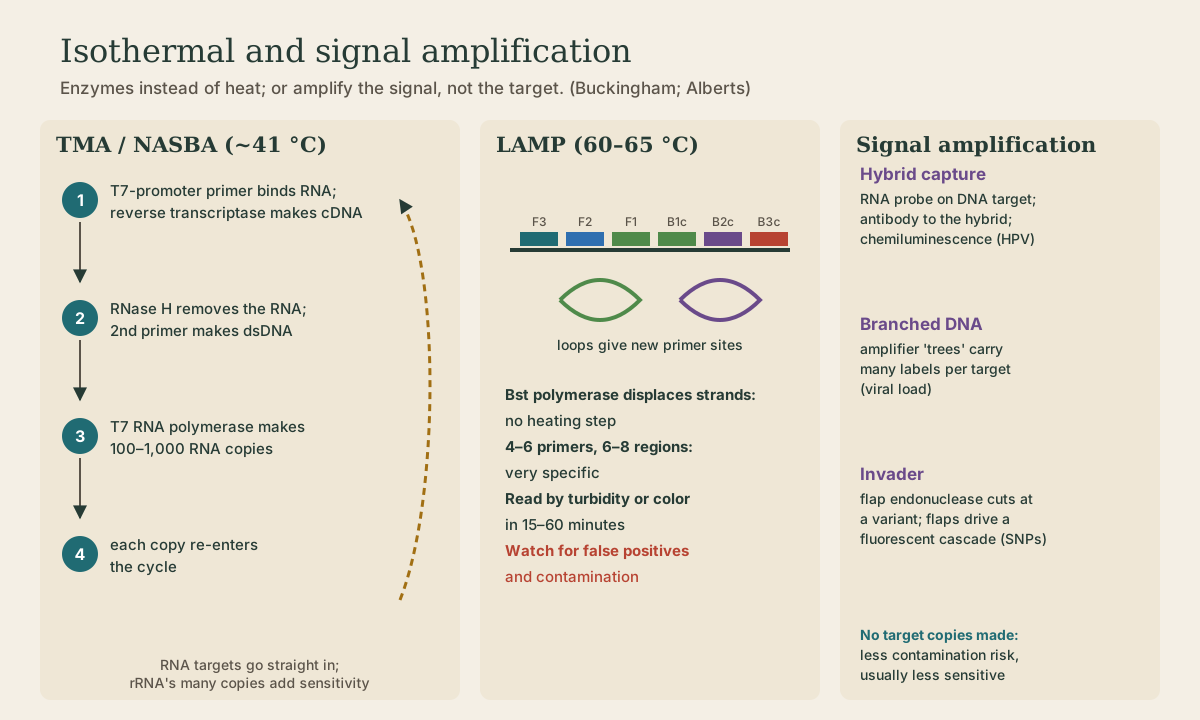
- A primer carrying a T7 promoter binds target RNA; reverse transcriptase copies it into DNA.
- RNase H activity degrades the RNA strand of the hybrid; a second primer makes the DNA double-stranded with a working promoter.
- T7 RNA polymerase transcribes 100-1,000 RNA copies from each template.
- Every new RNA copy re-enters the cycle 2.
Output grows enormously in under an hour, and RNA targets go straight in. TMA is the engine of widely used high-volume Chlamydia trachomatis / Neisseria gonorrhoeae and HIV/HCV assays; targeting rRNA, present in thousands of copies per cell, boosts sensitivity further.
Quick check
Each DNA template is transcribed into many RNA copies, which re-enter the cycle; a natural fit for RNA targets.
LAMP
Loop-mediated isothermal amplification uses a strand-displacing polymerase and four to six primers recognizing six to eight regions of the target 1. Two primers carry tails that fold back into loops, giving other primers new places to bind, so synthesis cascades into long looped products without any denaturation.
- Specific: several independent sites must all match.
- Fast: positive in 15-60 minutes.
- Readable by eye: pyrophosphate from massive synthesis clouds the tube (turbidity), or a pH or fluorescent dye changes color 1.
- Drawbacks: complex primer design, and nonspecific amplification can produce false positives if reactions run too long; huge product amounts mean contamination must be managed carefully.
LAMP spread widely in home and point-of-care SARS-CoV-2 tests.
Quick check
Four to six primers on six to eight target regions also make it very specific.
Amplifying signal instead of target
Buckingham sorts amplification into three kinds: target amplification (PCR, TMA, LAMP), probe amplification (copying the probe, as in ligase chain reaction), and signal amplification, which makes each detected target produce more signal 1:
| Method | How it works |
|---|---|
| Hybrid capture | RNA probes bind target DNA; antibodies specific for RNA:DNA hybrids capture them, and enzyme-labeled antibodies give a chemiluminescent signal. The classic high-risk HPV test |
| Branched DNA (bDNA) | capture probes hold the target; branched “amplifier” DNA builds a tree with many labeled probes per target. Used for viral loads |
| Invader (cleavase) | an overlapping probe structure is cut by a flap endonuclease at a variant, releasing flaps that drive a fluorescent signal cascade; for SNP genotyping |
Because no target copies are made, signal methods have less amplicon contamination risk and measure target directly, but are usually less sensitive than target amplification 1.
Quick check
With no target amplicons made, there is less risk of amplicon contamination.
What to take from this
Isothermal methods replace heat with enzymes. TMA and NASBA cycle through RNA with reverse transcriptase and T7 RNA polymerase at about 41 °C - ideal for RNA and rRNA targets. LAMP uses a strand-displacing polymerase and four to six primers at 60-65 °C, read by turbidity or color in under an hour. Signal methods (hybrid capture, bDNA, Invader) amplify the readout, not the target, trading some sensitivity for less contamination risk.
Lesson complete
Nice work.
Sources for this lesson
- 1Lela Buckingham. Molecular Diagnostics: Fundamentals, Methods, and Clinical Applications. 3rd ed. F.A. Davis Company. 2019. verifiedThe standard clinical molecular-diagnostics textbook for MLS/MB programs; author holds MB DLM(ASCP). Covers nucleic-acid chemistry, techniques, lab operations, and applications across infectious disease, oncology, genetics, and identity. Primary topic reference for the ASCP MB program.
- 2Bruce Alberts, Rebecca Heald, Alexander Johnson, David Morgan, Martin Raff, Keith Roberts, Peter Walter. Molecular Biology of the Cell. 7th ed. W. W. Norton & Company. 2022. verifiedThe canonical cell/molecular biology textbook; used for nucleic-acid chemistry and the central dogma.
Further reading
- Michael R. Green, Joseph Sambrook. Molecular Cloning: A Laboratory Manual. 4th ed. Cold Spring Harbor Laboratory Press. 2012. verifiedThe classic three-volume molecular-biology methods manual — authoritative for nucleic-acid isolation, electrophoresis, restriction digestion, labeling, and hybridization techniques. Standard-tier topic reference for the techniques courses.