CML and BCR::ABL1 Monitoring
The Philadelphia chromosome, the p210 and p190 transcripts, quantitative RT-PCR on the International Scale, the 10-1-0.1 percent milestones, and kinase domain mutations like T315I.
- 4 min
- 8 steps
- 3 questions
- Lesson 49 of 60
In this lesson
- The fusion
- Diagnosis and treatment
- Quantitative monitoring
- The International Scale
- Milestones
- Kinase domain mutations
- Worked example
- What to take from this
Picking up where you left off.
The fusion
Chronic myeloid leukemia (CML) is driven by the Philadelphia chromosome, a balanced translocation t(9;22)(q34;q11) that fuses BCR on chromosome 22 to ABL1 on chromosome 9. The fusion gene, BCR::ABL1, makes a constitutively active tyrosine kinase that drives myeloid proliferation.
Where BCR breaks determines the transcript and protein 1:
| Breakpoint | Transcripts | Protein | Typical disease |
|---|---|---|---|
| Major (M-bcr) | e13a2 (b2a2), e14a2 (b3a2) | p210 | More than 95% of CML |
| Minor (m-bcr) | e1a2 | p190 | Most Ph+ ALL |
| Micro (μ-bcr) | e19a2 | p230 | Rare, neutrophilic CML |
Knowing the transcript at diagnosis matters because the monitoring assay must detect it. Standard quantitative assays target e13a2 and e14a2; atypical transcripts need specialized assays 2.
Quick check
CML usually has the major-breakpoint p210 transcripts e13a2 or e14a2. Most Ph+ ALL has the minor-breakpoint e1a2 transcript encoding p190.
Diagnosis and treatment
CML is diagnosed by finding the Philadelphia chromosome (karyotype), the fusion (FISH), or the transcript (RT-PCR). It’s treated with tyrosine kinase inhibitors (TKIs): imatinib, dasatinib, nilotinib, and bosutinib first-line 2. Most patients now have a near-normal life expectancy, and molecular monitoring is how their treatment is managed.
Quantitative monitoring
Response is monitored by quantitative RT-PCR of BCR::ABL1 transcripts in peripheral blood, every 3 months until response is established 2. The result is a ratio: BCR::ABL1 transcripts divided by a control gene (usually ABL1, sometimes GUSB or BCR) in the same sample. The control corrects for RNA quantity and quality, and a minimum number of control transcripts is required for a result to count as deeply negative.
The International Scale
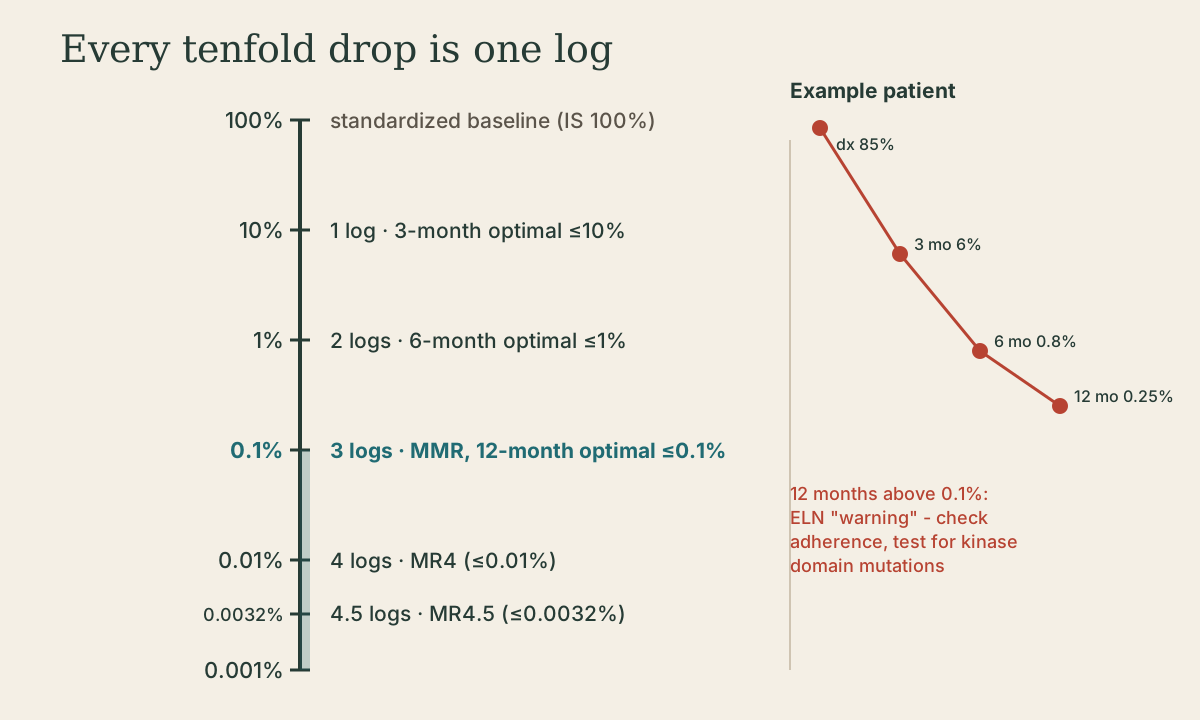
Ratios from different labs once couldn’t be compared. The International Scale (IS) fixes this: each lab derives a conversion factor against reference material, so a result of 0.1% IS means the same thing everywhere. The IS sets 100% as the standardized baseline from the original trials, so log reductions read directly:
| IS level | Log reduction | Name |
|---|---|---|
| 10% | 1 log | |
| 1% | 2 logs | |
| 0.1% | 3 logs | Major molecular response (MMR) |
| 0.01% | 4 logs | MR4 |
| 0.0032% | 4.5 logs | MR4.5 |
Quick check
MMR is BCR::ABL1 ≤0.1% IS, a 3-log reduction from the standardized baseline. ELN 2020 sets it as the optimal 12-month milestone.
Milestones
ELN 2020 milestones 2:
| Time on TKI | Optimal | Warning | Failure |
|---|---|---|---|
| 3 months | ≤10% | >10% | >10% if confirmed |
| 6 months | ≤1% | >1-10% | >10% |
| 12 months | ≤0.1% (MMR) | >0.1-1% | >1% |
Missing milestones, losing MMR, or rising transcripts prompt a check of adherence, kinase domain mutation analysis, and a change of TKI 2.
Patients with sustained deep response (MR4 or better for at least two years, among other criteria) may try treatment-free remission: stopping the TKI with frequent PCR monitoring, monthly at first, and restarting if MMR is lost 2.
Kinase domain mutations
Resistance often comes from point mutations in the ABL1 kinase domain that stop a TKI from binding. They’re found by sequencing the BCR::ABL1 kinase domain (Sanger, or NGS for lower-level variants) in patients with failure or warning responses 2.
The famous one is T315I, the “gatekeeper” mutation, resistant to imatinib, dasatinib, nilotinib, and bosutinib. ELN 2020 named ponatinib as the only TKI then active against it 2; in October 2021 FDA also approved asciminib, which binds a different site on the kinase, for CML with T315I 3.
Worked example
A patient’s BCR::ABL1 results (% IS): diagnosis 85%, 3 months 6%, 6 months 0.8%, 12 months 0.25%.
- 3 months: 6% ≤10%, optimal.
- 6 months: 0.8% ≤1%, optimal.
- 12 months: 0.25% is above 0.1% but below 1%: warning. Check adherence and drug interactions, test for kinase domain mutations, and monitor closely; a change of therapy may be considered.
What to take from this
CML is driven by BCR::ABL1 from t(9;22); p210 (e13a2/e14a2) is typical of CML and p190 (e1a2) of most Ph+ ALL. Response is monitored by quantitative RT-PCR as a ratio to a control gene, reported on the International Scale. The milestones are ≤10% at 3 months, ≤1% at 6, and ≤0.1% (MMR) at 12; MR4 is 0.01% and MR4.5 0.0032%. Failing milestones calls for kinase domain sequencing, and T315I responds only to ponatinib or asciminib.
Practice
T315I, the ‘gatekeeper’ mutation, blocks imatinib, dasatinib, nilotinib, and bosutinib. ELN 2020 named ponatinib; FDA approved asciminib for T315I in 2021.
Lesson complete
Nice work.
Sources for this lesson
- 1BCR::ABL1 (molecular pathology topic). PathologyOutlines.com. verifiedMajor bcr (e13a2, e14a2; p210) in more than 95% of CML; minor bcr (e1a2; p190) in most Ph+ ALL; micro bcr (e19a2; p230).
- 2Andreas Hochhaus, et al.. European LeukemiaNet 2020 recommendations for treating chronic myeloid leukemia. Leukemia 34(4):966-984. 2020. verifiedMilestones on the International Scale - optimal ≤10% at 3 months, ≤1% at 6, ≤0.1% (MMR) at 12; MR4 ≤0.01%, MR4.5 ≤0.0032%; mutation analysis on failure; T315I treated with ponatinib.
- 3FDA approves asciminib for Philadelphia chromosome-positive chronic myeloid leukemia. U.S. Food and Drug Administration. 2021. verifiedOctober 29, 2021 approval for Ph+ CML in chronic phase after two or more TKIs and for CML with the T315I mutation.
Previous: Genotyping, Resistance, and Molecular Epidemiology