Decontamination, UNG, and Monitoring
How nucleic acid is destroyed - fresh bleach followed by ethanol and water, UV, and the dUTP/UNG system that makes old amplicon unamplifiable - and how wipe tests find contamination before patients do.
- 4 min
- 6 steps
- 3 questions
- Lesson 37 of 60
In this lesson
- Chemical decontamination
- UV light
- UNG and dUTP
- Monitoring: the wipe test
- When you find it
- What to take from this
Picking up where you left off.
Chemical decontamination
The aim is to destroy nucleic acid, not just kill organisms; DNA from a dead organism amplifies perfectly well.
- Sodium hypochlorite (bleach) oxidizes and nicks nucleic acid and is the most effective common decontaminant for molecular labs 1. Use a freshly prepared 10% dilution of household bleach (about 0.5 to 0.6% hypochlorite), because diluted bleach loses strength within a day or so. After the contact time, wipe with ethanol and water to remove the corrosive residue 2.
- Dilute hydrochloric acid (1 N) depurinates nucleic acid; it’s stable but needs long contact times 1.
- Commercial DNA-destroying products (such as DNA Away) are alternatives where bleach would damage surfaces 2.
- 70% ethanol alone does not destroy DNA. It cleans and disinfects but leaves amplifiable template.
Clean workstations at the start and end of each day or run, and regularly clean the less obvious spots: the inside and outside of pipettes, centrifuges and vortexers, door knobs, and freezer handles 2.
Quick check
Freshly prepared 10% bleach is the most effective nucleic-acid decontaminant, but it corrodes metal and instruments. Wipe it off with ethanol and water after the contact time.
UV light
Ultraviolet light creates thymine dimers and other damage that make DNA unusable as template 2. It’s built into PCR workstations, biosafety cabinets, and some extraction instruments, typically run 10 to 15 minutes 1. Its limits 1:
- It works only on surfaces in direct line of sight.
- Short amplicons are hard to damage enough (fewer adjacent thymines to dimerize).
- Bulbs lose output over time.
- Prolonged exposure degrades plastics.
UV supplements cleaning; it doesn’t replace bleach.
UNG and dUTP
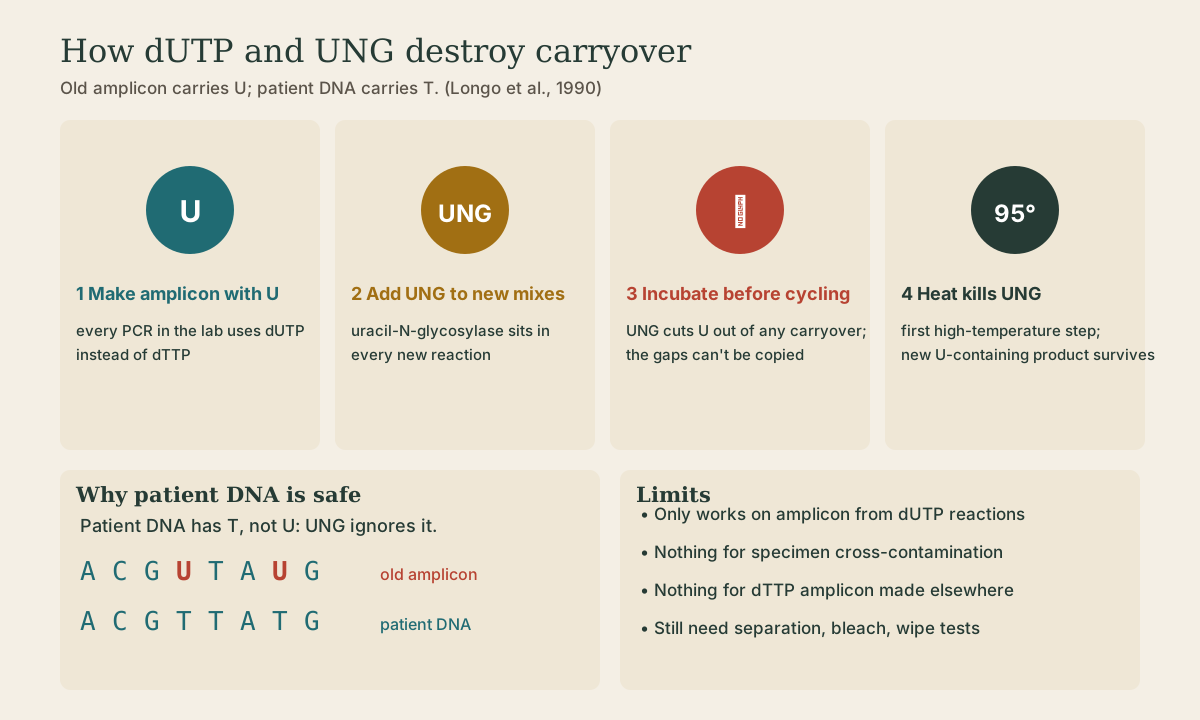
The dUTP/UNG system, described by Longo and colleagues in 1990, attacks carryover chemically 3:
- Every amplification in the lab uses dUTP in place of dTTP, so every amplicon contains uracil.
- Each new reaction mix contains the enzyme uracil-N-glycosylase (UNG, also called UDG).
- Before cycling, a short incubation lets UNG cleave uracil from any contaminating amplicon, leaving abasic sites that polymerase can’t copy and that break on heating.
- The first high-temperature step inactivates UNG, so it doesn’t destroy the new, uracil-containing product.
Patient DNA contains thymine, not uracil, so it’s untouched 3.
Limits 1:
- It protects only against amplicon from dUTP reactions. It does nothing for specimen cross-contamination or for amplicon made with dTTP elsewhere.
- It’s most effective against low-level contamination.
- Assays that need the product afterward (sequencing, some downstream steps) must account for uracil.
Quick check
Native template contains thymine, not uracil, so UNG ignores it. Carryover amplicons from earlier dUTP reactions are cleaved and can’t be amplified. The initial heat step inactivates UNG so it doesn’t attack the new product.
Monitoring: the wipe test
Don’t wait for patient results to reveal contamination. Run environmental wipe tests on a schedule (monthly is a common frequency) 2:
- Wet a polyester swab with clean water 1.
- Wipe a defined area: bench tops, pipettes, centrifuge rotors, freezer handles, keyboards, instrument surfaces.
- Place the swab in about 0.5 mL of water and vortex 1.
- Test the eluate with the assays you run (or a target you amplify most).
- Record the results by location and track them over time.
Also track NTC results, positivity rates, and Cq distributions, which reveal contamination indirectly 1.
When you find it
- Stop testing affected assays and hold results.
- Swab to localize the source.
- Decontaminate thoroughly: bleach and rinse all surfaces and equipment; discard opened reagent aliquots, tips, and consumables; replace reagents from unopened stock.
- Retest NTCs and swabs until clean.
- Review and correct the cause: workflow breaks, a spill, a new staff member’s technique.
- Assess patient results reported since the last clean monitoring and correct them if needed.
What to take from this
Destroy nucleic acid with fresh 10% bleach followed by an ethanol and water rinse; 70% ethanol alone doesn’t destroy DNA. UV damages DNA on exposed surfaces but has limits. The dUTP/UNG system makes earlier amplicon unamplifiable but doesn’t touch specimen DNA. Monitor with scheduled wipe tests, NTCs, and positivity trends, and when you find contamination, stop, localize, decontaminate, verify, fix the cause, and review reported results.
Practice
Specimen DNA contains thymine, so UNG can’t tell it from the real template. Specimen cross-contamination is prevented by technique, not chemistry.
Lesson complete
Nice work.
Sources for this lesson
- 1Dean A. Jobe, Erik Reisdorf. PCR Contamination and Laboratory Best Practices. Wisconsin State Laboratory of Hygiene and Gundersen Health System. 2018. verifiedSigns of contamination (rising positivity for rare targets, more high-Ct positives, out-of-season positives, positive environmental swabs); bleach, HCl, UV, and UNG; wipe testing with a wet polyester swab.
- 2Rachel Lee. Molecular Laboratory Design and QA/QC Considerations. Association of Public Health Laboratories (NBS Molecular Training Workshop). 2020. verifiedThree areas with positive pressure in reagent prep and negative in sample prep and post-amp; CAP MOL.35350 carryover and run order; fresh 10% bleach then ethanol and water; monthly wipe tests; MOL.49520 thermocycler checks annually; MOL.34516 cut-off verification each lot or 6 months; control types.
- 3M. C. Longo, M. S. Berninger, J. L. Hartley. Use of uracil DNA glycosylase to control carry-over contamination in polymerase chain reactions. Gene 93(1):125-128. 1990. verifiedSubstitute dUTP for dTTP in all amplifications, then treat new reactions with UNG before cycling; UNG removes uracil from carryover amplicons but leaves native DNA intact, and is heat-inactivated.