Who Regulates What: CMS, FDA, CAP, TJC, CLSI
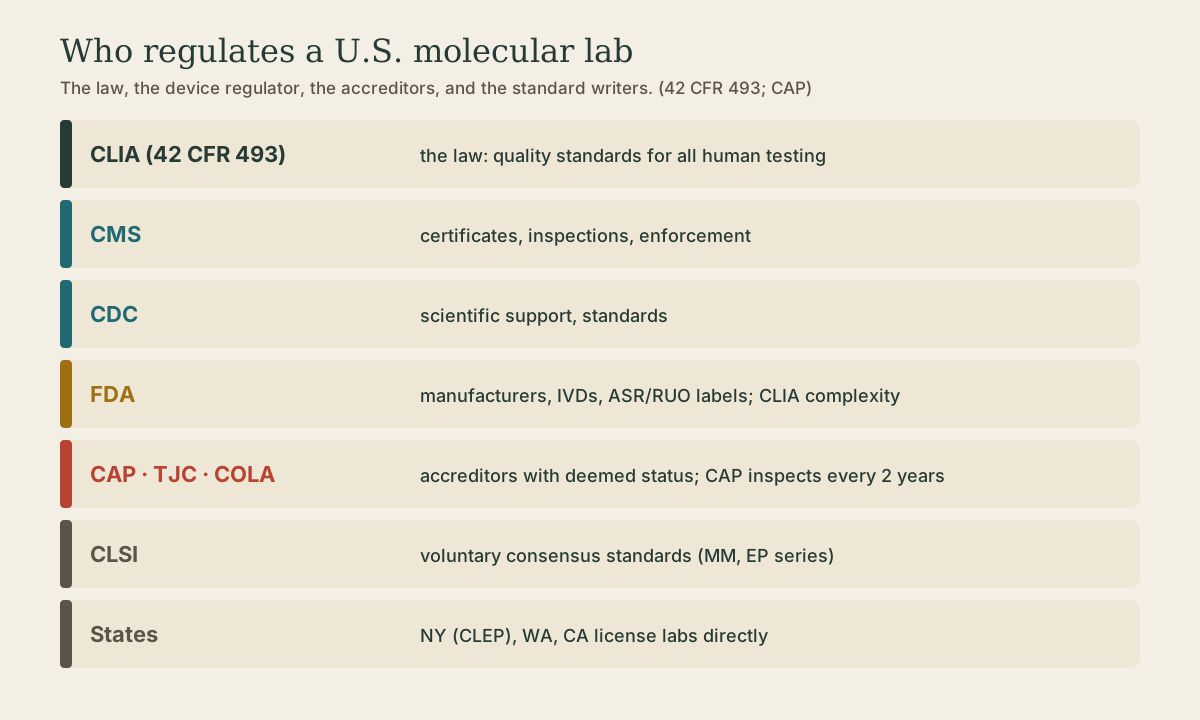
CLIA sets the law and CMS enforces it; FDA regulates manufacturers and categorizes complexity; CAP, TJC, and COLA accredit; CLSI writes the consensus standards; and some states add their own licensure.
- 4 min
- 7 steps
- 3 questions
- Lesson 43 of 60
In this lesson
- The layers
- CLIA and CMS
- FDA
- Accreditation
- CLSI
- States and others
- What to take from this
Picking up where you left off.
The layers
U.S. molecular labs answer to several bodies with different jobs:
| Body | Role |
|---|---|
| CMS | Administers CLIA: certificates, inspections, enforcement |
| CDC | Scientific support for CLIA; standards development |
| FDA | Regulates manufacturers and IVD devices; categorizes CLIA complexity |
| CAP, TJC, COLA | Accrediting organizations with CMS “deemed status” |
| CLSI | Voluntary consensus standards (MM, EP, and other series) |
| States | Some license labs directly (New York, Washington, California) |
CLIA and CMS
The Clinical Laboratory Improvement Amendments of 1988 (CLIA) set quality standards for all human testing for diagnosis, prevention, or treatment, wherever it’s performed 1. The regulations are at 42 CFR Part 493, including the performance-specification rules covered in the last lesson 2.
CMS issues one of several certificates:
- Certificate of Waiver (waived tests only).
- Provider-Performed Microscopy.
- Certificate of Compliance (inspected by the state agency for CMS).
- Certificate of Accreditation (inspected by an approved accreditor).
CLIA has no separate molecular specialty; molecular tests fall under general requirements and the relevant specialties, and most are high complexity, which sets personnel qualifications (laboratory director, technical supervisor, testing personnel) 1.
Quick check
CMS runs the CLIA program and its certificates and inspections. FDA categorizes test complexity, and CDC provides scientific and technical support.
FDA
FDA regulates the manufacturers of IVD kits, instruments, and ASRs under the Food, Drug, and Cosmetic Act: clearance and approval, labeling (including the ASR, RUO, and IUO statements), quality system rules, and adverse event reporting. It also assigns each commercial test a CLIA complexity. FDA’s attempt to regulate LDTs as devices was vacated in 2025, so lab-developed tests are governed by CLIA 3.
Accreditation
Most molecular labs choose accreditation over state-agency inspection:
- CAP (College of American Pathologists) is the main accreditor for molecular labs. A peer team inspects every two years, and the lab completes a self-inspection in the alternate year 4. Labs are inspected against the checklists matching their testing: Laboratory General, All Common, and discipline checklists including Molecular Pathology (MOL) 4. CAP requirements are often stricter and more specific than CLIA’s: the carryover, thermocycler, and cut-off rules quoted earlier in this course are MOL checklist items 1.
- The Joint Commission (TJC) accredits many hospital laboratories along with the hospital.
- COLA accredits many physician office and smaller labs.
Accreditation also usually requires participation in the accreditor’s proficiency testing.
Quick check
CAP inspects every two years with a peer team, and the lab completes a self-inspection in the off year.
CLSI
The Clinical and Laboratory Standards Institute publishes consensus documents that define good practice. Molecular labs use the MM series (for example, MM19 on establishing molecular testing in clinical lab environments) and the EP evaluation protocols (EP17 for detection capability, EP05 for precision, among others). They aren’t law, but inspectors expect labs to follow them or justify an alternative.
States and others
- New York State requires its own approval (through the Clinical Laboratory Evaluation Program) for any lab testing New York residents’ specimens, including review of LDTs 1.
- Washington and California license labs.
- ISO 15189 accreditation (medical laboratory quality and competence) is used by some labs, especially those working internationally 1.
What to take from this
CLIA is the law, at 42 CFR 493, and CMS enforces it through certificates and inspections. FDA regulates manufacturers and IVDs and sets CLIA complexity, but not LDTs after 2025. CAP accreditation, with inspections every two years and the Molecular Pathology checklist, is the norm for molecular labs, alongside TJC and COLA. CLSI writes voluntary standards that inspectors rely on, and New York and a few other states add their own requirements.
Practice
CLSI standards aren’t law, but CAP checklists and inspectors lean on them, and following them is how labs show they meet CLIA’s general requirements.
Lesson complete
Nice work.
Sources for this lesson
- 1Rachel Lee. Molecular Laboratory Design and QA/QC Considerations. Association of Public Health Laboratories (NBS Molecular Training Workshop). 2020. verifiedThree areas with positive pressure in reagent prep and negative in sample prep and post-amp; CAP MOL.35350 carryover and run order; fresh 10% bleach then ethanol and water; monthly wipe tests; MOL.49520 thermocycler checks annually; MOL.34516 cut-off verification each lot or 6 months; control types.
- 242 CFR 493.1253 - Establishment and verification of performance specifications. Legal Information Institute (CLIA regulations). verifiedUnmodified FDA-cleared systems - verify accuracy, precision, reportable range, reference intervals; modified systems and LDTs - establish those plus analytical sensitivity and analytical specificity including interfering substances.
- 3Federal District Court Vacates FDA's Laboratory Developed Tests Final Rule. FDA Law Blog (Hyman, Phelps & McNamara). 2025. verifiedOn March 31, 2025, the E.D. Texas vacated FDA's 2024 rule treating LDTs as devices (ACLA v. FDA; AMP v. FDA); FDA formally rescinded the rule effective September 19, 2025.
- 4Guide to CAP Accreditation. College of American Pathologists. 2018. verifiedOn-site peer inspection every two years with a self-inspection in the alternate year; discipline checklists including Molecular Pathology.