Pharmacogenomics
Genotype-guided prescribing: star alleles and metabolizer phenotypes, clopidogrel and CYP2C19, warfarin and CYP2C9/VKORC1, and the HLA alleles that predict severe reactions to carbamazepine and abacavir.
- 5 min
- 6 steps
- 3 questions
- Lesson 60 of 60
In this lesson
- Genotype to phenotype
- Clopidogrel and CYP2C19
- Warfarin: CYP2C9 and VKORC1
- HLA and severe drug reactions
- Others to know
- What to take from this
Picking up where you left off.
Genotype to phenotype
Pharmacogenomics uses a patient’s genotype to choose a drug or dose. Most genes involved encode drug-metabolizing enzymes (cytochrome P450s and others), drug targets, or HLA molecules that trigger immune reactions.
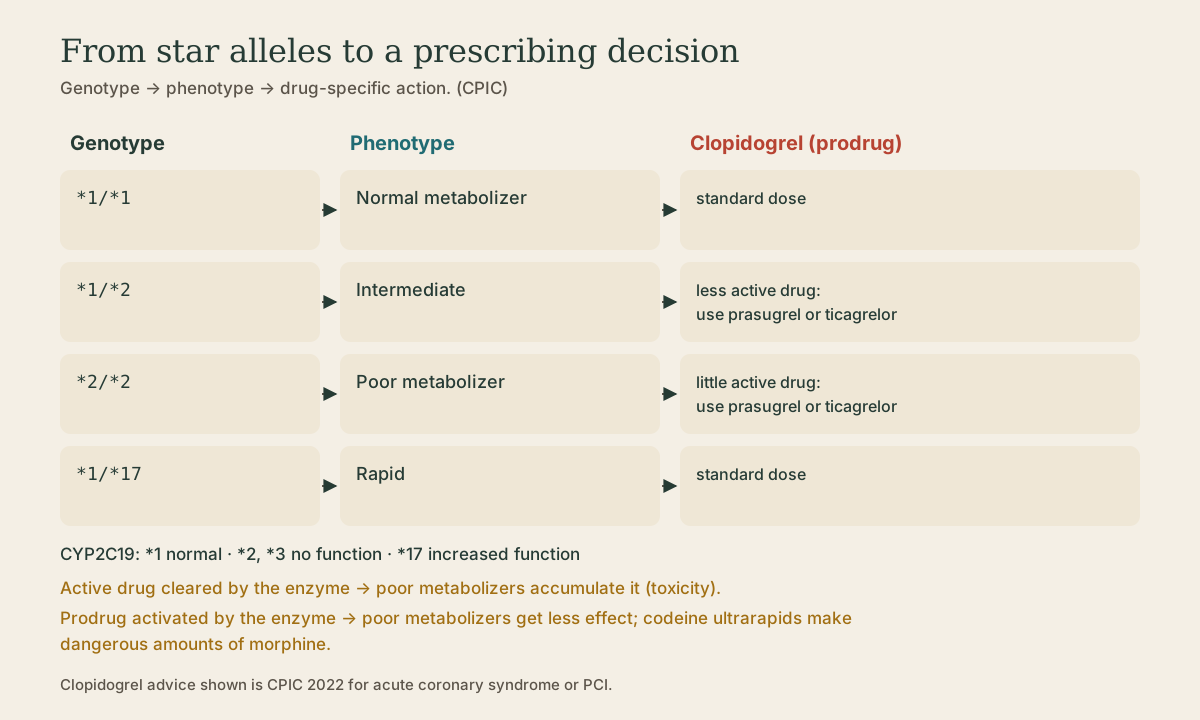
Variant combinations are named with star alleles: 1 is usually the reference (normal function), and others are numbered as discovered. Each allele is assigned a function (normal, decreased, no function, increased), and the diplotype is translated to a phenotype* 1:
- Poor metabolizer (PM): two no-function alleles.
- Intermediate metabolizer (IM): one normal and one no-function allele, or similar combinations.
- Normal metabolizer (NM).
- Rapid / ultrarapid metabolizer: increased-function alleles (or gene duplications, for CYP2D6).
Whether a phenotype raises or lowers drug exposure depends on the drug:
- Active drug cleared by the enzyme: poor metabolizers accumulate drug and risk toxicity.
- Prodrug activated by the enzyme (clopidogrel by CYP2C19, codeine by CYP2D6): poor metabolizers make less active drug and get less effect; ultrarapid metabolizers of codeine make dangerous amounts of morphine.
The Clinical Pharmacogenetics Implementation Consortium (CPIC) publishes guidelines that translate genotypes into prescribing actions.
Quick check
For prodrugs (clopidogrel, codeine via CYP2D6), poor metabolizers make less active drug. For active drugs cleared by the enzyme, poor metabolizers accumulate drug.
Clopidogrel and CYP2C19
Clopidogrel is an antiplatelet prodrug that needs CYP2C19 for activation. CYP2C19 *2 and *3 are no-function alleles, and *17 is increased function 1. Intermediate and poor metabolizers taking clopidogrel have less platelet inhibition and more major cardiovascular and cerebrovascular events 1.
CPIC 2022, for acute coronary syndrome or PCI 1:
- Poor metabolizers (*2/*2, *2/*3): avoid clopidogrel if possible; use prasugrel or ticagrelor (strong).
- Intermediate metabolizers (*1/*2, *1/*3): avoid standard-dose clopidogrel if possible; use prasugrel or ticagrelor (upgraded to strong in 2022).
For stroke or TIA, an alternative P2Y12 inhibitor is considered for IMs and PMs; prasugrel is contraindicated after stroke 1.
Quick check
2/2 is a poor metabolizer: clopidogrel is a prodrug activated by CYP2C19, so poor and intermediate metabolizers get less active drug and more cardiovascular events.
Warfarin: CYP2C9 and VKORC1
Warfarin needs careful dosing: too little allows clots, too much causes bleeding. Two genes have the largest effects:
- CYP2C9 metabolizes the more potent S-warfarin; *2 and *3 reduce function, so carriers clear warfarin more slowly and need lower doses.
- VKORC1 encodes warfarin’s target, vitamin K epoxide reductase. The -1639G>A promoter variant reduces VKORC1 expression, so carriers are more sensitive and need lower doses.
CYP2C9, VKORC1, CYP4F2, and a CYP2C cluster variant (rs12777823), together with clinical factors (age, weight, interacting drugs), explain about half of warfarin dose variability 2. CPIC recommends genotype-informed dosing algorithms with ancestry-specific guidance, since important variants differ between populations 2.
HLA and severe drug reactions
Some HLA alleles present drug-altered peptides to T cells, triggering life-threatening immune reactions 3:
Carbamazepine and HLA-B*15:02: strongly associated with Stevens-Johnson syndrome and toxic epidermal necrolysis (SJS/TEN) with carbamazepine and oxcarbazepine. CPIC: if a patient is carbamazepine-naive and B15:02-positive, don’t use carbamazepine (strong) 4. B15:02 is common in parts of East and Southeast Asia (frequencies are high in Thai and Vietnamese populations and lower in Japanese and Korean ones) 4. HLA-A*31:01 is linked to SJS/TEN, DRESS, and maculopapular rash with carbamazepine, and carriers should avoid it when alternatives exist 4.
Abacavir and HLA-B*57:01: carriers risk a serious, sometimes fatal hypersensitivity reaction. FDA labeling recommends screening before starting abacavir, and positive patients shouldn’t receive it; routine screening cut hypersensitivity from about 8% to under 0.5% 5.
Allopurinol and HLA-B*58:01: severe cutaneous reactions 3.
Others to know
- TPMT and NUDT15 with thiopurines (azathioprine, mercaptopurine): poor metabolizers develop severe myelosuppression on standard doses.
- DPYD with fluoropyrimidines (5-fluorouracil, capecitabine): deficient patients risk severe toxicity.
- CYP2D6 with codeine and tramadol (prodrugs) and many antidepressants.
- HER2 / trastuzumab and other tumor biomarkers are pharmacogenomics in the broad sense (covered in the oncology course).
What to take from this
Star alleles combine into poor, intermediate, normal, and rapid metabolizer phenotypes; poor metabolizers accumulate active drugs but under-activate prodrugs. CYP2C19 *2/*3 poor and intermediate metabolizers should avoid clopidogrel for ACS/PCI and take prasugrel or ticagrelor. CYP2C9 *2/*3 and VKORC1 -1639A lower warfarin dose needs. HLA-B*15:02 means no carbamazepine in drug-naive patients, HLA-B*57:01 means no abacavir, and HLA-B*58:01 flags allopurinol risk.
Practice
CPIC: HLA-B*15:02-positive, carbamazepine-naive patients should not receive carbamazepine (strong recommendation).
Lesson complete
Nice work.
Sources for this lesson
- 1Craig R. Lee, et al.. Clinical Pharmacogenetics Implementation Consortium Guideline for CYP2C19 Genotype and Clopidogrel Therapy: 2022 Update. Clinical Pharmacology & Therapeutics 112(5). 2022. verifiedCYP2C19 *2 and *3 are no-function, *17 increased function; for ACS/PCI, poor and intermediate metabolizers should avoid clopidogrel and use prasugrel or ticagrelor (strong).
- 2Julie A. Johnson, Kelly E. Caudle, et al.. Clinical Pharmacogenetics Implementation Consortium (CPIC) Guideline for Pharmacogenetics-Guided Warfarin Dosing: 2017 Update. Clinical Pharmacology & Therapeutics 102(3):397-404. 2017. verifiedCYP2C9, VKORC1, CYP4F2, and rs12777823 genotypes with clinical factors explain about half of warfarin dose variability; ancestry-specific recommendations.
- 3HLA-B gene. MedlinePlus Genetics (National Library of Medicine). verifiedHundreds of HLA-B alleles; HLA-B27 raises ankylosing spondylitis risk (1-5% of carriers develop it); B*57:01 abacavir, B*15:02 carbamazepine, B*58:01 allopurinol reactions.
- 4Elizabeth J. Phillips, et al.. Clinical Pharmacogenetics Implementation Consortium Guideline for HLA Genotype and Use of Carbamazepine and Oxcarbazepine: 2017 Update. Clinical Pharmacology & Therapeutics 103(4). 2018. verifiedHLA-B*15:02 carriers who are carbamazepine-naive should not receive carbamazepine (SJS/TEN risk); HLA-A*31:01 carriers should avoid it if alternatives exist (SJS/TEN, DRESS, MPE); B*15:02 is common in parts of East and Southeast Asia.
- 5HLA-B*57:01 for Abacavir Sensitivity. ARUP Consult. verifiedFDA labeling recommends HLA-B*57:01 screening before abacavir; positive patients should not receive it; screening cut hypersensitivity from about 8% to under 0.5%.