Instruments, Proficiency Testing, and Reporting
Thermocycler checks and calibration verification, proficiency testing twice a year (and what to do when no PT exists), and reporting molecular results in HGVS nomenclature with the required disclaimers.
- 4 min
- 5 steps
- 3 questions
- Lesson 40 of 60
In this lesson
- Instruments
- Proficiency testing
- Reporting results
- HGVS nomenclature
- What to take from this
Picking up where you left off.
Instruments
Molecular instruments need the same discipline as any analyzer, plus a few specifics:
- Thermocyclers: CAP requires checking the temperature accuracy of individual wells (or a representative sample) before placing the instrument in service and at least annually. A functional check such as amplification performance can substitute, and for closed systems it’s part of the manufacturer’s preventive maintenance (MOL.49520) 1.
- Pipettes: calibration checked on a schedule, commonly every 6 to 12 months.
- Centrifuges, heat blocks, freezers, refrigerators: speed and temperature monitored and logged.
- Calibration verification for quantitative assays at least every six months, with new reagent lots, and after major maintenance 1.
- Preventive maintenance on the manufacturer’s schedule, with records.
Every instrument has a maintenance log; a missing record is treated as maintenance not done.
Proficiency testing
Proficiency testing (PT) sends blind samples from an outside provider (CAP, for most molecular tests) to be tested like patient samples, with results graded against peer labs. PT is usually twice a year for molecular tests 1. Rules:
- Test PT samples like patient samples, by the staff who normally test, with the usual methods.
- Never send PT samples to another lab or discuss them with other labs before the deadline. PT referral is a serious CLIA violation.
- Investigate and document every unacceptable result, even if the overall event passes.
Most molecular tests aren’t “regulated analytes” listed in CLIA subpart I. For those, and for any test without a compatible CMS-approved PT program, the lab must verify accuracy at least twice a year by another method 2. Options include:
- Split samples exchanged with another laboratory.
- Testing previously characterized samples or reference materials.
- Comparison with an alternative method.
Quick check
42 CFR 493.1236(c) requires labs to verify accuracy at least twice annually for tests not in subpart I or without compatible PT samples.
Reporting results
A molecular report must say exactly what was tested and found. It typically includes:
- Patient and specimen identifiers, specimen type, collection and receipt dates.
- The test name, method, and genes or targets covered (and what wasn’t covered).
- The result in standard nomenclature, and an interpretation in plain language.
- Limitations: the assay’s limit of detection, variants not detected by the method, the effect of tumor content.
- For lab-developed tests using ASRs, the required statement that the test “was developed and its performance characteristics determined by” the lab and “has not been cleared or approved by the U.S. Food and Drug Administration” 3.
HGVS nomenclature
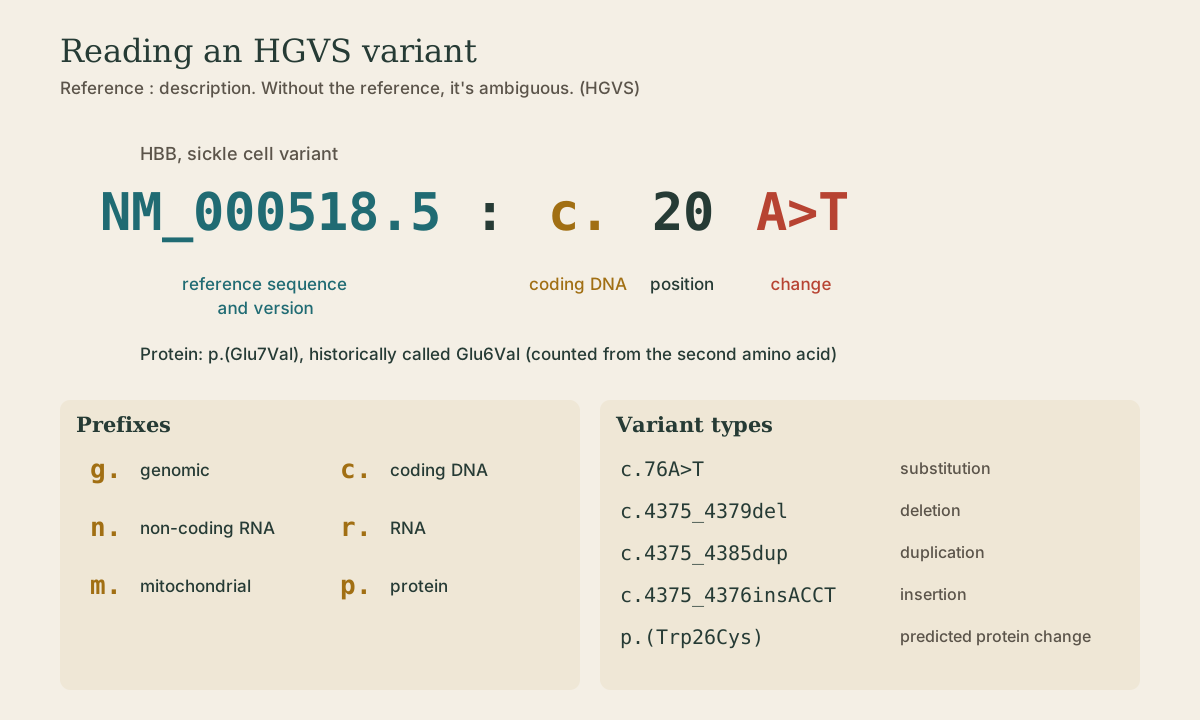
Sequence variants are written in HGVS format: reference sequence : description 4. Without the reference sequence, a description is ambiguous.
Prefixes 4:
- g. genomic, c. coding DNA, n. non-coding RNA, r. RNA, m. mitochondrial, p. protein.
Variant types 4:
| Type | Example | Meaning |
|---|---|---|
| Substitution | c.76A>T | A replaced by T at coding position 76 |
| Deletion | c.4375_4379del | Positions 4375 to 4379 deleted |
| Duplication | c.4375_4385dup | Positions 4375 to 4385 duplicated |
| Insertion | c.4375_4376insACCT | ACCT inserted between 4375 and 4376 |
| Deletion-insertion | c.4375_4376delinsAGTT | 4375 to 4376 replaced by AGTT |
| Protein | p.(Trp26Cys) | Predicted tryptophan to cysteine at 26 |
Parentheses around a protein change mean it’s predicted, not directly observed 4.
Examples you’ll meet: the sickle variant HBB c.20A>T, p.(Glu7Val) (historically “Glu6Val”, which counted from the second amino acid), and the common cystic fibrosis variant CFTR c.1521_1523del, p.(Phe508del).
Quick check
c. means coding DNA reference, and del means deletion. This is the CFTR deletion that removes phenylalanine 508, p.(Phe508del).
What to take from this
Check thermocycler wells before service and annually, verify calibration of quantitative assays every six months and with lot changes, and keep maintenance records. Treat PT samples like patients, never refer them, and investigate every miss. For tests without approved PT, verify accuracy twice a year another way. Report the method, targets, result, interpretation, and limitations, with the ASR disclaimer for LDTs, and write variants in HGVS format with a reference sequence.
Practice
CAP MOL.49520: individual wells, or a representative sample, are checked for temperature accuracy before use and at least annually; for closed systems it’s part of the manufacturer’s preventive maintenance.
Lesson complete
Nice work.
Sources for this lesson
- 1Rachel Lee. Molecular Laboratory Design and QA/QC Considerations. Association of Public Health Laboratories (NBS Molecular Training Workshop). 2020. verifiedThree areas with positive pressure in reagent prep and negative in sample prep and post-amp; CAP MOL.35350 carryover and run order; fresh 10% bleach then ethanol and water; monthly wipe tests; MOL.49520 thermocycler checks annually; MOL.34516 cut-off verification each lot or 6 months; control types.
- 242 CFR 493.1236 - Evaluation of proficiency testing performance. Legal Information Institute (CLIA regulations). verifiedTests not listed in subpart I (most molecular tests) or without CMS-approved PT must have accuracy verified at least twice a year. Cited at: (c).
- 321 CFR 809.30 - Restrictions on the sale, distribution and use of analyte specific reagents. Legal Information Institute. verifiedASRs sold to IVD manufacturers, CLIA high-complexity labs, and non-diagnostic users; labeled "Analyte Specific Reagent. Analytical and performance characteristics are not established."; in-house test reports carry the "developed and its performance characteristics determined by" disclaimer.
- 4HGVS Nomenclature: Simple Variant Descriptions. Human Genome Variation Society. verifiedreference:description format; c., g., m., n., r., p. prefixes; substitution c.76A>T, del, dup, ins, delins; predicted protein changes in parentheses.