Competency Assessment and Continuing Education
CLIA's six required elements of competency assessment, the semiannual-then-annual schedule, the difference between training and competency, and how continuing education keeps an MB(ASCP) certification current.
- 4 min
- 6 steps
- 3 questions
- Lesson 44 of 60
In this lesson
- Training versus competency
- The six elements
- The schedule
- Practical examples
- Continuing education
- What to take from this
Picking up where you left off.
Training versus competency
Training teaches someone to perform a test and is documented before they test patient specimens on their own. Competency assessment is the recurring proof that a trained person still performs the test correctly. Both are required, and inspectors check both.
Molecular labs add training on the hazards particular to amplification: the amplicon risk, one-way workflow, pipetting technique, and how to handle a spill or a contamination event 1.
The six elements
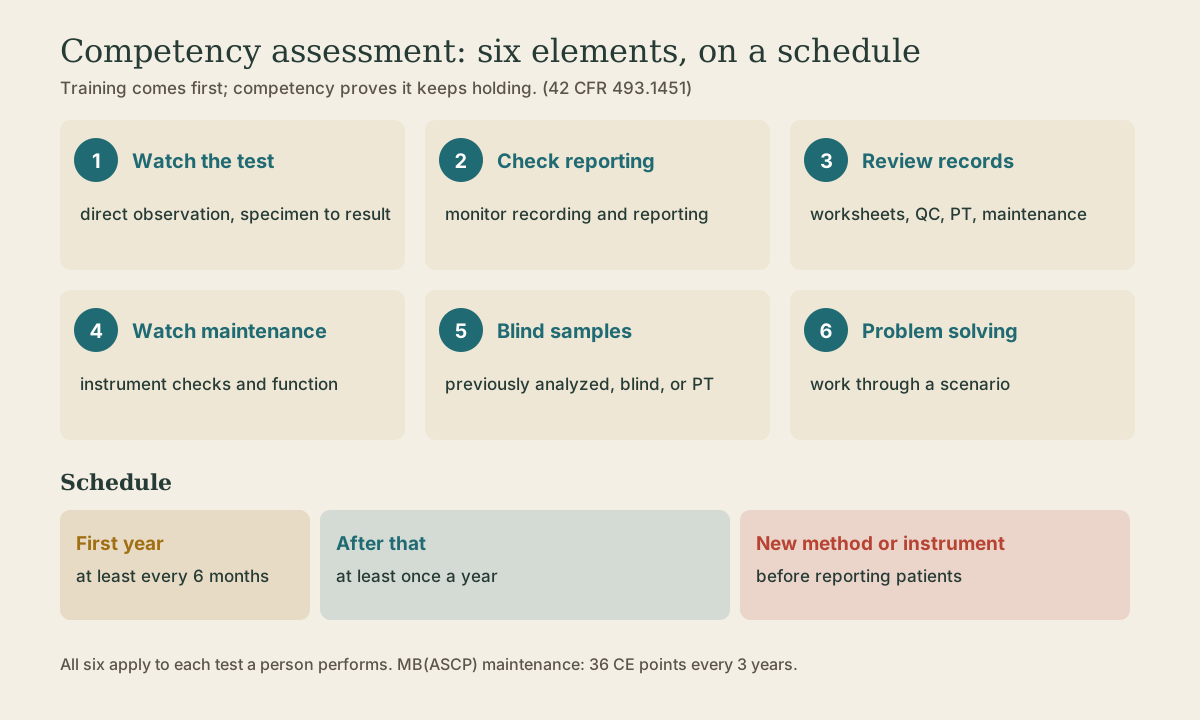
For high-complexity testing, the technical supervisor is responsible for evaluating competency using six elements 2:
- Direct observation of routine patient test performance, including specimen handling, processing, and testing.
- Monitoring the recording and reporting of test results.
- Review of intermediate results or worksheets, QC records, proficiency testing results, and preventive maintenance records.
- Direct observation of instrument maintenance and function checks.
- Assessment of test performance using previously analyzed specimens, internal blind samples, or external PT samples.
- Assessment of problem-solving skills.
All six apply to each test (or test system) a person performs, though one observation can cover several tests run on the same platform. Assessors are qualified individuals the technical supervisor designates.
Quick check
The six elements are direct observation of testing, monitoring result recording and reporting, review of worksheets/QC/PT/maintenance records, direct observation of maintenance, testing previously analyzed or blind samples, and problem-solving.
The schedule
Competency is evaluated 2:
- At least semiannually during a person’s first year of testing,
- At least annually thereafter,
- And before reporting patient results whenever test methods or instruments change.
A new hire in March is therefore assessed around September and the following March, then yearly.
Quick check
42 CFR 493.1451(b)(9): semiannually during the first year, annually after, and whenever methods or instruments change.
Practical examples
For a technologist running a real-time PCR viral load assay:
| Element | Evidence |
|---|---|
| Direct observation of testing | Supervisor watches a full run from specimen to result |
| Recording and reporting | Review of results entered in the LIS against instrument output |
| Records review | Sign-off on the person’s QC, maintenance logs, and PT worksheets |
| Maintenance observation | Watch the weekly instrument maintenance |
| Blind samples | Five previously tested specimens re-run blind; results within acceptable limits |
| Problem-solving | Written or verbal scenario: an IC failure, a positive NTC, a control out of range |
When someone fails an element, the lab documents retraining and reassessment before they resume independent testing.
Continuing education
MB(ASCP) certification is maintained through ASCP’s Credential Maintenance Program, which requires 36 points of continuing education every three years, with required points in molecular biology and in laboratory or patient safety. State licenses (in states that license lab personnel) and CAP also expect ongoing education, and many labs track it alongside competency records.
What to take from this
Training comes before independent testing; competency assessment checks a trained person on a schedule. CLIA’s six elements are direct observation of testing, monitoring reporting, records review, observation of maintenance, blind or previously tested samples, and problem-solving. Assess twice in the first year, annually after, and before reporting on a new method or instrument. Keep MB(ASCP) current through ASCP’s three-year Credential Maintenance Program.
Practice
Training must be documented before independent testing. Competency is the ongoing check that the person still does it right.
Lesson complete
Nice work.
Sources for this lesson
- 1Dean A. Jobe, Erik Reisdorf. PCR Contamination and Laboratory Best Practices. Wisconsin State Laboratory of Hygiene and Gundersen Health System. 2018. verifiedSigns of contamination (rising positivity for rare targets, more high-Ct positives, out-of-season positives, positive environmental swabs); bleach, HCl, UV, and UNG; wipe testing with a wet polyester swab.
- 242 CFR 493.1451 - Technical supervisor responsibilities (high complexity). Legal Information Institute (CLIA regulations). verifiedSix competency elements; evaluated at least semiannually in the first year, annually after, and before reporting on a new method or instrument. Cited at: (b)(8); (b)(9).