Verification and Validation
What CLIA makes a lab prove before reporting - accuracy, precision, reportable range, reference intervals, and for LDTs analytical sensitivity and specificity - and how a limit of detection is actually set.
- 5 min
- 6 steps
- 3 questions
- Lesson 42 of 60
In this lesson
- Verify or establish
- What CLIA requires
- Limit of detection
- Analytical specificity
- A verification in practice
- What to take from this
Picking up where you left off.
Verify or establish
CLIA draws the line clearly 1:
- Unmodified FDA-cleared or approved test: the lab must verify it can match the manufacturer’s performance for accuracy, precision, reportable range, and that the reference intervals fit its patients.
- Modified test or LDT: the lab must establish accuracy, precision, analytical sensitivity, analytical specificity including interfering substances, reportable range, reference intervals, and any other characteristic the test needs.
In both cases this is done before reporting patient results, and the results determine the lab’s control procedures and calibration schedule 1.
What CLIA requires
What each characteristic means for a molecular test:
| Characteristic | Question | Typical study |
|---|---|---|
| Accuracy | Do results agree with the truth? | Compare with a reference method or characterized samples: known positives and negatives, or quantitative correlation |
| Precision | Do repeat results agree? | Replicates within a run, across days, operators, instruments, and lots |
| Analytical sensitivity | How little can it detect? | Limit of detection study |
| Analytical specificity | Does anything else trigger or block it? | Cross-reactivity panels and interference testing |
| Reportable range | Over what range are quantitative results valid? | Dilution series across the measuring range |
| Reference interval | What’s the expected result in unaffected people? | For most molecular tests, “not detected” or wild type |
For a qualitative test, accuracy is reported as positive and negative percent agreement with the comparator. For a quantitative test such as viral load, it’s a regression and bias analysis across the range.
Quick check
For unmodified tests, CLIA requires verifying accuracy, precision, reportable range, and reference intervals. LDTs and modified tests must also establish analytical sensitivity and specificity, including interferences.
Limit of detection
CLSI EP17 defines two limits 2:
- Limit of blank (LoB): the highest apparent result expected from samples with no analyte. For PCR, a well-designed assay’s LoB is effectively zero.
- Limit of detection (LoD): the lowest concentration detected about 95% of the time.
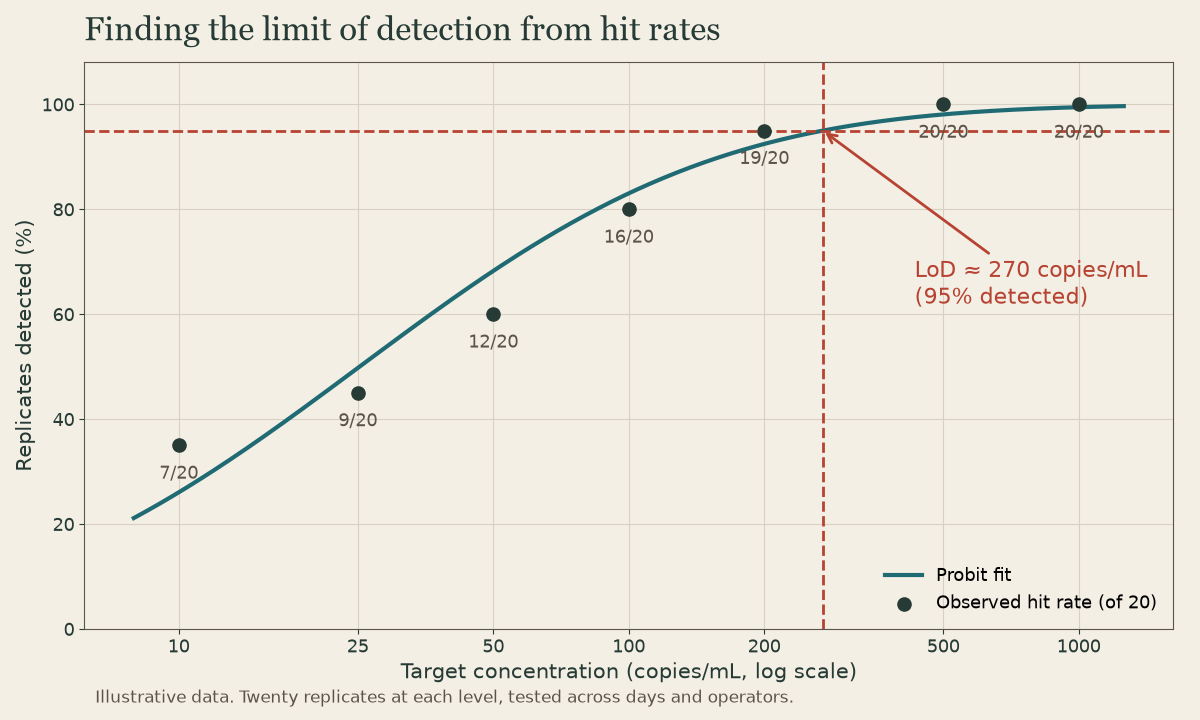
For molecular assays, LoD is found from hit rates 2:
- Prepare a dilution series of a characterized target in the specimen matrix, bracketing the expected LoD.
- Test many replicates at each level (20 is common), across days and operators.
- Record the fraction detected at each level.
- Fit a probit curve, or take the lowest level with at least 19 of 20 detected, as the LoD.
- Confirm with additional replicates at the claimed LoD.
The two methods can disagree. In the chart above, 200 copies/mL had 19 of 20 detected, but the probit fit through all the data puts 95% detection nearer 270. Probit uses every level and is usually the more conservative and defensible claim.
LoD should be expressed in units that mean something clinically (copies/mL of specimen, or international units), and it’s measured for the whole process, extraction included.
Quick check
LoD is the lowest concentration detected about 95% of the time. 19/20 is 95%, so 200 copies/mL; probit analysis would refine the estimate.
Analytical specificity
Two parts:
- Cross-reactivity: test near-neighbor organisms and homologous sequences. A C. difficile toxin assay is tested against other clostridia; a gene assay against pseudogenes.
- Interference: spike target into samples containing potential interferents - blood, mucin, lipids, bilirubin, common drugs, transport-medium components, heparin - and confirm results aren’t affected.
A verification in practice
A lab brings in an FDA-cleared, unmodified respiratory panel. A practical verification plan might include:
- Accuracy: 20 or more previously characterized positive samples (covering the main targets) and 20 or more negatives, compared with the lab’s existing method or a reference lab.
- Precision: a low positive and a negative run in replicate over several days by different operators.
- Reportable range: not applicable for a qualitative panel; for a quantitative test, a dilution series.
- LoD: confirm the manufacturer’s claim with replicates at that concentration.
The medical director reviews and signs the summary before patient testing starts. Sample numbers come from the lab’s policy, accreditor guidance, and statistics, not from CLIA, which doesn’t specify them.
What to take from this
Unmodified FDA-cleared tests are verified for accuracy, precision, reportable range, and reference intervals; LDTs and modified tests must also establish analytical sensitivity and specificity, including interferences. LoD is the concentration detected about 95% of the time, found from replicate hit rates and probit analysis across the whole process. Specificity studies cover cross-reacting organisms and sequences and interfering substances. All of it is done and signed off before patient results are reported.
Practice
Specificity covers cross-reactivity (near-neighbor organisms or homologous genes) and interference (blood, mucin, drugs, heparin) that could cause false results.
Lesson complete
Nice work.
Sources for this lesson
- 142 CFR 493.1253 - Establishment and verification of performance specifications. Legal Information Institute (CLIA regulations). verifiedUnmodified FDA-cleared systems - verify accuracy, precision, reportable range, reference intervals; modified systems and LDTs - establish those plus analytical sensitivity and analytical specificity including interfering substances.
- 2LoB, LoD, and LoQ Explained. Analyse-it. verifiedCLSI EP17 definitions - LoB = mean blank + 1.645 SD; LoD is the lowest concentration detected about 95% of the time; for PCR the LoB is effectively zero and LoD is set by probit analysis of hit rates.