Lesson 27 of 34 · The Polymerase Chain Reaction

Multiplex, Allele-Specific, and Digital PCR

PCR Variations

The basic polymerase chain reaction amplifies a single target defined by one primer pair, doubling that product with each thermal cycle. Once that core engine is in hand — together with the primer-design rules and the real-time detection chemistries covered in the preceding lessons — it can be reshaped to answer questions the standard reaction cannot. By changing how many primer pairs are present, where a primer’s 3’ end sits relative to a sequence variant, or how the reaction volume is physically arranged, the same enzymology yields assays that test many targets at once, distinguish single-base differences, or count individual template molecules. This lesson surveys the major variations named in the molecular-diagnostics technique outline: multiplex PCR, allele-specific PCR, and digital PCR, with a brief look at array-based and high-throughput formats.

Multiplex PCR

Multiplex PCR places several primer pairs in a single reaction, so that two or more distinct targets are amplified simultaneously in one tube. The chemistry of each individual amplification is unchanged; what changes is that the reaction must support all of them at once without the primer sets interfering. The payoff is efficiency: one specimen, one reaction, and one set of reagents can interrogate many sequences, conserving sample and reducing cost and hands-on time 1.

The cost of that efficiency is design difficulty. Because every primer experiences the same thermal program, all pairs must work at a compatible annealing temperature; a primer set whose optimal annealing temperature is far from the others will either fail to prime or lose specificity. The primers must also avoid cross-interactions — a forward primer for one target can anneal to a primer or amplicon from another, forming primer-dimers and chimeric products that consume reagents and suppress the intended amplifications. As the number of pairs grows, the combinatorial space of possible unwanted hybridizations grows faster, so multiplex panels are tuned empirically and often rebalanced by adjusting the relative concentration of each primer pair so that abundant targets do not outcompete scarce ones for shared polymerase and nucleotides 2.

A multiplex reaction also needs a way to tell the products apart. Two readout strategies dominate. The first distinguishes amplicons by size: each primer pair is designed to yield a product of a characteristic length, and the products are resolved by electrophoresis, where they appear as a ladder of bands or peaks. The second, used in real-time multiplex assays, distinguishes products by probe color: each target carries a hydrolysis or other probe labeled with a spectrally distinct fluorophore, so the instrument assigns signal to a target by the wavelength it detects. The number of targets a single real-time reaction can resolve is therefore limited by the number of optical channels the instrument can separate.

 Multiplex PCR — one tube, three targets, two readout styles

   primers:  [A> <A]   [B> <B]   [C> <C]      (distinct Tm-matched pairs)

   BY SIZE (gel / capillary)        BY PROBE DYE (real-time)
     -- long  -- target C            channel 1 (blue)   = target A
     -- mid   -- target B            channel 2 (green)  = target B
     -- short -- target A            channel 3 (red)    = target C

Multiplexing is well suited to assays that must report on a defined set of sequences together. A common clinical example is a syndromic infectious-disease panel — for instance a respiratory panel that tests one specimen for many pathogens at once; the detailed design and interpretation of such panels are taken up in the infectious-disease testing material. Multiplexing is also routine as an internal-control strategy, where an additional primer pair amplifies a housekeeping sequence to confirm that the reaction worked even when the target of interest is absent.

Allele-Specific PCR (ARMS)

Allele-specific PCR turns the polymerase’s own behavior into a genotyping readout. The method — also called the amplification-refractory mutation system (ARMS) — uses a primer whose 3’ terminal base is positioned exactly at the variant nucleotide. When that terminal base matches the template allele, the primer is fully paired and the polymerase extends it, producing amplicon. When the terminal base does not match, the 3’ mismatch leaves the primer poorly anchored and extension is strongly inhibited, so little or no product forms. Genotype is then read from the simple presence or absence of a product 1.

Why is the 3’ base decisive while a mismatch elsewhere in the primer is tolerated? As covered in the primer-design lesson, a thermostable DNA polymerase extends by adding nucleotides to a properly paired 3’ hydroxyl; the enzyme is highly sensitive to whether that terminal 3’ nucleotide is correctly base-paired to the template. A mismatch in the middle of an otherwise long, complementary primer still leaves a stable duplex with a paired 3’ end, so extension proceeds. A mismatch at the 3’ end disrupts the very base the polymerase must extend from, sharply lowering efficiency. Allele-specific PCR exploits exactly this asymmetry 3.

 Allele-specific PCR — the 3' base decides

   MATCH allele (extends):          MISMATCH allele (refractory):
     5'-...primer...A-3'              5'-...primer...A-3'
                    |||                              x        <- 3' mismatch
     3'-...template..T...-5'          3'-...template..C...-5'
            polymerase EXTENDS               extension BLOCKED
              -> product                       -> little/no product

In practice an assay runs two reactions per sample, one with a primer specific for each allele, often paired with a shared opposite primer and a control amplicon to confirm the template was amplifiable. A product in the wild-type reaction only, the variant reaction only, or both reports a homozygous wild-type, homozygous variant, or heterozygous genotype, respectively. Because the discrimination is built into priming itself, allele-specific PCR needs no post-amplification digestion or sequencing, which makes it a fast and inexpensive way to type a known single-nucleotide variant.

Digital PCR

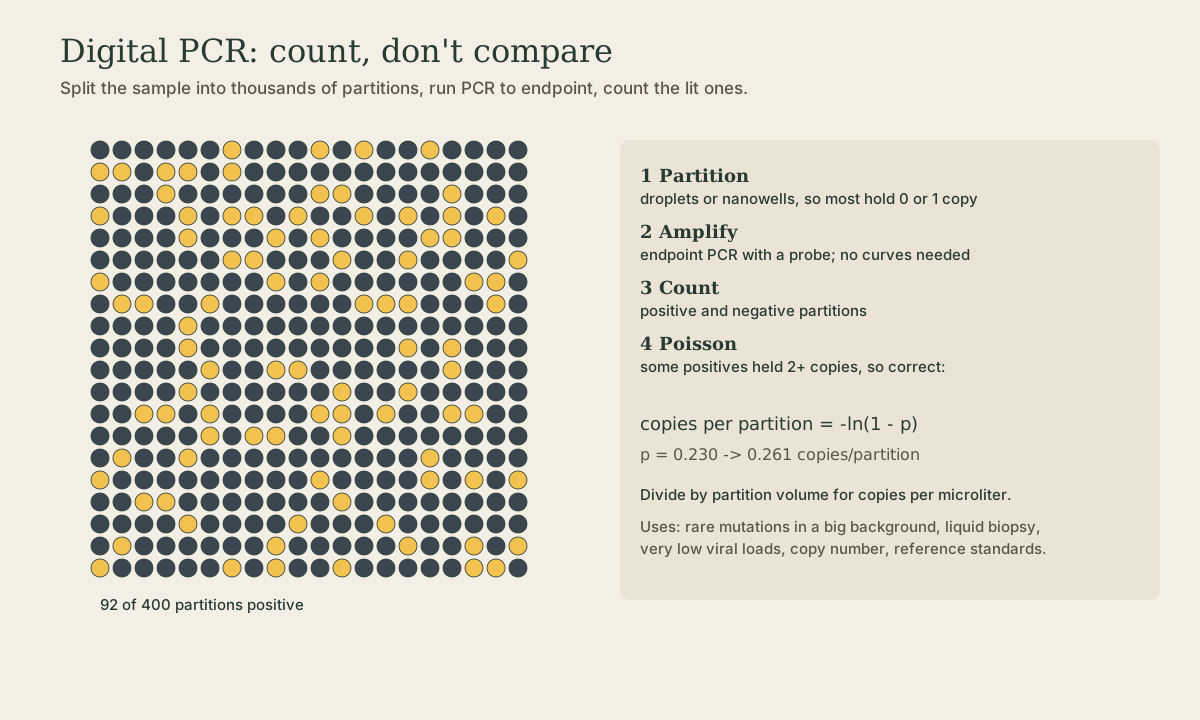
Digital PCR (dPCR) re-imagines quantification by changing the physical form of the reaction rather than its chemistry. Instead of measuring how fast signal rises in one bulk reaction, the assay first partitions the reaction mixture into thousands of tiny, separate compartments — wells on a chip, or aqueous droplets suspended in oil in the droplet-based variant, droplet digital PCR (ddPCR). The template is diluted enough that each partition contains either zero or only a few target molecules. Every partition is then amplified to completion and scored at endpoint as simply positive (fluorescent) or negative (dark) 1.

Counting positive partitions alone would undercount the target whenever a partition happened to receive more than one molecule, because such a partition still reads as a single positive. Digital PCR corrects for this statistically. Because template molecules distribute randomly among many partitions, the number per partition follows the Poisson distribution, the standard model for rare independent events scattered across many containers. Poisson statistics relate the observed fraction of negative partitions to the average number of molecules per partition, so the instrument can infer the true target concentration — including the partitions that held more than one molecule — from the positive-and-negative counts alone. Conceptually: the more partitions that come up negative, the fewer molecules were present; as the negative fraction falls, the estimated concentration rises in a defined, nonlinear way.

 Digital PCR — partition, amplify to endpoint, count

   bulk mix  ->  thousands of partitions, ~0-few targets each

     [+][ ][+][ ][ ][+][ ][+][ ][ ]   + = positive (>=1 target)
     [ ][+][ ][ ][+][ ][ ][ ][+][ ]     = negative (0 targets)

   count positives & negatives -> Poisson correction
        -> ABSOLUTE copies, no standard curve

The decisive consequence is that digital PCR gives an absolute count of target copies without a standard curve. Real-time PCR, by contrast, reads quantity from a threshold cycle that must be calibrated against a dilution series of known standards. By removing that dependence, dPCR becomes both more precise at low template levels and more robust to amplification-efficiency differences and inhibitors, since endpoint scoring does not depend on reaction rate. Those properties make it well suited to rare-variant detection — finding a handful of mutant molecules against a large background of normal sequence — and to precise low-level quantification. These strengths are why digital PCR features in oncology applications such as measuring minimal residual disease and quantifying circulating cell-free DNA, which are developed in the oncology testing material.

Array-Based and High-Throughput PCR

At the high-throughput end, PCR is miniaturized and parallelized rather than redesigned. Array-based and microfluidic platforms run hundreds to thousands of small reactions side by side — for example in nanoliter-scale wells preloaded with different primer sets — so that many targets, many samples, or many sample-by-assay combinations are amplified in one run. The chemistry in each reaction remains ordinary real-time or endpoint PCR; the gain comes from scale, automation, and the small volumes that lower reagent cost per data point. These formats sit alongside the array hybridization and large-scale genotyping technologies treated later, and they bridge naturally toward the massively parallel approaches of next-generation sequencing 1.

Summary

The named PCR variations are, at heart, the same amplification reaction arranged to answer a different question. Multiplex PCR adds primer pairs to test many targets at once, trading design simplicity for throughput and demanding compatible annealing temperatures, minimal cross-dimers, and size- or dye-based readouts. Allele-specific PCR (ARMS) places a primer’s 3’ terminus on a variant base so that the polymerase extends only the matching allele, converting a single-base difference into a presence-or-absence genotype. Digital PCR partitions the reaction into thousands of compartments and counts positive endpoints, using Poisson statistics to deliver absolute quantification without a standard curve and exceptional sensitivity for rare variants. Array-based and microfluidic formats extend the same chemistry to massive parallelism. Together these methods carry PCR from amplifying one sequence to interrogating genomes at scale.

References

  1. Lela Buckingham. Molecular Diagnostics: Fundamentals, Methods, and Clinical Applications. 3rd ed. F.A. Davis Company. 2019. verified
  2. Michael R. Green, Joseph Sambrook. Molecular Cloning: A Laboratory Manual. 4th ed. Cold Spring Harbor Laboratory Press. 2012. verified
  3. Bruce Alberts, Rebecca Heald, Alexander Johnson, David Morgan, Martin Raff, Keith Roberts, Peter Walter. Molecular Biology of the Cell. 7th ed. W. W. Norton & Company. 2022. verified