Applications of the Derivative
Critical points and concavity, a worked optimization (the 32 m³ open box), related rates through the chain rule, linear approximation, and Newton's method for roots.
- 6 min
- 7 steps
- 3 questions
- Lesson 3 of 36
In this lesson
- Why Derivatives Matter in Engineering
- Critical Points and the Sign of the First Derivative
- Concavity, Inflection Points, and the Second Derivative
- Optimization: A Worked Engineering Example
- Related Rates: Linking Rates Through the Chain Rule
- Linear Approximation and Newton’s Method
- Takeaways
Picking up where you left off.
Why Derivatives Matter in Engineering
A derivative measures how one quantity responds to a change in another. That single idea drives an enormous amount of engineering practice: shaping a beam so it uses the least material, choosing a tank’s dimensions to maximize volume, predicting how fast a pressure or temperature rises, and locating the operating point where a system is most efficient. Once you can differentiate, the next step is to read what the derivative tells you about the function it came from. This lesson turns the mechanics of differentiation into tools for analysis, optimization, and prediction 1.
Critical Points and the Sign of the First Derivative
A critical point of \(f\) is an input \(x=c\) in the domain where either \(f'(c)=0\) or \(f'(c)\) does not exist. These are the only candidates for local maxima and minima, because at a smooth peak or valley the tangent line is horizontal, and a non-smooth point (a corner or cusp) can also turn the function around 1.
The first derivative also reports the function’s direction. On any interval where \(f'(x)>0\), the function is increasing; where \(f'(x)<0\), it is decreasing. So a practical recipe is: find the critical points, mark them on a number line, and test the sign of \(f'\) in each gap between them.
The first-derivative test then classifies each critical point \(c\):
- If \(f'\) changes from \(+\) to \(-\) at \(c\), then \(f(c)\) is a local maximum.
- If \(f'\) changes from \(-\) to \(+\) at \(c\), then \(f(c)\) is a local minimum.
- If \(f'\) does not change sign, \(c\) is neither.
For example, \(f(x)=x^3-3x\) has \(f'(x)=3x^2-3=3(x-1)(x+1)\), so the critical points are \(x=-1\) and \(x=1\). The sign of \(f'\) is \(+\) on \((-\infty,-1)\), \(-\) on \((-1,1)\), and \(+\) on \((1,\infty)\): a local max at \(x=-1\) and a local min at \(x=1\).
Concavity, Inflection Points, and the Second Derivative
The second derivative \(f''\) describes how the slope itself is changing. Where \(f''(x)>0\), the curve is concave up (it bends like a cup); where \(f''(x)<0\), it is concave down. A point where concavity switches is an inflection point, and it can occur only where \(f''(x)=0\) or \(f''\) is undefined 1.
Concavity gives a quick alternative for classifying critical points, the second-derivative test. Suppose \(f'(c)=0\):
- If \(f''(c)>0\), the graph is concave up at \(c\), so \(f(c)\) is a local minimum.
- If \(f''(c)<0\), the graph is concave down, so \(f(c)\) is a local maximum.
- If \(f''(c)=0\), the test is inconclusive; fall back to the first-derivative test.
For \(f(x)=x^3-3x\), \(f''(x)=6x\). At \(x=1\), \(f''(1)=6>0\) (local min); at \(x=-1\), \(f''(-1)=-6<0\) (local max); and \(f''=0\) at \(x=0\), an inflection point where concavity flips.
Quick check
Positive second derivative means concave up: the bottom of a valley.
Optimization: A Worked Engineering Example
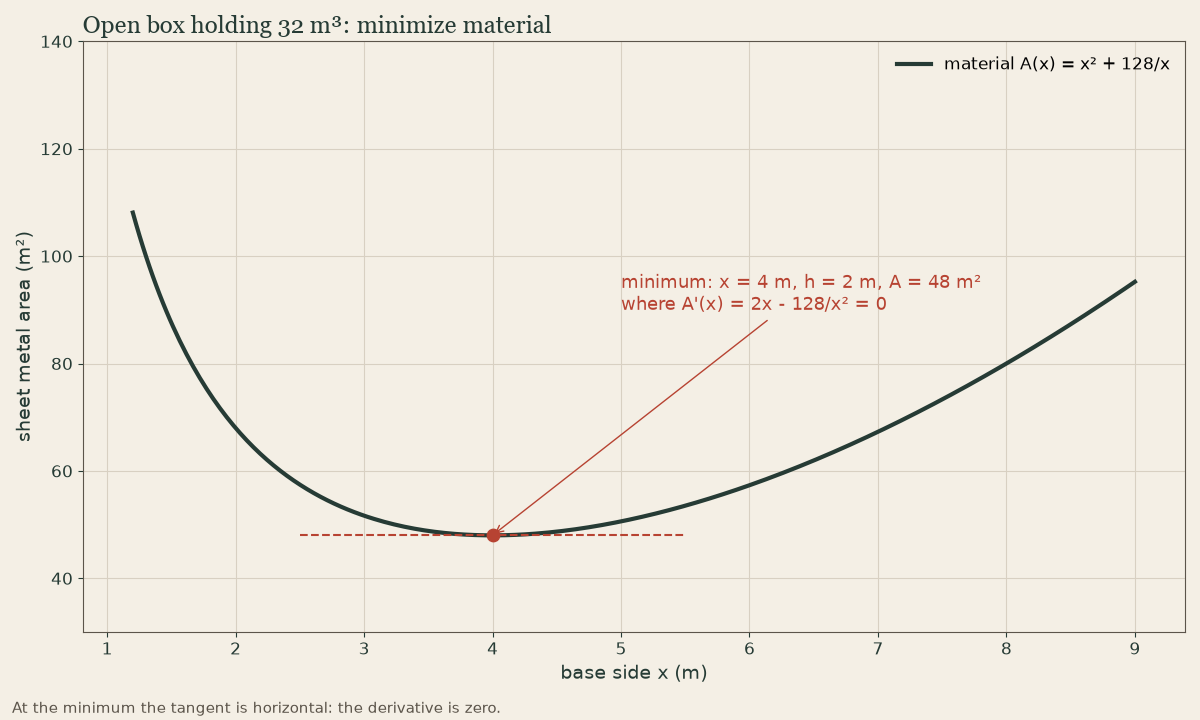
Optimization is where these ideas earn their keep. Suppose you must build an open-top rectangular box with a square base that holds a fixed volume of \(32\,\text{m}^3\), and you want to minimize the sheet metal used. Let the base side be \(x\) and the height be \(h\).
The volume constraint is \(x^2 h = 32\), so \(h = 32/x^2\). The material is the base plus four sides: $$ A(x) = x^2 + 4xh = x^2 + 4x\cdot\frac{32}{x^2} = x^2 + \frac{128}{x}. $$
Differentiate and set the derivative to zero: $$ A’(x) = 2x - \frac{128}{x^2} = 0 \quad\Longrightarrow\quad 2x^3 = 128 \quad\Longrightarrow\quad x = 4. $$
Check it is a minimum with the second derivative: \(A''(x) = 2 + 256/x^3\), which is positive for all \(x>0\), so the curve is concave up and \(x=4\) gives a minimum. The height is \(h = 32/16 = 2\,\text{m}\), and the minimal material is \(A(4)=16+32=48\,\text{m}^2\). The same method—write the objective, eliminate variables with the constraint, set the derivative to zero, and confirm with \(f''\) or endpoint checks—optimizes everything from pipeline diameters to antenna gain 1.
Quick check
A’(x) = 2x - 128/x² = 0 gives x = 4, h = 2, area 48 m².
Related Rates: Linking Rates Through the Chain Rule
Many engineering quantities change together over time. Related-rates problems use the chain rule to connect their rates of change. Imagine a cylindrical tank of radius \(3\,\text{m}\) being filled with water; the volume rises at \(2\,\text{m}^3/\text{min}\). How fast is the water level \(y\) rising?
The volume of water is \(V = \pi r^2 y = 9\pi y\). Differentiate both sides with respect to time \(t\), treating each quantity as a function of \(t\): $$ \frac{dV}{dt} = 9\pi \frac{dy}{dt}. $$
Substitute \(dV/dt = 2\): $$ \frac{dy}{dt} = \frac{2}{9\pi} \approx 0.0707\ \text{m/min}. $$
The pattern generalizes: write the equation relating the quantities, differentiate with respect to time, then substitute the known rates and values 1. The same approach governs how quickly a shadow lengthens, a pressure drops, or a rotating linkage moves.
Linear Approximation and Newton’s Method
Near a point \(x=a\), a differentiable function is well approximated by its tangent line, the linear approximation: $$ f(x) \approx f(a) + f’(a)(x-a). $$
This is the basis of countless quick estimates and of linearizing nonlinear models around an operating point. The same tangent idea drives Newton’s method for solving \(f(x)=0\): start from a guess \(x_n\), follow the tangent line down to where it crosses the axis, and use that crossing as the next, usually better, guess: $$ x_{n+1} = x_n - \frac{f(x_n)}{f’(x_n)}. $$
Iterating this converges rapidly for well-behaved functions, which is why it underlies many numerical solvers in engineering software 1.
Quick check
It follows the tangent line down to the axis; convergence is fast near a simple root.
Takeaways
The first derivative locates critical points and tells you where a function rises or falls; the second derivative reveals concavity and confirms maxima and minima. Together they power optimization, while the chain rule links changing quantities in related-rates problems, and the tangent line gives fast approximations and root-finding. Optimization and rates of change pervade design and dynamics, which is exactly why the derivative is one of the most reused tools in an engineer’s mathematics.
Lesson complete
Nice work.
Sources for this lesson
- 1Calculus, Volumes 1–3. OpenStax (Rice University). verifiedOpen (CC BY-NC-SA) calculus text. Vol 1 functions/limits/derivatives/integrals; Vol 2 integration/series; Vol 3 multivariable and vector calculus. Cited at: Vol 1, Ch. 4.