Derivatives and Differentiation Rules
The derivative as the limit of secant slopes: notation, why differentiability implies continuity, the power, product, quotient, and chain rules, common derivatives, and higher derivatives like acceleration.
- 5 min
- 8 steps
- 3 questions
- Lesson 2 of 36
In this lesson
- From Limits to the Derivative
- What the Derivative Measures
- Notation
- Differentiability Implies Continuity
- The Differentiation Rules
- Derivatives of Common Functions
- Higher-Order Derivatives
- Looking Ahead
Picking up where you left off.
From Limits to the Derivative
In the previous lesson, you saw that a limit captures the value a function approaches as its input nears some point. The derivative is the most important application of that idea. Given a function \(f\), its derivative at \(x\) is defined as the limit of a difference quotient:
when this limit exists, we say \(f\) is differentiable at \(x\) 1. The expression \(\frac{f(x+h)-f(x)}{h}\) is the average rate of change of \(f\) over the interval from \(x\) to \(x+h\); letting \(h\to 0\) collapses that interval to a single point.
What the Derivative Measures
The derivative has two equivalent interpretations that recur throughout calculus.
First, it is the instantaneous rate of change of \(f\) with respect to \(x\). If \(f(t)\) gives the position of an object at time \(t\), then \(f'(t)\) is its velocity — not an average over an interval, but the rate at the exact instant \(t\).
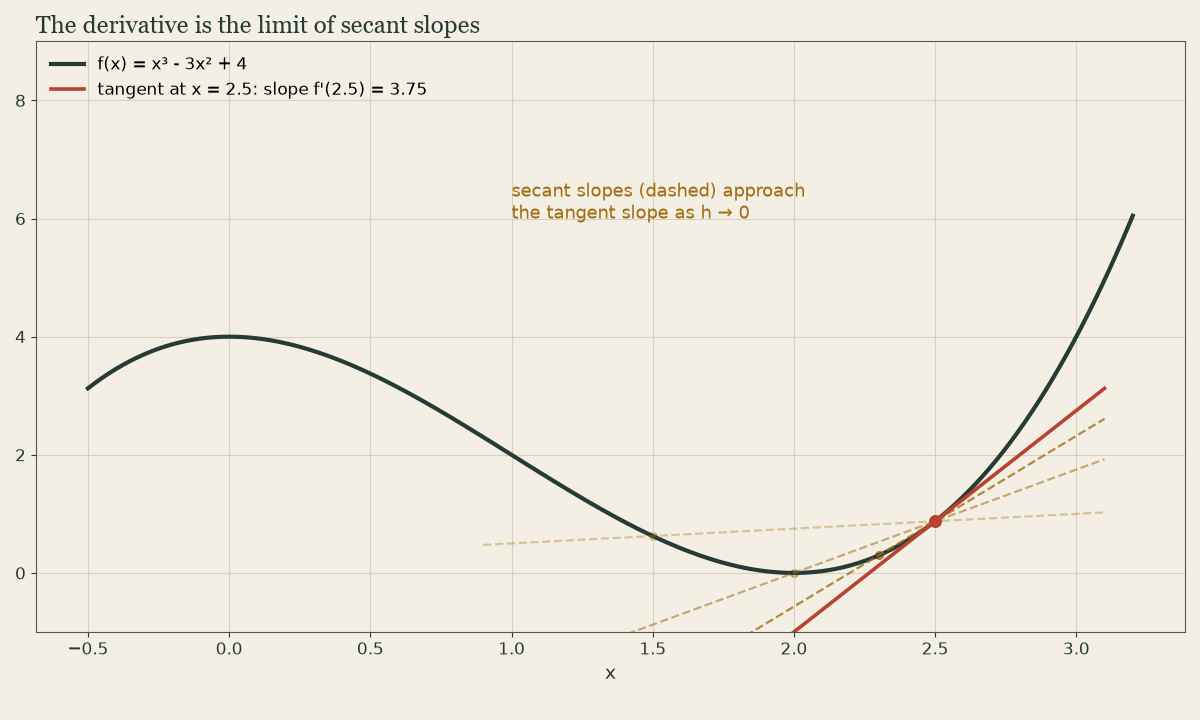
Second, it is the slope of the tangent line to the graph of \(f\) at the point \((x, f(x))\). Each difference quotient is the slope of a secant line through two points on the curve; as \(h\to 0\), those secant lines tilt toward the tangent, and their slopes converge to \(f'(x)\) 1.
Quick check
It’s the limit of secant slopes as the second point slides into a.
Notation
Several notations for the derivative coexist because they emphasize different things. Lagrange’s prime notation \(f'(x)\) is compact. Leibniz’s notation \(\frac{dy}{dx}\) (for \(y=f(x)\)) keeps the input variable visible and behaves suggestively under the chain rule. You will also see \(\frac{d}{dx}f(x)\), which reads as “the derivative with respect to \(x\) of \(f\).” These all denote the same object.
Differentiability Implies Continuity
If \(f\) is differentiable at \(x\), then \(f\) is continuous at \(x\) 1. Intuitively, a function with a well-defined tangent line cannot jump or break at that point. The converse fails: continuity does not guarantee differentiability. The function \(f(x)=|x|\) is continuous everywhere but has no derivative at \(x=0\), because the difference quotient approaches \(+1\) from the right and \(-1\) from the left, so the limit does not exist. Sharp corners, cusps, and vertical tangents are continuous points where differentiation fails.
The Differentiation Rules
Computing every derivative from the limit definition is tedious. A small set of rules lets you differentiate almost any elementary function quickly. In each rule below, assume the functions involved are differentiable.
Power rule. For any real constant \(n\), \(\frac{d}{dx}x^{n}=n\,x^{n-1}\). For example, \(\frac{d}{dx}x^{4}=4x^{3}\) and \(\frac{d}{dx}\sqrt{x}=\frac{d}{dx}x^{1/2}=\tfrac{1}{2}x^{-1/2}\).
Constant and constant-multiple. The derivative of a constant is \(0\), and constants factor out: \(\frac{d}{dx}\,c\,f(x)=c\,f'(x)\).
Sum rule. Derivatives distribute over addition: \(\frac{d}{dx}\big(f(x)+g(x)\big)=f'(x)+g'(x)\). Combining these three rules, \(\frac{d}{dx}(3x^{2}+5x-7)=6x+5\).
Product rule. The derivative of a product is not the product of derivatives. Instead,
For example, \(\frac{d}{dx}\big(x^{2}\sin x\big)=2x\sin x+x^{2}\cos x\) 1.
Quotient rule. For a quotient with \(g(x)\neq 0\),
For example, \(\frac{d}{dx}\frac{x}{x+1}=\frac{1\cdot(x+1)-x\cdot 1}{(x+1)^{2}}=\frac{1}{(x+1)^{2}}\).
Chain rule. For a composition,
You differentiate the outer function at the inner one, then multiply by the derivative of the inner function 1. For example, \(\frac{d}{dx}\sin(x^{2})=\cos(x^{2})\cdot 2x=2x\cos(x^{2})\).
Quick check
Outer derivative 4(·)³ times inner derivative 6x.
Derivatives of Common Functions
These standard derivatives, used constantly with the rules above, are worth memorizing 1:
- Polynomials follow from the power and sum rules, term by term.
- \(\frac{d}{dx}e^{x}=e^{x}\) — the exponential is its own derivative.
- \(\frac{d}{dx}\ln x=\frac{1}{x}\) for \(x>0\).
- \(\frac{d}{dx}\sin x=\cos x\) and \(\frac{d}{dx}\cos x=-\sin x\).
Together with the chain rule, these handle expressions like \(\frac{d}{dx}e^{3x}=3e^{3x}\) and \(\frac{d}{dx}\ln(x^{2}+1)=\frac{2x}{x^{2}+1}\).
Higher-Order Derivatives
The derivative \(f'\) is itself a function, so it can be differentiated again. The result, \(f''(x)=\frac{d^{2}y}{dx^{2}}\), is the second derivative, the rate of change of the rate of change. If \(f(t)\) is position, then \(f'(t)\) is velocity and \(f''(t)\) is acceleration. Continuing the process gives \(f'''(x)\), and in general the \(n\)th derivative \(f^{(n)}(x)\). For instance, if \(f(x)=x^{3}\), then \(f'(x)=3x^{2}\), \(f''(x)=6x\), \(f'''(x)=6\), and \(f^{(4)}(x)=0\).
Quick check
First derivative is velocity, second is acceleration, third is jerk.
Looking Ahead
With these definitions and rules in hand, the derivative becomes a practical tool rather than a limit to be computed by hand each time. The next lesson puts it to work: locating maxima and minima, analyzing where functions increase or decrease, and using the second derivative to describe concavity — the foundation of applied optimization.
Lesson complete
Nice work.
Sources for this lesson
- 1Calculus, Volumes 1–3. OpenStax (Rice University). verifiedOpen (CC BY-NC-SA) calculus text. Vol 1 functions/limits/derivatives/integrals; Vol 2 integration/series; Vol 3 multivariable and vector calculus. Cited at: Vol 1, Ch. 3.