Electric Potential and Capacitance
Electric potential energy and the volt, the field as the downhill gradient of potential, point-charge potential and equipotentials, capacitance and stored energy, and practical cases: battery energy, charged capacitors, and step potential near a downed line.
- 6 min
- 7 steps
- 3 questions
- Lesson 21 of 36
In this lesson
- Electric potential energy
- Potential as energy per unit charge
- The field is the downhill gradient of potential
- Potential of a point charge and equipotentials
- Potential in practice
- Capacitance and stored energy
Picking up where you left off.
In the previous lesson we described how a charge distribution fills the surrounding space with an electric field \(\vec E\), a vector at every point that tells a test charge which way it would be pushed. Fields are powerful, but bookkeeping three vector components at every point is cumbersome. This lesson introduces a scalar partner to the field — the electric potential — which captures the same physics with a single number per point, and which leads directly to one of the most-used components in all of engineering: the capacitor.
Electric potential energy
The electrostatic force is conservative, just like gravity. That means the work done moving a charge between two points does not depend on the path taken, and we can define a potential energy \(U\) whose change equals the negative of the work the field does on the charge 1. Lifting a positive charge “against” the field — toward another positive charge, say — stores energy, exactly as lifting a mass against gravity does. Releasing the charge lets that energy convert back into kinetic energy as the field pushes it away.
Potential as energy per unit charge
The potential energy of a charge depends on both the field and the size of the charge \(q\) we place in it. To describe the field itself, independent of any particular test charge, we divide out \(q\). The result is the electric potential:
Its unit is the volt, equal to one joule per coulomb (\(1\ \mathrm{V} = 1\ \mathrm{J/C}\)) 1. Potential is the electrostatic “height” of a location: it tells how much energy each coulomb of charge would carry there.
A crucial subtlety: only differences in potential have physical meaning. Just as the height of a tabletop depends on whether you measure from the floor or from sea level, the value of \(V\) depends on an arbitrary reference point. The measurable quantity is the potential difference \(V_b - V_a\), called voltage, which equals the work per unit charge to move between the two points. When a battery is labeled 9 V, that is a difference between its terminals, not an absolute number.
The field is the downhill gradient of potential
Because potential is energy per charge and the field is force per charge, the two are tightly linked. In your math course you met the gradient \(\nabla\), the vector that points in the direction a scalar function increases fastest, with magnitude equal to that steepest slope. The electric field is exactly the negative gradient of the potential:
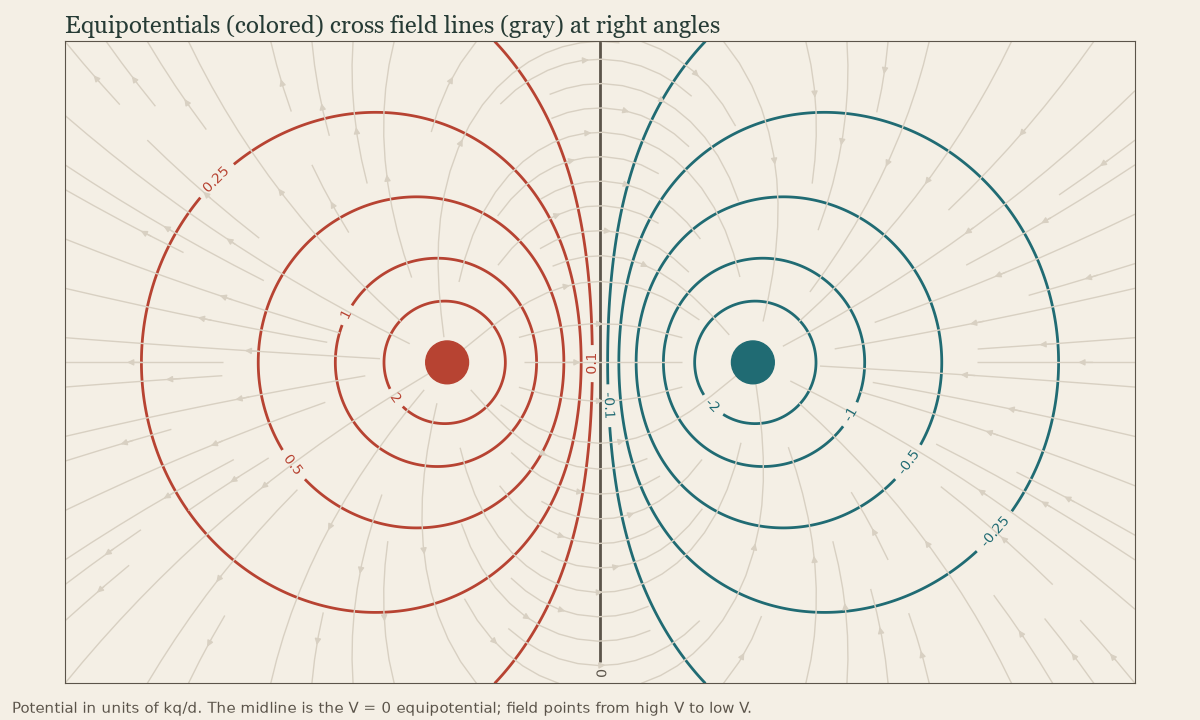
The minus sign says the field points downhill in potential — from high \(V\) toward low \(V\) — just as a ball rolls toward lower ground. Where the potential changes steeply over a short distance, the gradient is large and the field is strong; across a flat plateau of constant potential, the field vanishes. This relationship lets engineers compute the field anywhere by mapping a single scalar function and then taking its slope, which is far easier than tracking a vector directly.
Quick check
A strong field means a steep potential slope.
Potential of a point charge and equipotentials
For a single point charge \(q\), measuring potential relative to infinity gives
where \(k\) is the Coulomb constant and \(r\) the distance from the charge 1. The potential falls off as \(1/r\), more gently than the field’s \(1/r^2\).
Connecting all points that share the same potential traces out an equipotential surface. Moving a charge along such a surface requires no work, because there is no potential difference to climb. It follows that equipotential surfaces are everywhere perpendicular to the field lines: the field, being the downhill gradient, can have no component along a direction of constant \(V\). Around a point charge the equipotentials are nested spheres; near a flat charged plate they are parallel planes.
Quick check
No potential difference, no work, which is why equipotentials cross field lines at right angles.
Potential in practice
- Battery energy: each coulomb moved through a 12 V battery gains 12 J. A battery rated 50 amp-hours moves 180,000 C, about 2.2 MJ, at 12 V.
- Charged capacitors bite: a 1,000 µF capacitor at 50 V stores \(\tfrac12(0.001)(50)^2 = 1.25\) J; the high-voltage capacitor in a microwave oven or a power supply can hold a dangerous charge long after it’s unplugged. Discharge it through a resistor before touching it.
- Step potential: when a power line falls, current spreads into the ground and the potential falls off with distance from the contact point, like the equipotential rings around a point charge. A person standing with feet apart bridges a potential difference. Utilities advise staying well away, and if you must move, shuffling with feet together so they never span a gap.
Capacitance and stored energy
Place two conductors near each other and put charge \(+Q\) on one and \(-Q\) on the other, and a voltage \(V\) appears between them. The ratio defines the capacitance:
measured in farads (\(1\ \mathrm{F} = 1\ \mathrm{C/V}\)) 1. Capacitance is purely geometric — it depends on the size, spacing, and shape of the conductors, not on how much charge you happen to store.
The archetype is the parallel-plate capacitor: two flat conductors separated by a small gap. Charge spreads evenly across the plates, producing a nearly uniform field between them, so larger plates or a smaller gap yield more capacitance. Charging the capacitor takes work, because each additional bit of charge must be pushed against the voltage already built up. That work is stored in the field as energy:
Voltage and capacitance are everywhere in engineering. Capacitors store energy for camera flashes and power supplies, smooth or filter noisy signals, and set timing intervals in oscillators and clocks by charging through a resistor. In the next module on circuits, we will combine capacitors with resistors and sources to see how voltage drives current through real networks 1.
Quick check
U = ½CV² = ½ × 0.001 × 2,500.
Lesson complete
Nice work.
Sources for this lesson
- 1University Physics, Volumes 1–3. OpenStax (Rice University). verifiedOpen calculus-based physics. Vol 1 mechanics; Vol 2 thermodynamics and electricity & magnetism; Vol 3 optics & modern physics. Cited at: Vol 2, Ch. 7; Vol 2, Ch. 8.