Magnetic Fields and Induction
The magnetic field and the force on moving charges and currents, Ampère's law, magnetic flux and Faraday's law of induction with Lenz's law, generators, motors, transformers, and inductors, and why the grid runs on high-voltage AC.
- 6 min
- 7 steps
- 3 questions
- Lesson 23 of 36
In this lesson
- The magnetic field
- The magnetic force on charges and currents
- Currents create magnetic fields
- Electromagnetic induction
- Applications
- Transformers and the grid
- Maxwell’s equations
Picking up where you left off.
The magnetic field
Alongside the electric field, the second piece of classical electromagnetism is the magnetic field \(\vec B\), measured in teslas (T) 1. Like \(\vec E\), it is a vector field that fills space, but it acts only on charges that are moving and on the magnetized matter of compass needles and bar magnets. Where the electric field has isolated sources — positive and negative charges — no isolated magnetic “charge” (a magnetic monopole) has ever been found. Magnetic field lines therefore never begin or end; they always form closed loops, a fact captured formally by the magnetic version of Gauss’s law.
The magnetic force on charges and currents
The defining property of \(\vec B\) is the force it exerts on a charge \(q\) moving with velocity \(\vec v\) 1:
The cross product makes this force fundamentally different from the electric force. Its magnitude is \(qvB\sin\theta\), largest when the velocity is perpendicular to the field and zero when they are parallel. Crucially, \(\vec F\) is always perpendicular to \(\vec v\). A force at right angles to the motion can change the direction of a velocity but never its speed, so the magnetic force does no work: it cannot speed up or slow a charge, only curve its path. A charge moving across a uniform field therefore travels in a circle, the principle behind cyclotrons and mass spectrometers.
A current is just many charges in motion, so a current-carrying wire feels a magnetic force too. For a straight segment of length \(\vec L\) (pointing along the current \(I\)) in a field \(\vec B\) 1:
This is the force that turns electric motors and deflects loudspeaker cones.
Quick check
It can bend the path but never change the speed.
Currents create magnetic fields
Charges do not merely respond to magnetic fields — moving charges and currents create them. A straight wire carrying current is wrapped by circular field lines whose direction follows a right-hand rule, and whose strength falls off with distance from the wire. The quantitative statement is Ampère’s law: the line integral of \(\vec B\) around any closed loop is proportional to the current threading that loop. Because a steady current makes \(\vec B\) circulate around it rather than point toward or away from it, the field has a nonzero curl — the same curl introduced in the math track. A current is a source of “swirl” in the magnetic field, just as charge is a source of “spread” (divergence) in the electric field 1.
Electromagnetic induction
Electricity and magnetism become a single subject through induction: a changing magnetic field produces an electric field, and hence a voltage. The key quantity is the magnetic flux through a surface — a measure of how much field passes through it 1:
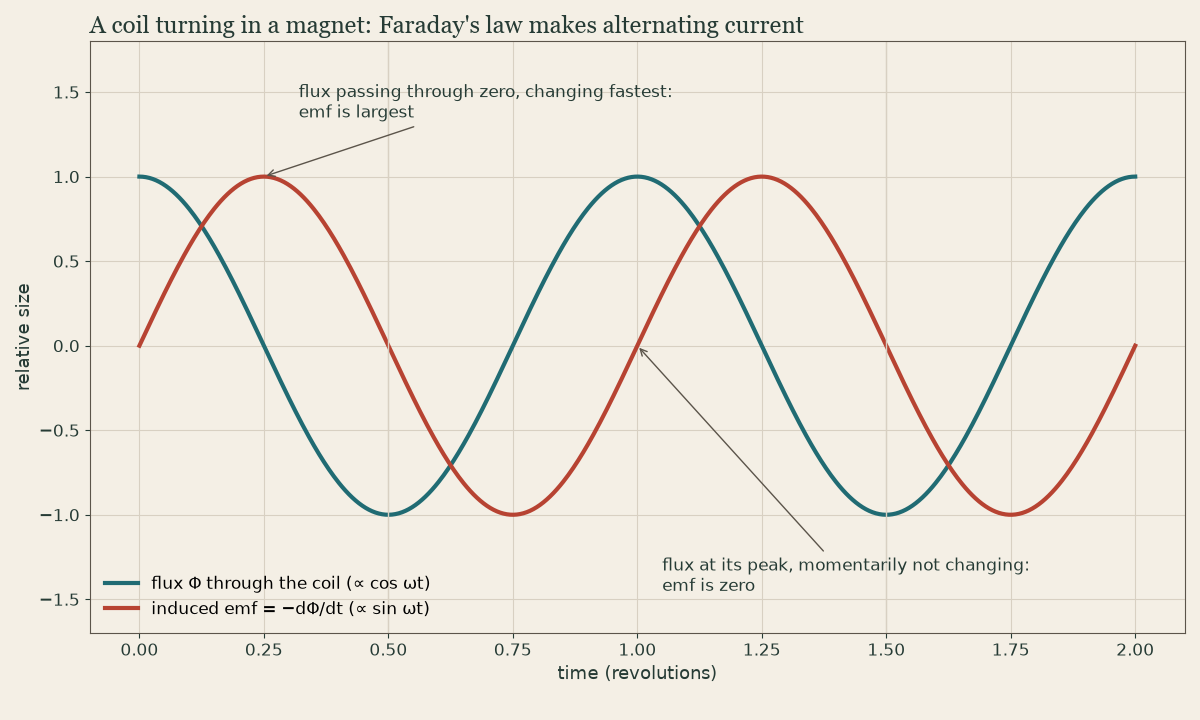
Faraday’s law states that a changing flux drives an electromotive force (an induced voltage) \(\mathcal{E}\) around the boundary of that surface:
Flux can change because the field strengthens or weakens, or because the loop moves, rotates, or changes area. The minus sign is Lenz’s law: the induced current flows in whatever direction opposes the change in flux that produced it. This is not an arbitrary rule but a statement of energy conservation — if the induced current reinforced the change instead, it would amplify itself without limit and create energy from nothing. Opposition means you must do work to change the flux, and that work is what becomes electrical energy 1.
Quick check
Faraday’s law: emf = −dΦ/dt. Steady DC makes steady flux and no induced voltage.
Applications
Faraday’s law underlies most of the electrical world. A generator rotates a coil in a magnetic field; the steadily changing flux induces an alternating voltage, converting mechanical work into electricity. A motor runs the same physics in reverse, using the \(I\vec L \times \vec B\) force to convert electrical energy into rotation. A transformer links two coils through a shared changing flux, stepping voltage up or down according to the ratio of their turns — the device that makes long-distance power transmission practical. And an inductor, a coil that opposes changes in its own current through self-induced voltage, stores energy in its magnetic field and shapes the behavior of every AC and electronic circuit 1.
Transformers and the grid
A transformer’s voltages follow its turns ratio, \(V_s/V_p = N_s/N_p\), and because it needs a changing flux, it works only on AC. With little loss, power in equals power out, so stepping voltage up steps current down.
That’s why power is transmitted at high voltage. Line loss is \(I^2R\): sending the same power at ten times the voltage takes a tenth of the current and loses a hundredth as much energy in the wires. A typical rural distribution line in the U.S. runs at several thousand volts; the transformer on the pole steps it down to the 120/240 V that enters a house.
Induction also protects you. A GFCI outlet passes both the hot and neutral wires through a small sensing coil. Normally their currents are equal and opposite, so the net flux is zero. If a few milliamps leak to ground through a person, the imbalance induces a voltage in the coil and the device trips in a fraction of a second.
Quick check
Current drops tenfold, and loss goes as I².
Maxwell’s equations
This module has assembled four foundational laws: Gauss’s law (electric charge is the source of \(\vec E\)), its magnetic counterpart (no magnetic monopoles), Faraday’s law (a changing magnetic field induces an electric field), and Ampère’s law. James Clerk Maxwell added one missing term — a changing electric field also creates a magnetic field — and the four together form Maxwell’s equations, the complete classical theory of electromagnetism 1. Their most remarkable consequence is that changing \(\vec E\) and \(\vec B\) fields can sustain each other and propagate through empty space as light. Working with these equations as a full mathematical system — including electromagnetic waves and antennas — is the subject of the Electromagnetics course in the Electrical Engineering track.
Lesson complete
Nice work.
Sources for this lesson
- 1University Physics, Volumes 1–3. OpenStax (Rice University). verifiedOpen calculus-based physics. Vol 1 mechanics; Vol 2 thermodynamics and electricity & magnetism; Vol 3 optics & modern physics. Cited at: Vol 2, Ch. 11–13; Vol 2, Ch. 11; Vol 2, Ch. 12; Vol 2, Ch. 13.